Geothermal Think Tank Takes On The Extraordinary Job
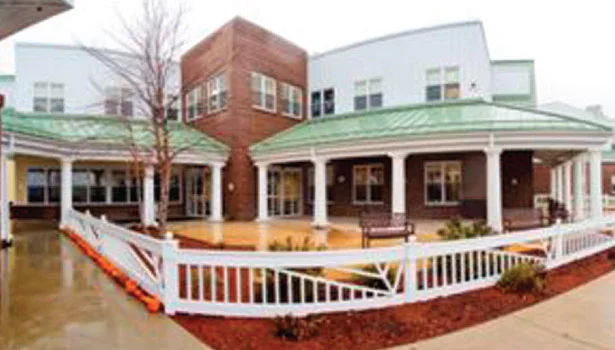
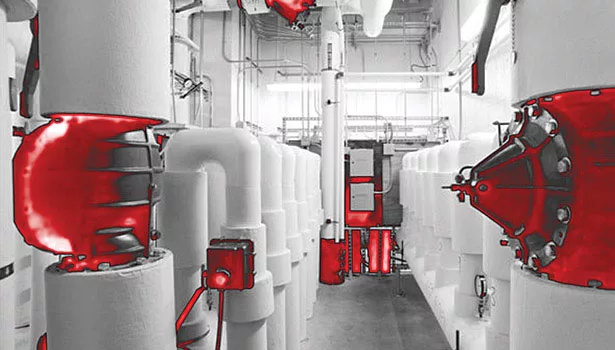
It was back in 2005 when Hampstead, HN-based Water Energy Distributors, Inc. was hired as a subcontractor by the engineering firm, McFarland-Johnson, to design an all-geothermal mechanical system for MCNH. Work on the system — installed in several stages as the facility went through various construction phases — was just completed.
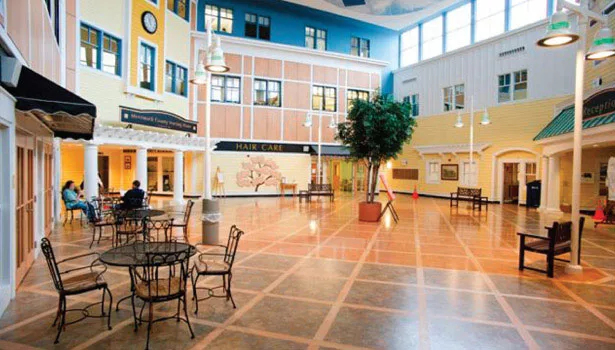
The 235,000-sq-ft facility has a staff of 425 and 290 beds with luxury accommodations for elderly residents. Merrimack’s über-green mechanical system incorporates 16 standing column wells and 326 ClimateMaster water-to-air heat pumps for a total of 615 tons of capacity.
LOOKING BACK
Success of the project ties to early development of an energy-tapping technique developed by the founder of Water Energy Distributors. Carl Orio spearheaded development of the standing-column geo-exchange well almost 35 years ago. Today, the company he founded in 1981 is recognized as offering one of the highest efficiencies of any geo-exchange system.
Three years after Carl Orio incorporated Water Energy Systems, he brought his daughter Christina into the business as general manager. In 2000, she became president of the firm. All along, the focus has been the sale and design of sustainable, renewable energy systems.
So, as one generation encourages involvement of the next, mechanical challenges like this one benefit from decades-old vision and expertise and the latest technology.
NO JOB TOO BIG
“At MCNH, the first order of business was to closely study the area’s hydrogeology to determine the best location for the well field. Water Energy was instrumental in determining optimal well spacing and number of wells within the identified area as being most suitable for geo-exchange,” said Fred Mock, vice president of Binghamton, NY-based McFarland-Johnson.
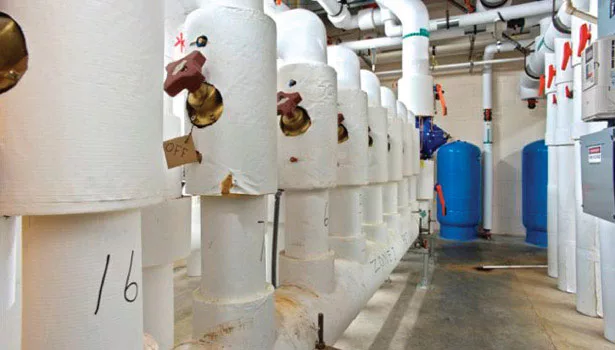
“Based on the heat load, we recommended 16, 10-8-6 wells, each 1,500 ft deep,” said Orio. The term “10-8-6” stands for a 10 in. casing sealed into the bedrock, an 8 in. rock bore, and a 6 in. sleeve and pump. Each submersible pump has a 10-hp motor to push water to the building’s mechanical room and from there to all the heat pumps within the system.
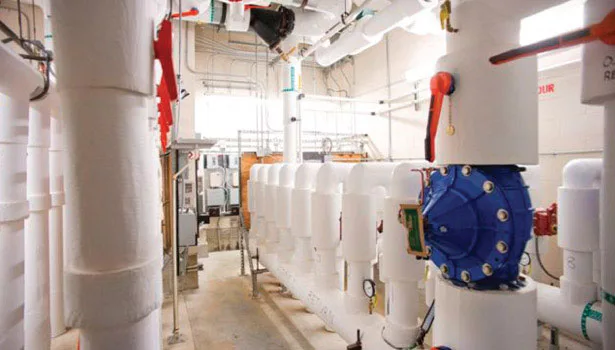
All 16 wells are located beneath the nursing home’s parking lot. Split up into two well fields, eight wells are located under the upper parking lot, and eight below the lower, with the farthest well being 850 ft from point of entry into the building. Each eight-well field is piped to its own supply and return manifold. The caps are protected by manhole covers, and can be found in the green spaces between parking areas. Amherst, NH-based Skillings and Sons was the driller contracted for the MCNH job. The company had two of their four drilling rigs on the job, operated by five employees.
“Each well took us about six days to drill,” said Roger Skillings, president. Drilling an 8 in. hole through 1,500 feet of solid granite is no small task; it was a blessing in disguise, though. According to Skillings, the number-one enemy of a healthy standing column well is soft rock that cracks, collapses, and caves in.
“The first thing we do at any job that is to include a standing column well, is to drill a test well,” explained Skillings. “If the rock hardness, density, and the quality of the water are all desirable, that test well becomes the first well on the field.” At this site, we found some of the best, mineral-free water we’ve ever seen, and the rock was also very stable.” The average water temperature across all the wells was 52°F.
SYSTEM DETAILS
“Each of the eight-well supply and return manifolds feed well water to a series of risers to the upper floors,” explained Orio. “There are two of the big manifolds; each field feeds half of the building. We generally prefer to have no more than 10 wells, or 300 to 400 tons, on a given field. At MCNH, there’s a nominal 310 tons on each field.”
According to Orio, limiting the fields to 10 wells is for ease of balancing. The wellheads should be kept at the same elevation across the field. Since MCNH rests on a hill, the two fields are roughly five feet apart in elevation from each other.
As customary for all standing column well systems, no circulators are used; there aren’t even any flow centers on the ClimateMaster units.
Pressure at the mechanical room supply manifolds are maintained by the VFD-controlled submersible pumps, which operate in parallel. Pressure in the manifold that serves the upper field is kept at 52 psi, and at 55 psi for the lower manifold, insuring 25 psi at the furthest, fourth floor heat pump. “You take the furthest well and the most distant heat pump, and that gives you the requirement for sizing the submersible pumps,” said Orio.
PATHOGENIC PURITY
“Two key things come together when determining system head pressure,” said Orio. “The design engineer determines the total dynamic head (TDH) in the building, and the geothermal engineer determines the TDH from the well to the manifold.” Together, these provide the pressure drop to the highest heat pump in the building at peak flow.
Either three or four-ton ClimateMaster TS units with copper-nickel heat exchangers are suspended above drop-ceiling tiles. The majority of the units serve two bedroom areas. A big advantage in having many small units — as opposed to a large, central unit for each floor — is sanitation. With the smaller systems, air movement is limited to two rooms, greatly reducing the threat posed by airborne pathogens.
“I was skeptical at first,” said Sid McDonald, director of facilities at MCNH. “The bugs got worked out the first year the system was in, and ever since then, it’s has been phenomenal. I was really impressed with everyone involved and the technical solutions that were offered.”
BTU GUSHER: A ‘GEO DREAM’
According to Carl Orio, most standing column wells are designed to bleed off 10% of the water used. In the case of MCNH, the wells were designed to bleed off only 5% of the geo-exchange water. This was done to prevent water from overfilling the property’s detention pond, which would then put it on a downhill course and into Merrimack River, requiring another, higher level of environmental permitting.
Yet aquifer flow under MCNH was much better than expected. The flow of water in the wells is so steady, easily maintaining design temp despite the influence of system geo-exchange, that there’s no need even for a five percent bleed-off of water.
But it gets better. So rich and steady is the supply of waterborne Btu that, for eight or nine months of the year, only 10 of the 16 wells are used. So, just to keep things equal in the wells, BTUs are tapped from different wells on a rotating basis year-round.
“It’s really amazing how well the system has worked out, almost like a dream,” said Skillings. “By rotating wells, MCNH not only saves even more electric but conserves pump life and the aquifers as well.” ES
Looking for a reprint of this article?
From high-res PDFs to custom plaques, order your copy today!