Safety Valve Requirements For Deaerator Installations: How Much Relief?
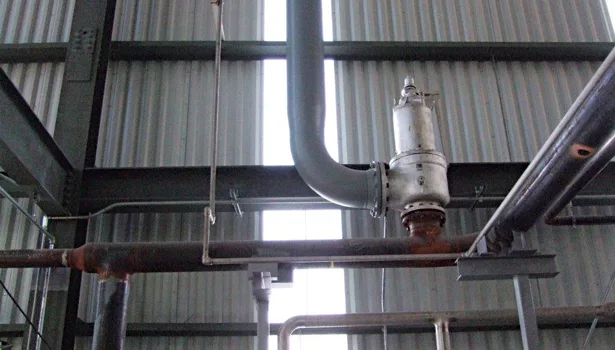

Minimum sentinel relief valve size per HEI standards shown mounted on deaerator vessel. A full-size safety relief valve is also provided elsewhere on the system.
Learn about the proper location for those valves, managing blowoff steam and turbine exhaust, and more.
Very few deaerators utilize vessels that are not constructed and stamped in accordance with ASME VIII Pressure Vessel rules.
The ASME Code requires that all pressure vessels be protected against overpressure from any source, if not by positive control of the pressure source then by the use of properly sized relieving devices.
What are the sources that could result in loss of deaerator pressure control? The most likely sources are discussed below. In all cases, the worst-case scenario would occur if the deaerator load is zero due to high water level and/or temporary diversion of low-temperature condensate returns away from the deaerator.
STEAM PRESSURE REDUCING VALVES
A deaerator requires a source of heat in the form of steam to heat the feedwater to saturation and to remove dissolved gases. For many deaerators, this source of steam is high-pressure steam reduced to the desired deaerator operating pressure by a steam pressure control valve.
In the event of a steam pressure control valve failure, an excess flow of steam will be provided to the deaerator, causing the deaerator pressure to rise. In the worst conceivable case, the maximum excess steam flow may be considered to be the steam flow which the pressure reducing valve can pass with the usual supply pressure on its upstream side and deaerator design pressure on its downstream side. This assumes that the valve has failed in the wide open position and that the deaerator load is zero (i.e., the deaerator has a zero steam demand).
The wide open capacity of pressure control valves can be obtained with the valve manufacturer's assistance or can be calculated from data in the form of maximum flow coefficients for the valve(s) installed in the system.
HIGH-PRESSURE CONDENSATE RETURNS
High-pressure (HP) condensate is condensate that is produced at a temperature greater than the operating temperature of the deaerator. The usual sources of this condensate are process equipment (cookers, driers, etc.) and heat exchangers.
In some plants, this HP condensate is drained to a receiver where its pressure and temperature is reduced to atmospheric conditions (0 gauge pressure, 212°F or less). Pumps are then used to transfer the 'flashed" condensate to the deaerator. Under these conditions, the HP condensate does not present a risk of overpressurizing the deaerator. However, in many situations where it is desired to conserve heat, HP process condensates may be returned directly to the deaerator. In these cases, the excess heat in the condensate must be absorbed by colder streams (e.g., makeup water and cool condensates) entering the deaerator if the deaerator pressure is to be controlled at a steady level. Heat not absorbed goes into elevating the operating temperature and pressure within the deaerator. If the condensate can produce a positive amount of flash steam when reduced to the deaerator design pressure, that amount of flash steam should be included in the safety valve capacity requirement.
CONTINUOUS BLOWOFF / RECOVERED STEAM
In plants using a continuous blowoff heat recovery system, the flash steam produced by the blowdown is usually directed to the deaerator so that its heat content can be recovered. As with HP condensate returns, if the deaerator is operated at loads capable of utilizing the heat in this steam, the deaerator pressure can be controlled at a desired level. If the deaerator load is such that there is insufficient demand for the blowoff steam, the pressure in the deaerator will rise above the control point unless the excess steam is relieved.
Safety valve capacity required to protect against overpressure due to excessive continuous blowoff may be determined by calculating the amount of flash steam produced when the maximum blowoff flow is flashed to a pressure equal to the design pressure of the deaerator and that amount of flash steam should be included in the safety valve capacity requirement. The maximum blowoff flow to be considered is a function of boiler pressure, the number, size, and setting of the blowoff valves as well as the blowoff line size.
TURBINE EXHAUST
In some installations, the steam supply to the deaerator may consist of steam turbine exhaust, augmented with reduced high-pressure steam (described above). If the maximum turbine exhaust pressure exceeds the deaerator design pressure, safety valves must be provided to protect the deaerator; otherwise, relief or safety valves will be needed to protect the turbine. Since the worst case for excessive turbine exhaust flow would occur at zero deaerator load, the safety valve capacity needed to protect against overpressure due to a turbine exhaust is equal to the throttle flow of all turbine(s) connected to the deaerator steam line. Maximum throttle flow information can be obtained from the turbine manufacturer.
LIQUID STREAMS
If the pressure of any feedstream to the deaerator exceeds, or may exceed, deaerator design pressure, adequate relieving capacity must be provided to protect the unit against overpressure from that source. Consideration should be given to the shutoff heads of feedpumps and water supply pressures as well as to the steam sources described above. Usually, the safety valves required for liquid relief alone would be considerably smaller in size than those required for steam relief.
SAFETY VALVES PROVIDED BY THE MANUFACTURER
Usually, the deaerator manufacturer will not provide full capacity safety valves with his equipment. When specified to be within this scope of supply, the deaerator manufacturer can size and supply the required safety valves only when the user or plant designer has supplied all needed details related to sources of overpressure in his system. In the absence of complete information, the deaerator supplier may furnish relief valves in accordance with the HEI Standards For Deaerators. The safety valve number and sizes recommended by the HEI standards are determined on an arbitrary basis and are intended to protect the deaerator against overpressure due to minor sources of overpressure, such as the introduction of excess amounts of HP condensate. However, the HEI-recommended safety valve sizes should be considered as minimums and to ensure a compliant installation, their adequacy for any application should be verified.
SAFETY VALVE REQUIREMENTS
The ASME Code requires that sufficient relief valve capacity be provided to prevent the pressure inside the deaerator and storage tank from rising more than 10% or 3 psi, whichever is greater, above the maximum allowable working pressure of the vessels when a single safety valve or relieving device is utilized. When multiple safety valves are utilized, the set pressures of the individual devices may be staggered as permitted in paragraph UG-134 of the code. Safety valves on deaerators are normally set to relieve at maximum allowable working pressure of the vessels.
Safety valves for use on ASME Code vessels must meet the manufacturing and certification requirements set by the Code and outlined in Paragraphs UG-125 through UG-136 of ASME Section VIII, Division 1.
LOCATION OF SAFETY VALVES
The ASME Code requires that safety valves intended for relieving steam be connected to the steam space of the pressure vessel when the source of overpressure is internal to the vessel. For this reason, it is common to connect the safety valves to protect against overpressure due to excessive flashing returns directly on the deaerator. If the source of overpressure is external to the pressure vessel, the ASME Code does not require the safety valves to be installed directly on the vessel. It is for this reason that the full capacity safety valves, whether provided by the purchaser or the deaerator manufacturer, are not normally located on the deaerator but on the piping connecting the deaerator to the source. In this way, the deaerator is protected and the risk of internal damage due to steam flows in excess of design is minimized.
OPERATION
The reaction-type safety valves normally used are characterized by 'pop' action where the valve is rapidly pushed to the wide open position shortly after set pressure is exceeded. The safety valve remains open until such a time that vessel pressure has been reduced to a value approximately 5% below the set pressure of the safety valve. This difference between set pressure and reseating (closing) pressure is termed blowdown.
Due to these operating characteristics, it is important to consider the potential effects of safety valve operation on the deaerator. Consider a deaerator operating at a controlled pressure of 10 psig but designed for 50 psi maximum allowable working pressure with a safety valve set at 50 psi. If for some reason, the deaerator is supplied with more heat input than can be absorbed at 10 psig by the incoming water, the deaerator pressure will begin to rise. The deaerator will heat the incoming water to the saturation temperature corresponding to each new (higher) operating pressure and this water will be held in the storage vessel. If the excess steam condition persists, the pressure in the deaerator will continue to rise toward the safety valve setpoint. Just prior to actuation of the safety valve, 50 psi in this example, the deaerator will be delivering water at 298° to the storage tank.
At the set pressure, the safety valve opens and soon reaches full open position; the deaerator is delivering water heated to 298° to 302° to the storage vessel all while the safety valve is blowing. As the source of overpressure begins to diminish, the safety valve remains open until the pressure in the deaerator decreases to approximately 45 psig. During the time period when the deaerator pressure is decreasing toward the control point (10 psi), the hot stored water is cooling to saturation temperature by flashing and steam is flowing from the storage tank to the deaerator through the equalizers. If possible, water flow rates should be controlled for slow rates of change during a safety valve blowing operation; at rapid rates of change, the deaerator may be subject to damage as a result of rapid depressurization.
Installation of relief valves in parallel with the safety valves on deaerator installations can prevent unnecessary activation and ‘chattering’ of the safeties from minor upsets in pressure control, e.g., situations where a discharge of steam considerably less than the combined safety valve capacity would suffice to prevent overpressurization. In contrast to safety valves (pop action to full capacity), relief valves open only in proportion to the amount of overpressure present, preventing excessively high discharges from slight disturbances. Many older boiler plants were equipped with relief valves in this manner but the practice has waned in the recent past. However, the prevention of frequent safety valve discharges remains a worthwhile goal to reduce noise emissions and maintenance requirements.
CONCLUSION
The information provided above is intended to illustrate typical procedures for determining the maximum flows to a deaerator which might overpressure the unit and provide a basis for sizing of relief valves. Since the design of each installation varies, the user is responsible for identification of all potential sources of overpressure and provision of sufficient relief valve capacity to ensure safe operation of the deaerator. TB
Looking for a reprint of this article?
From high-res PDFs to custom plaques, order your copy today!