Retrofitting Controls Reduces Fuel Costs
The main cause of boiler inefficiency is heat loss, and upgrading the controls is one of the most effective ways to recapture lost heat in an existing system. There are several control options available, depending upon a facility’s needs and goals. To increase boiler system efficiency and reduce costs, consider the following:
- O2 trim. Add an oxygen sensor/transmitter in the exhaust gas. The sensor/transmitter continuously senses oxygen content and provides a signal to the controller that “trims” the air damper and/or fuel valve, maintaining a consistent oxygen concentration. This minimizes excess air while optimizing the air-to-fuel ratio.
- Parallel positioning. Many boiler burners are controlled by a single modulating motor with a single jackshaft and corresponding linkages attached to the fuel valve and air damper. This arrangement, set during startup, fixes the air-to-fuel ratio over the firing range. Over time, the linkages wear down, causing the air-to-fuel ratio to become erratic as the burner modulates from low to high fire. Parallel positioning uses dedicated actuators for the fuel and air valves, so lower excess air levels can be set due to consistent repeatability.
- VSDs. VSDs enable a motor to operate only at the speed needed at a given moment, rather than a constant rpm, regardless of firing or delivery rate. This speed variance results in the elimination of unnecessary electrical energy consumption. A VSD can be used on any motor but is most common on boiler feed pumps and combustion air motors greater than 5 hp. These drives also reduce maintenance costs by decreasing the stress on the impeller and bearings.
- Lead lag (boiler sequencing control). Lead lag sequences the operation of multiple boilers, matching system load. Lead lag allows the boilers to operate at peak efficiency, reduce cycling, and decrease maintenance and downtime.
FACILITY REAPS THE BENEFITS OF A CONTROLS RETROFIT
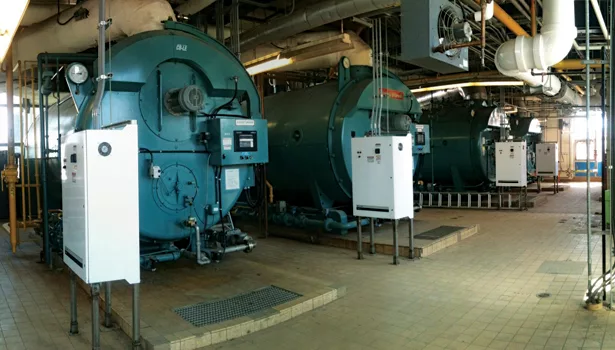
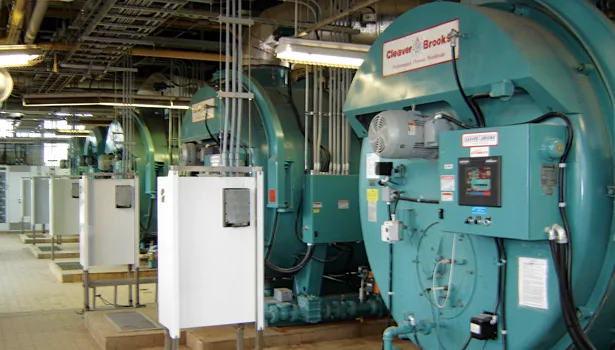
A wastewater treatment plant in West Hill, Ontario, relies on five, 400-hp, Cleaver Brooks hot-water, firetube boilers to treat wastewater for a half a million area residents. The plant’s boiler controls were outdated and compromised the system’s efficiency. In addition, the two newest models (1998) had 30 ppm NOx reduction capabilities, but the plant’s three older boilers did not. The plant wanted to bring all of its boilers into compliance with CCME (Canadian Council of Ministers and the Environment) guidelines. After analyzing their options, plant management determined that upgrading the controls would meet both their efficiency and emissions goals.
Plant management contacted Kevin Kingston, sales and project manager for Johnson Paterson Inc., in Aurora, Ontario. Based upon the treatment plant’s needs and goals, Kingston recommended the following:
- Add digester gas firing capabilities to the three older boilers, including new stainless steel gas trains and associated fuel components.
- Convert each burner to high (10:1) turndown firing capabilities.
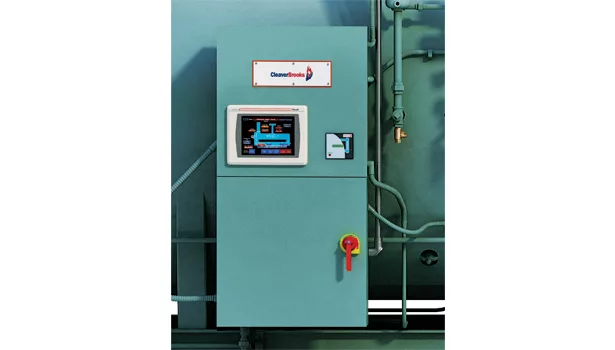
- Add an advanced Cleaver-Brooks Hawk PLC control system to each boiler.
- Add parallel positioning (linkage-less controls) to each boiler.
- Add a new Siemens HE blower motor and VSD control system to each boiler.
- Install O2 trim on each boiler.
- Convert the three older boilers to 30 ppm NOx firing.
- Install a Hawk master boiler lead lag sequencing control.
The conversion took place in three phases, beginning in June 2010. It was completed in January 2012. The wastewater treatment plant expects annual fuel savings of 12% to 15%.
There are several reasons for the anticipated double-digit fuel savings. First, the new boiler controls enable the plant to operate on digester gas more continuously, which also decreases the rate of natural gas consumption. The plant only uses natural gas as a backup fuel. Prior to the conversion, the older boiler control system was not able to provide proper boiler sequencing and controlled fire rates, so natural gas was tapped frequently.
In addition, the new Hawk master boiler lead lag sequencing control was interfaced with the boiler building SCADA system, providing operator interface with the individual boiler control panels and the master boiler lead lag sequencing control. The design engineer for the project wrote a strategy to control the main heating system’s circulating pumps based on the plant's heating loads. Summer heating loads require lower flow rates than the winter heating loads. The Cleaver-Brooks Hawk control systems are programmed to transmit a signal to the main remote processing unit (RPU). Depending on the number of boilers operating and the rate of firing, flow rates will increase or decrease to the main heating pumps, controlled by new VSDs, to match the heating loads.
Lastly, with 10:1 burner turndown, there is less cycling, and repeatability in the management of the fuel mixtures through the new parallel positioning controls. TB
Looking for a reprint of this article?
From high-res PDFs to custom plaques, order your copy today!