search
Ask ACHR NEWS AI
cart
facebook twitter instagram linkedin youtube
  • Sign In
  • Subscribe
  • Sign Out
  • My Account
  • NEWS
  • TECHNOLOGY
    • Heating & Boilers
    • Cooling & Chillers
    • Pumps & Flow Controls
  • SECTORS
    • Commercial
    • Health Care
    • Data Center
    • Educational Facilities
  • DESIGN | CONSTRUCTION
  • OTHER TOPICS
    • High-Performance Buildings & Automation
    • Ventilation and IAQ
    • Commissioning
    • HVAC Retrofits
  • TODAY’S BOILER
    • Today’s Boiler Archives
    • Today’s Boiler Digital Edition
  • MORE
    • Case Studies
    • Podcasts
    • Videos
    • Directory
    • Webinars
    • ES NEWS Store
    • White Papers
  • SIGN UP
  • Back to The NEWS
Engineered Systems NEWSCommissioning

Trend Analysis Summary

Commissioning
June 3, 2012
This is the final commissioning column dedicated to trend log analysis for a while. Since November, 2011, we have looked at a variety of trend logs and gleaned meaningful systems performance information from them. This month, I will describe the “issue” disclosed through analysis of the trend graph included in my May 2012 “Commissioning” column, followed by a wrap-up summary regarding trend logs and new construction commissioning.


MAY 2012 TREND LOG ANALYSIS

Last month’s trend graph showed about two weeks of 2-min interval data from the BAS for selected points on an office building rooftop unit. The unit had hot water heating and chilled water cooling coils and full airside economizer capability. It was a VAV system supplying 55°F air to VAV/reheat terminal units. During the trend period, the outdoor air conditions were cool and dry enough for the system to be in economizer mode the entire time.

One of the first challenges in reviewing the trend graph was noting that the hot water trend points (e.g., 0% to 100%) represented the heating valve’s “percentage closed.” This is intuitively difficult for most of us to grasp and adds an unnecessary level of complexity to the analysis process. For the most part, we have been trained to think of “0%” as fully closed and “100%” as fully open. I believe any DDC system worth having will allow the programmer to present valve and damper positions consistently as (0-100%) = (Closed-Open). As commissioning professionals, I recommend that we review the control system specification to confirm that this is a requirement for programmers, regardless of which brand BAS is selected.

With only a few exceptions, the chilled water valve is signaled to be fully closed (0%) throughout the entire trend period. The hot water valve is signaled to modulate between 100% (fully closed) and about 80% (20% open) in its attempt to maintain the discharge air temperature at its setpoint of 55°. With no source of cooling between the mixed air and the discharge air, why is the discharge air temperature lower than the mixed air temperature? We can only surmise that the “closed” cooling valve is leaking past and lowering the air temperature such that some heat is actually required to keep the air temperature at 55°.

This is a condition which would likely go unnoticed without trend log analysis, especially in an existing building. There are no temperature control problems at the rooftop unit, as it is consistently maintaining the desired 55° discharge air. However, both chilled water energy (electricity) and heating hot water energy (natural gas) is being wasted.

Finally, this commercial office building rooftop unit is clearly operating continuously day and night, weekdays, and weekends. When asked about this, the building operators said this unit could not shut down because it served a data closet that had a 24/7 cooling load. This prompted evaluation of an energy conservation measure to cool the data closet with a standalone split system, thus allowing the rooftop unit to be shut down during unoccupied hours.


TREND ANALYSIS SUMMARY

During new construction commissioning, trend log analysis is not a substitute for field functional performance testing. However, I highly recommend analyzing trend logs and addressing performance issues identified through trend logging as a pre-test commissioning activity. It will improve the chances of the field functional performance testing being successful and everyone’s testing time being used as efficiently as possible.

In addition, pre-test trend analysis would only be the first step in functional performance testing HVAC systems. Field testing would still be needed to focus on things that wouldn’t have been caught in the trend logs, such as:

 •Other-season modes of operation (e.g., if left to run on its own) the HVAC system will only respond to the weather/occupancy conditions at the time of trending. In most climates above the Maxon-Dixon line, that means there are probably two other weather conditions that would need to be simulated in the field.

•Safety devices (freezestats, high static switches, etc.)

•Failure mode operation (what happens if a pump fails?)

•Extreme load conditions (seeing components (boilers, chillers, valves, etc.) sequence on/off based on all possible load conditions

•Occupant-driven load conditions (i.e., demand ventilation, occupancy sensors, etc.)

• Integration with other systems

•Performance of systems/equipment not monitored/controlled by the central automation system ES


Share This Story

Looking for a reprint of this article?
From high-res PDFs to custom plaques, order your copy today!


Recommended Content

JOIN TODAY
To unlock your recommendations.

Already have an account? Sign In

  • HVAC-enrollment

    The Trades Are Back: HVACR Programs See Nearly 30% Enrollment Spike

    A new wave of future technicians is entering the pipeline.  
    News
    By: Matt Jachman
  • 2025 Top 40 Under 40

    2025 Top 40 Under 40 HVACR Professionals List

    The 11th annual Top 40 Under 40 list highlights those...
    HVAC Contracting
    By: Hannah Belloli-Oster
  • LG Ductless Mini-Split Systems

    The 9 Types of Heat Pumps

    As the U.S. moves toward electrification, heat pumps are...
    HVAC Residential Market
    By: Joanna R. Turpin

More Videos

Today's Boiler

Spring 2026 Issue

Today's Boiler - Spring 2026 Cover

Read More from Today's Boiler

Case in Point Logo

Smarter Hydronic Design for Data Centers - Free Webinar - January 22, 2026

Related Articles

  • AHU2

    Critical Air-Handling System Trend Analysis

    See More
  • Commissioning

    PARKING GARAGE MAKEUP AIR — Heating Trend Analysis

    See More
  • Commissioning

    A Deeper Dive into Trend Analysis

    See More

Related Products

See More Products
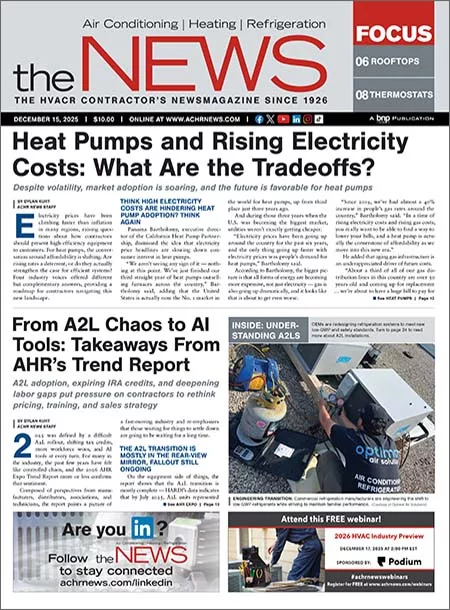
  • The ACHR News - December 15 2025

    ACHR NEWS December 15, 2025, Issue

See More Products

Events

View AllSubmit An Event
  • September 9, 2025

    How Maintenance Plays into the HVAC Decarbonization Trend

    On Demand This webinar will explore maintenance strategies for advanced HVAC systems, including VAVs and demand-controlled ventilation.
View AllSubmit An Event
×

Sign Up. Stay Informed.

The #1 trusted source for the HVACR industry since 1926

SUBSCRIBE
  • RESOURCES
    • Advertise
    • Contact Us
    • Advisory Board
    • Classifieds
    • Submit a Letter
    • Directories
    • Store
  • ACCOUNT CENTER
    • Create an Account
    • Start a Subscription
    • Manage My Account
    • Sign Up for Newsletters
    • Visit Customer Service
    • Update Preferences
  • SERVICES
    • Marketing Services
    • Reprints
    • Market Research
    • List Rental
    • Survey/Respondent Access
  • STAY CONNECTED
    • LinkedIn
    • Facebook
    • Instagram
    • YouTube
    • X (Twitter)
  • PRIVACY
    • PRIVACY POLICY
    • TERMS & CONDITIONS
    • DO NOT SELL MY PERSONAL INFORMATION
    • PRIVACY REQUEST
    • ACCESSIBILITY

Copyright ©2026. All Rights Reserved BNP Media, Inc. and BNP Media II, LLC.

Design, CMS, Hosting & Web Development :: ePublishing