Case In Point
Financial exchange trades up to modular fan system


|
| A modular fan system installed in the Chicago Board of Trade building saved on space and reduced noise. |
options exchange. Until recently, the building also housed a pair of aging built-up systems that were beginning to worry management. Due to their location, replacing these systems would be a virtually impossible task. But a difficult retrofit job was greatly simplified by the modular design of Fanwall Technology® from Huntair, Inc., a CES Group company. Despite limited access to the mechanical room, there was no need to knock down walls or make other significant structural changes.
Designated a National Historic Landmark, the 45-story CBOT Building is an Art Deco structure consisting of two towers. For many years, the air-handling system — including two large supply fans and two return fans — provided airflow for floors 10 to 23 in each tower. Installed in 1970, these old air handlers were becoming a cause for concern at CBOT. Maintenance costs were increasing; moreover, building owners wanted to ensure uninterrupted HVAC service to traders and tenants.
Deciding to replace the old coils and fan systems may have been easy, but carrying out the task posed unique challenges for the general contractor, Alps Construction and the mechanical contracting firm, Competitive Piping Systems Inc. (CPS, Chicago).
“The age of the building, the location of the equipment in the building, the need to keep the old system operational with a single weekend cut-over and access were the most unique items about the retrofit,” said Adam Smith, project manager, Alps Construction.
The initial problem centered on how to move equipment to and from the two mechanical rooms that house the air handlers, which are located on the 24th floor. The only access to those rooms is through a door that leads into tenant office space where electronic trading and other important activities take place.
The contractors knew they had to find another way to get men and equipment into and out of the mechanical rooms during the project. They developed a different route, one that lead through from the mechanical room, through a small exterior opening cut to the outside and then down to a sub-roof on the 23rd floor.
The difficulties involved in moving equipment via this route played a big role in the choice of new air-handling equipment. The original plan was to replace the old units with something similar, but given the access limitations, that idea no longer seemed feasible.
“The original blowers were extremely large,” said Tom Muraski, vice president of Competitive Piping Systems. “In order to get something that size into the building, we would have had to take out walls. It would have been a massive undertaking.”
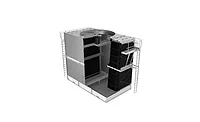
So instead of large conventional fans like the old ones, the team chose a modular fan system. A Fanwall system consists of a number of individual cube-shaped cells, each of which houses a fan, motor, and electrical connections. The number and configuration of these relatively compact cells depend on the application and its requirements.
“The Fanwall components were of a manageable size to allow us to work around the existing equipment that remained in the penthouse and gain access through standard doors,” said Smith.
Because the modular fan system could be installed cell by cell, no significant structural changes were needed. With Fanwall fan cubes, “we could bring the system up in small pieces and build everything onsite,” said Muraski.
Fanwall Technology systems are custom-configured by specifying the number of fans, as well as fan operating speed (rpm) and wheel width and diameter. This allows each system to be optimized for maximum efficiency. For this job, Midwest Applied Solutions of Hillside, IL, a Huntair manufacturer representative that provides engineered solutions for HVAC and refrigeration, designed two identical fan systems totaling 470,000 cfm. Each system consists of a 130,000 cfm supply array made up of 21 Fanwall cells and a 105,000 cfm return array made up of 15 cells. The cells measure approximately 3 ft by 4 ft and weigh about 400 pounds.
One by one, CPS personnel brought the 72 fan cells up to the 23rd floor using a dolly. Then the installers moved the cells outside onto the sub-roof, where scaffolding and a hoisting rig lifted each cell up to a catwalk next to the mechanical room on the 24th floor. Finally, a construction worker wheeled the cells into the mechanical room through the temporary hole in the wall.
Now operational in the two towers of the CBOT Building, Fanwall Technology produces a uniform piston of air that creates a stable velocity profile at the unit coils and filters, as well as throughout the unit’s airway path. This airflow profile reduces static pressure drop due to turbulence and system effects.
The Fanwall motor-control panels include three active VFDs, each of which controls a third of the 21 motors in the supply array. The supply systems also include one redundant VFD wired for automatic switchover in the event of a VFD failure.
In addition, the new airflow systems are equipped with a full complement of VAV boxes that allow airflow control on each floor served by the systems. The old air-handling system did not include VAV boxes for all floors. On floors without VAV boxes, static pressure would build up at certain times of the year with no way to relieve it.
The identically sized fans and motors that make up a Fanwall array operate in parallel to create the same airflow rate as a single, larger fan sized for the same duty. Due to this system redundancy, a fan/motor failure is only a high-priority maintenance issue rather than a mission-critical failure that disables the entire air-handling system.
If one of the fan’s motors fails during operation, the VFD and control system increase the speed of the other motors so that overall system performance can be maintained at the same level during the time it takes to replace the failed motor. Losing one fan doesn’t noticeably affect the system’s operation.
The modular design also simplifies maintenance. For example, each fan motor is much smaller than those required by systems with large plenum fans. Further reducing maintenance, the direct-drive design requires no belts or sheaves. Nor does it require fan bearings, the HVAC component most likely to fail or deteriorate over time. The fan assembly also eliminates lubrication requirements with permanently sealed motor bearings.
SHHHHH — QUIET!
In the mechanical rooms of the CBOT Building, small fans operating at relatively high speeds produce less of the particularly troublesome low-frequency noise than lower-speed larger fans sized for the same airflow and static pressure. The modular fan design also benefits from careful attention to balance within each of the fan wheels, which significantly reduces vibration. Another key to noise reduction, a Coplanar Silencer® surrounds the fan and motor of each fan cube with acoustically absorbent material to greatly reduce airborne noise at the source.
“I remember being in the mechanical rooms with the old fans running and having to yell at everyone at the top of my lungs. Now we can have a piano recital up there if we want to,” said Joe Kurcz, sales engineer for Midwest Applied Solutions. In addition, the footprint of the Fanwall system is about half the size of the old fans, which has opened up about 600 sq ft of additional space in each of the mechanical rooms. “We literally gave them their mechanical rooms back,” Kurcz added.
Now, the building’s tenants and visitors will benefit from an HVAC system that delivers better performance and reliability. Giving up an old, unwieldy fan system for a modular Fanwall system was definitely a “good trade” for the Chicago Board of Trade Building.
Looking for a reprint of this article?
From high-res PDFs to custom plaques, order your copy today!