Compact exhaust system helps thin out a ‘rooftop jungle'

One of the laboratories needed a canopy hood and rooftop stack system to capture and exhaust odors and fumes created during the research experiments. Previously, the university's physical plant engineering department had built its own custom hood stacks on-site, but limited space, funding, and time prompted the project estimator at Texas Tech to look into other options. External funding was available to fund the project if the university could find a way of completing the project during the timeframe in which funding was available.
Seeing the forest for the trees
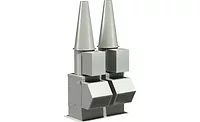
Mike Halley of David G. Halley & Company, Greenheck's representative in Lubbock, reviewed the merits of Greenheck's Laboratory Exhaust System, TCB-LE, with Don Gamel, project estimator with the Texas Tech engineering staff. Because the building had not been designed originally as a science building, there was very limited space on the roof for lab exhaust systems.After reviewing the information on the Greenheck laboratory exhaust system, Gamel and Halley got together with Mike Powell of Anthony Mechanical, the mechanical contractor. Collectively, all agreed that Greenheck's lab exhaust system was the right choice for the project.
The TCB-LE's compact footprint not only preserved valuable roof space, but it also required only a single roof penetration, Gamel said. He added that another benefit was that the unit's stack is engineered to not require any unsightly guy wires. The TCB-LE served as a cost-effective alternative to standard field built-up fan and stack assemblies. In addition, the one-piece TCB-LE met ANSI Z9.5, UL 705 and ASHRAE lab design guidelines.
It was also important to Texas Tech that equipment could be easily maintained by its staff. "Whenever we add new equipment, we always look at maintainability as a general rule, and with so many stacks on the roof up there, it looks like a forest. We wanted something that could be easily accessed," Gamel said.
He also noted that the fact that unit doesn't require guy wires was key. "With guy wires on all those stacks up there, you really have to watch what you're doing. It would be nice if all the exhausts were like this one and you wouldn't have all those wires," Gamel said.
The unit provides safe, easy inspection and maintenance of internal fan components. By removing one access panel, service to the fan wheel, shaft, and bearing assembly is accomplished without removing the fan from the system. This improved process not only is much easier, but also can be accomplished efficiently on the TCB-LE laboratory exhaust system.
A high velocity exhaust cone incorporated in the TCB-LE displaces hazardous or noxious laboratory fumes high above the roof, preventing roof damage and re-entry of exhaust effluent into the building's makeup air system. An optional bypass air plenum and damper adds ambient air to the exhaust; this further dilutes fumes and provides additional exhaust displacement or allows the TCB-LE to be applied to variable volume lab exhausts.
exceeding specs
The university's new laboratory exhaust system now exceeds design and engineering specifications and space considerations. "I was really happy with the way it went in. Normally we've used the built-up stacks, but this one piece of equipment makes things simple. It's a good compact solution," Gamel said. The TCB-LE lab exhaust system was specified, built, shipped, and installed within six weeks - well within the deadline to qualify for the external funding to cover the costs for this project.
Additionally, in a West Texas climate where wind gusts of 40 to 50 mph occur when it's not even stormy, the stack has withstood the worst so far, without guy wires. Gamel added that the university's engineering department is certainly considering installation of more of these units in other laboratories in the building in the future. ES
Looking for a reprint of this article?
From high-res PDFs to custom plaques, order your copy today!