Spiral duct diffusers offer compelling advantages

Leaky ductwork can contribute to significant energy loss in a building. Well-designed duct systems distribute air efficiently throughout a facility and keep rooms at a comfortable temperature.
Whether it’s a new building, renovation or retrofit project, two types of ductwork are typically used in construction: rectangular and spiral (which includes both round and oval).
Spiral duct has been used in the United States since the 1950s after machines were invented that could fabricate rolls from steel or aluminum. Many European countries use spiral duct almost exclusively in construction. Popularity in the U.S. has grown significantly in recent years due to standards outlined by the American Society of Heating, Refrigerating and Air-Conditioning Engineers. The society’s standard 90.1 recommends using spiral duct whenever it’s feasible — and for good reason.
Easy to install, maintain
Spiral duct offers a great deal of installation flexibility. It comes in standard sizes and fittings, which can be purchased from existing stock to minimize custom manufacturing. Pairing spiral diffusers with spiral ductwork eliminates the need to install a tap, as required with rectangular grilles. Spiral diffusers can be installed directly onto the spiral duct, lowering both labor and material costs.
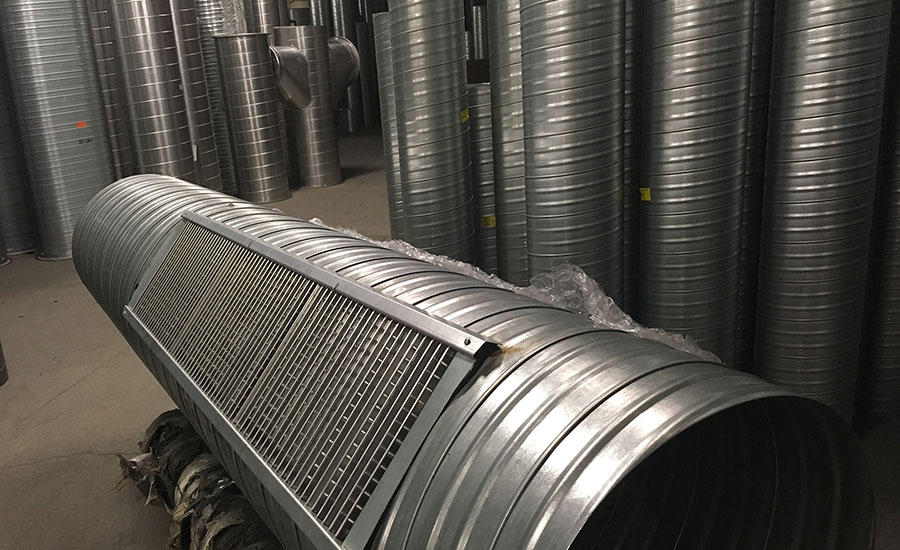
Diffusers can make duct maintenance easier.
Additionally, the cylindrical nature of spiral systems leaves less room for dust and other contaminates to collect, and can be easily cleaned with spinning brushes. Also, since less sealant is required, routine inspection and maintenance is quicker.
Measurement errors on the jobsite can be easily adjusted with spiral duct, and leftover material can be saved and used elsewhere. A well-installed spiral duct system has an extremely low leakage rate — as little as 0.5 percent. Rectangular duct can offer the same low leakage level; however, it’s much more expensive and time consuming to achieve this optimum level of performance.
Sealing requirements
ASHRAE standard 90.1 does not require full sealing of round or oval spiral diffusers, since taps are not needed for installation. Since the perimeter of a spiral diffuser is less than that of a rectangular diffuser, there are fewer and smaller joints that require sealing. Rectangular joints are harder to seal and can leak up to 50 percent more. Round and oval duct also use about one-third the sealant, reducing both material and labor costs.
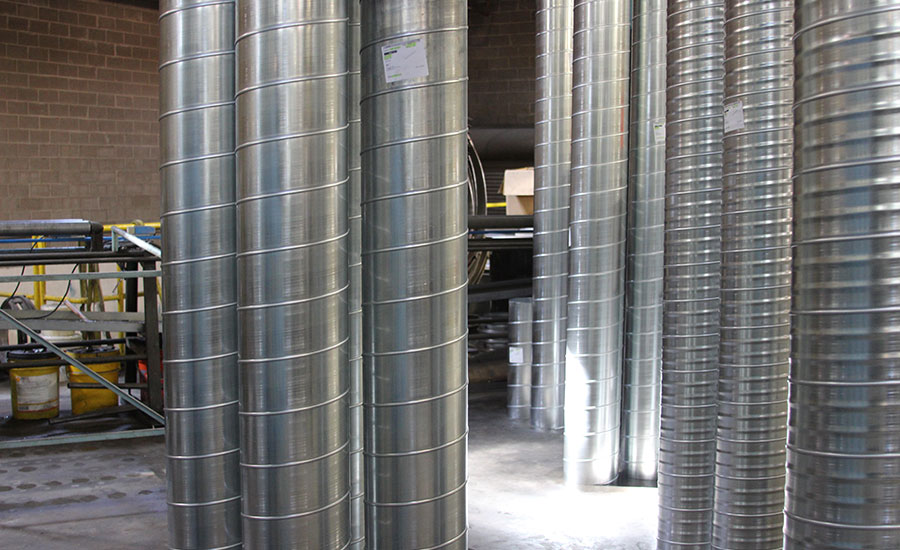
Spiral duct has long been popular in Europe.
Fittings also contribute to a tight seal. Some gasket fittings do not require sealant — just insert and screw in place — further reducing installation costs. Flanges that are factory preassembled to spiral duct eliminate spot welds and any additional sealing needed prior to being shipped to the jobsite. Look for spiral duct that meets the Sheet Metal and Air Conditioning Contractors’ National Association’s reinforcement standards at the connection.
Low leakage rates boost energy efficiency
When ductwork is leaking, fan power must increase to compensate for the loss of airflow, which can greatly increase the energy load needed to heat or cool a building. The cost of this wasted energy can add up quickly, prompting engineers and building owners to seek products that ensure the quality of their duct systems.
Spiral duct systems are proven to leak significantly less than other ductwork due to the nature of their construction. The source of leaks typically stems from a duct’s seams and connections. Since spiral ducts require no sealing, Air Movement and Control Association testing shows leakage rates to be so low that they do not affect performance.
Field connections also contribute to energy loss. Rectangular duct is manufactured in 5-foot sections and requires fittings to change size or direction. Spiral duct can be sourced in lengths of 12 feet or more, greatly reducing the number of required connections. If seams and corner connections aren’t sealed, duct can leak up to eight times more and greatly increase energy costs.
In addition to energy savings, spiral duct can also enhance indoor air quality, since duct sealants containing volatile organic compounds are not required. What’s more, the acoustical characteristics of the spiral design can contribute to a quieter and more relaxing environment.
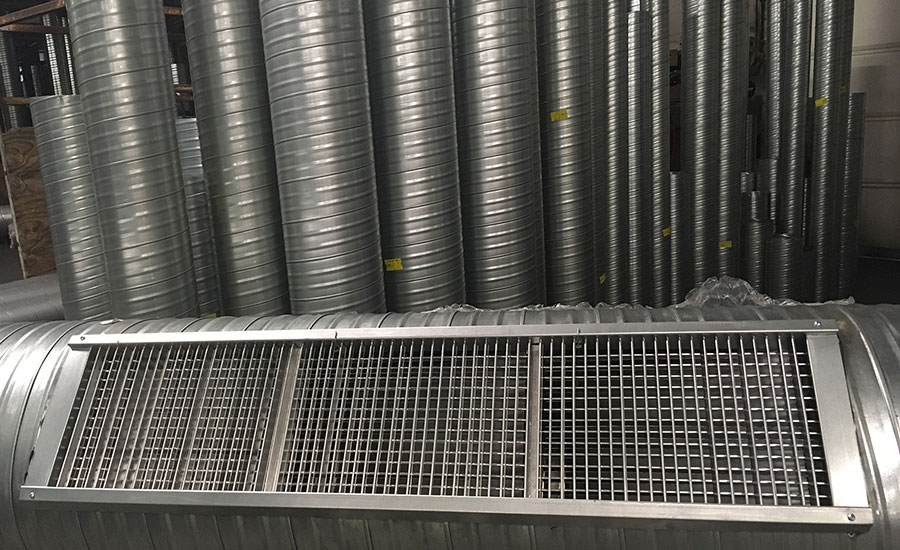
Installing diffusers on spiral duct is easy.
Additional benefits simplify installation, save money
The lighter composition of spiral duct can significantly reduce labor costs during installation. A single worker can install ductwork up to 10 feet long and 18 inches in diameter. Spiral duct’s light construction also reduces the number of hangers needed by up to 20 percent and requires only one anchor point above the duct.
Spiral duct can also reduce transportation costs, since pieces with smaller diameters can be stored in larger ones. The reduced surface area of spiral duct decreases the amount of unintended heat transfer as the ductwork passes through unconditioned spaces.
Visual appeal
In addition to installation, maintenance and performance benefits, spiral duct is typically regarded as more aesthetically pleasing than rectangular. More and more, engineers and building owners are opting to leave spiral ductwork exposed due to is eye-catching helical seam. Exposed duct can be left unpainted or painted on the job site to match the building’s color scheme. Spiral diffusers further add to the visual appeal of the ductwork, since the grilles lay flush for a smoother shape.
Spiral duct eases installation and maintenance for contractors, offers impressive performance benefits for building owners and facility managers, and provides an intriguing visual appeal for occupants. Contractors seeking ductwork that offers both superior form and function should look no further than spiral duct systems.
Looking for a reprint of this article?
From high-res PDFs to custom plaques, order your copy today!