IAQ
Healthier Indoor Air Doesn't Need to Cost Building Owners More

The scientific community now has a preliminary grasp on how large a threat the novel COVID-19 virus poses. What’s yet unknown – among building design professionals and the skilled construction trades - is the impact that coronavirus will have on commercial building codes.
Many design professionals are looking to expert sources like ASHRAE, the CDC, and the EPA for guidance. All of these organizations and agencies agree that increasing fresh air supply to buildings will improve indoor air quality (IAQ), but to date there’s no consensus or applicable codes tying to the ongoing pandemic. These are sure to follow.
For years, the rate at which fresh air is been introduced to commercial buildings has declined, resulting from the need to increase HVAC system efficiency. Increasing unconditioned air to a building via conventional approaches always has a negative impact on energy consumption, though ambient outdoor temperatures and the presence of energy recovery systems have a huge impact on how much extra energy is actually consumed.
Two decades ago, most new commercial HVAC designs provided outdoor air at a rate of roughly 20 CFM per building occupant. These days, that number hovers between 12 and 15 CFM per person.
With regard to IAQ and how fresh air impacts building health, there’s never been a question about its efficacy. The challenge has been, and now the dilemma posed by COVID-19, is weighing IAQ against the ever-pressing need to increase energy efficiency.
Historically, the codes that guide various elements of building design have swung like a pendulum. Though these swings may not vary to great extreme, they nonetheless represent changes in professional opinion.
The fresh air pendulum is now poised to swing again.
ASHRAE 62.1 and 62.2, the recognized standards for ventilation system design and acceptable IAQ, will almost certainly include new language prescribing greater fresh air requirements in the near future. This time, however, the nationwide push toward minimizing carbon footprint and the simultaneous need for healthy indoor environments have never been higher, despite the fact that these two objectives are usually positioned against one another.
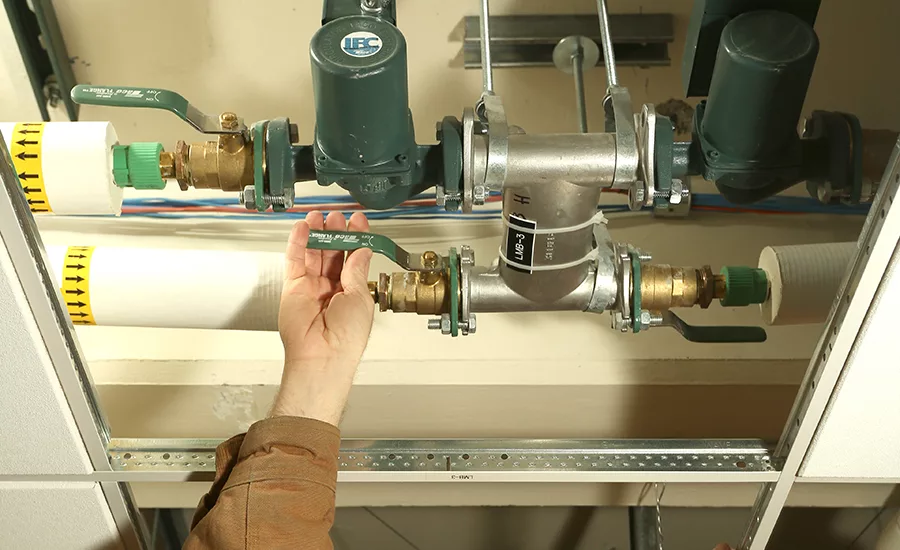
Decoupled hydronic systems – where water-based systems independent of the primary HVAC system supply all fresh air to a building – have proven to be the most efficient means of introducing fresh, outside air into commercial structures. However, these systems are not feasible for every building in the country. More on that later.
Two pronged approach Achieving optimal IAQ requires two HVAC system functions and/or components: filtration and ventilation, and the provision of fresh air.
Filtration and the addition of a treatment system like UV lights can have a big impact, but they have their limitations. MERV (minimum efficiency reporting value) 13 filters have become the gold standard for indoor air filtration. According to the National Air Filter Association, a MERV-13 filter is able to remove 90 percent of particles between 3 and 10 microns in size, 85 percent of particles between 1 and 3 microns in size, and 50 percent of particles between 0.30 and 1 micron in size.
The COVID-19 virus measures between .1 and .5 microns, but is generally attached to other particles in an airstream, such as water vapor (moisture). These COVID-laden particles range between .5 and 1.0 microns in size. MERV 13 filtration is an important part of the equation, but it is not the end all be all.
The second part of the healthy air equation is ventilation, or the introduction of outside air. Increasing the amount of fresh air decreases the concentration of airborne particles within an occupied space. This becomes more effective than filtration alone.
To help combat COVID, ASHRAE has recommended maintaining air circulation 24 hours a day, instead of shutting systems down when unoccupied. Another method of scrubbing the air in a building includes purging its air volume for several hours before occupation and again after close of business.
Yes, this is energy intensive. Not only is continual operation of system fan motors a consideration, but the greater the disparity between outdoor ambient temperatures and indoor setpoint, the more taxing it is to condition fresh air.
So, can we have our cake and eat it, too?
Decoupling the sensible load Decoupling the latent heating and cooling load from the sensible load is the best option for efficiently increasing the amount of fresh air in a commercial building, if at all possible. It is possible, with a properly designed and installed system, to increase outdoor air without an energy penalty. Ideally, this would include active chilled beams and a dedicated outdoor air system (DOAS).
At Taco Comfort Solutions, we’re already working diligently with many building owners, engineers and contractors to provide the optimal solutions to increase fresh air to all variety of commercial properties.
“Hydronic Systems offer a much more efficient method of transferring BTU’s throughout a building. While we recognize not every building is suitable for hydronic systems, when they are applicable, decoupling the ventilation and heating/cooling aspects, such as a chilled beam system, can greatly improve the operating efficiency of buildings to offset energy costs as engineers and owners adjust their designs to help make sure buildings are as safe as possible in pandemic situation.”
For this reason, we’re dedicated to helping professionals find the best solution for their buildings regardless of whether or not hydronics are on the table. When someone comes to Taco with a charge to increase fresh air in a building, we analyze all aspects of the project. Ours is a site-specific, evaluation-driven analysis, not a product-driven analysis. We can help engineers evaluate an existing building and its systems and provide multiple solutions for their consideration.
We start this evaluation with Taco’s BEST (Building Efficiency System Tool). With the very simplest of inputs, BEST compares the energy performance, first cost, life cycle cost and more for all major types of HVAC systems and is broadly applicable to most commercial buildings, anywhere on the continent.
If a hydronic system is already present in an existing building, or if the installation of a hydronic system is prudent, it’s almost given that a decoupled hydronic system dedicated to conditioning fresh air will be the most efficient option. We then use Taco’s Load Tool software to look at the components and system capacities that already exist in the building. This shows us what downstream components are needed to satisfy the increased fresh air load. Finally, our HSS (Hydronic System Solution) software can be used to design the entire decoupled system.
A Variety of Solutions for IAQ
While there are a wide variety of hydronic terminal components that could be used in conjunction with a DOAS, the best example of a decoupled sensible heating and cooling system may include active chilled beams.
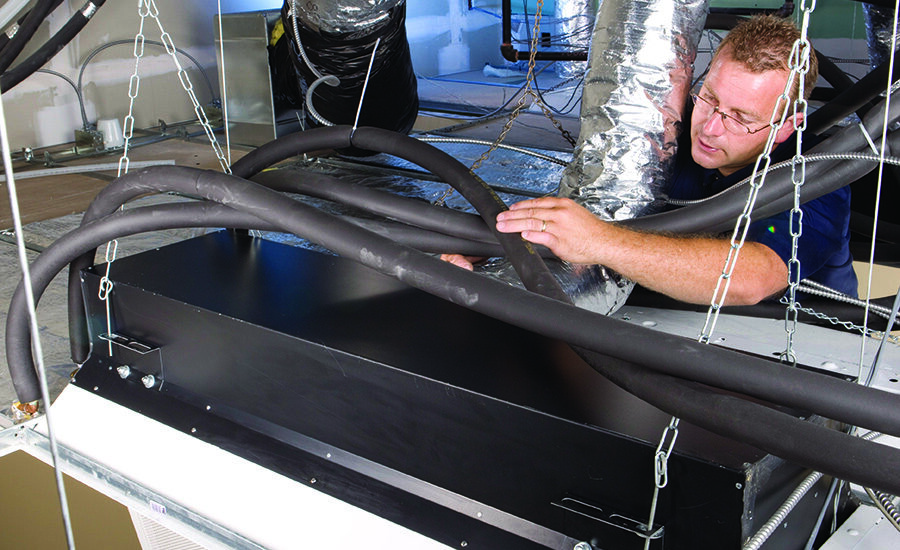
In most systems like this, 100 percent outdoor air is supplied to the chilled beam. The outdoor air passes through the beam’s induction nozzles and draws room air across the hot or chilled water coil and is introduced to the occupied space at a neutral or near-neutral (ambient indoor) temperature. Its volume can be fixed without affecting the heating or cooling capacity needed by the space. That said, the chilled beam system can be used to supplement the primary heating or cooling system.
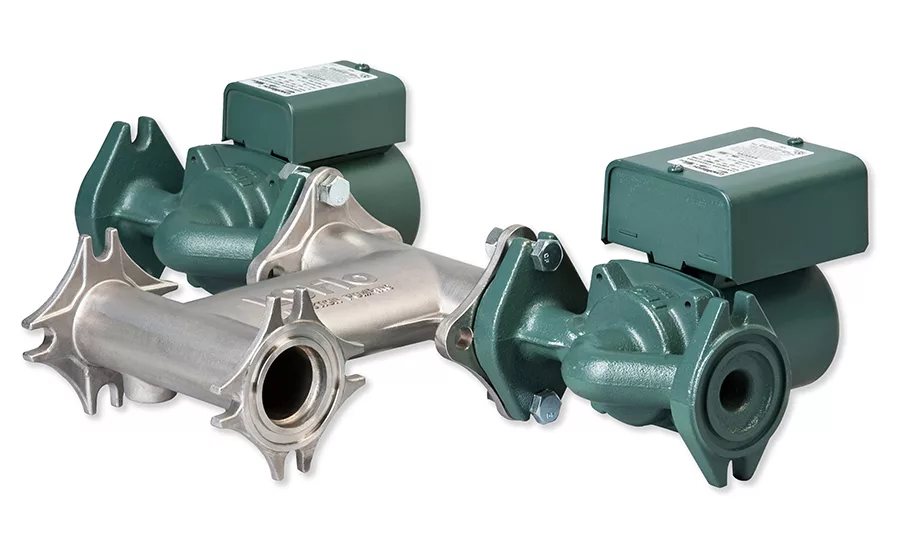
We recognize, however, that chilled beams don’t fit every hydronic application. Let’s say the building has an air handling unit with fan powered VAV boxes. In this scenario, we can place the existing pipe system in concert with our Clarity³ control system to effectively retrofit an airside system. Taco has the most advanced control components in the industry as well as all of the circulating components.
Decoupling the sensible load in a conventional hydronic system can potentially reduce fan horsepower by 90 percent. The tradeoff is generally a tiny increase in pumping horsepower. Hydronic systems also offer the ability to recover energy through the use of a run-around loop.
Even in a building with no hydronics, we have control strategies that allow engineers to interface a DOAS with the existing master controls. We’re in the process of partnering with other manufacturers to make controls for airside equipment.
Ultimately, there is no one-size-fits all solution to efficiently increasing the volume of fresh air in commercial buildings. Real solutions come from very site-specific, science based designs, and no single product holds the key to success.
Smart, holistic solutions do offer answers to challenges faced by commercial facility designers, installers, building managers and owners in light of COVID-19.
Looking for a reprint of this article?
From high-res PDFs to custom plaques, order your copy today!