READING MATERIAL
Lean expert’s framework for solving production problems
Art Smalley explains the four types of solutions that can reshape your shop
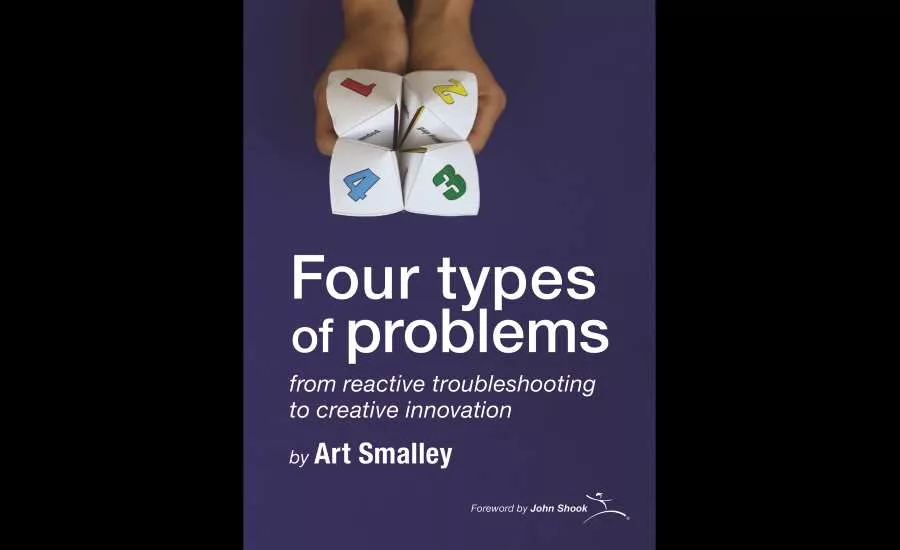
Does your business have a framework for solving problems? Lean expert Art Smalley was one of the first Americans to work for Toyota Motor Corporation in Japan. There, he learned how to problem solve and keep operations lean before he took what he learned back to the U.S.
He served as lean manufacturing director for Donnelly Corporation and later as a top lean management expert at McKinsey & Company. Now, as the founder of Art of Lean, Inc., Smalley regularly shares his learned-expertise with the masses through lectures and books like the recently released "Four Types of Problems."
“A problem I observe a lot is that teams and companies tend to apply one main approach to all types of problems. However, the issue of criticality, scarce resources, timing, and difficulty comes into play,” he explains. “Some situations require a quicker immediate response to ‘stop the bleeding’ while others require a slower, analytical methodology to determine deeper problems and root causes.”
Here, Smalley shares the four types of solutions that can help reshape your shop.
Was there a particular industry you had in mind when you were inspired to write this book?
No not in particular. I’ve used the four types of problems framework in service, health care, sports, manufacturing, and at national laboratories. It fits everywhere if you grasp the fundamental concepts in each of the four problem types – troubleshooting, gap-from-standard, kaizen or target-state, and innovation or open-ended problems.
Out of the four problem solving approaches, is there one that is stronger than the others?
Type one or troubleshooting probably is the most common in terms of frequency but not strength. What we mean by troubleshooting is that an abnormal condition or situation exists, and someone responds. If necessary, a supervisor or special first responder is involved. In other words, if the house is on fire then you first put it out. Or in the case of a medical patient: first stabilize and mitigate the immediate pain condition.
Now, the obvious problem with troubleshooting is it doesn’t always get to the root cause of what caused the fire in the first place. So that’s why we have type two or gap-from-standard problem solving, which is a more disciplined and deliberate approach for problems that either recur or are more serious in nature. If you want to think in terms of “strength” then this one generally gets the nod in that sense. This type aspires to prevent recurrence through root cause analysis of some time.
Type three is what we call kaizen or target-state problem solving. For this type you are at a stable and consistent level of operation so there is no problem, per se. For example, I’m shipping a 100 percent on-time delivery. Great, so no problem! However, I can still shorten the lead-time through the system to the customer. If you are struggling with maintaining 100 percent compliance with something, then improve the process to be simpler and easier.
Then type four is just bigger, better, and even more future-state oriented than the others. It’s commonly called innovation, or we also use the term open ended in the book. You can argue this would be the strongest of all types. It generally spans a longer time frame, involves a bigger change in the product, process, or system, or is entirely new. It starts with a clean slate and reconsiders the fundamental value proposition. Think of breakthroughs in history like penicillin or radar or the internet, etc., and you get the idea.
How does having a problem-solving framework improve continuous improvement efforts for businesses?
It goes back almost a century to the observation by American philosopher, psychologist, and educational reformer John Dewey that “a problem well-put is half-solved.” Individuals and continuous improvement teams simply can’t get traction without a clearly framed problem. Efforts get confused and muddled down as people go in different directions. Problems can be viewed through different lenses so to speak. One size does not always fit all.
So in short, continuous improvement isn’t all about the way your workers work. It also has to do with smoothing out processes within the company?
Continuous improvement should not just focus narrowly on human work. The focus should be on all aspects of a work site including people, product, and processes. We have to ask what capabilities people need to do the work and how will we go about solving problems that are bound to arise.
Does the book include a framework for how to identify if a problem is a person? And how to proceed in addressing that?
In general problem framing, we use the 5W1H framework of What, When, Where, Who, Why, and How. In a lean management system, we generally first ask the “five whys” of causal analysis and not the “five who’s” when looking for the cause of a problem. Most everyone comes to work wanting to do a good job. When their work is substandard, it’s often due to a problem with the physical process, tools, or materials involved. When it comes to the intersection with personnel it comes to the intersection of proper training, expectation setting, and sometimes work simplification. The logic of eliminate the underlying difficulty in the work (not the person), combine, rearrange, or simplify generally prevails.
Where should business leaders begin implementing these frameworks?
It really depends on the situation. What is the greatest need and how much time do you have? Where do you feel the most pain? What is the problem of the moment? What is the problem of the month? What is the problem of the year? What is the problem of the fundamental business or service? All areas are relevant, but the same exact approach does not work best in all cases.
Is it ever too late in addressing a problem to start one of the frameworks?
The "Four Types of Problems" framework is an analytical knife of sorts to make you consider different angles. Let’s take an extreme worse case example of an accident or fatality or a forest fire for example. You might be too late to prevent the problem that is currently occurring. However, in the moment we of course always seek to troubleshoot it better, get to the root cause, and most importantly think about how to prevent the same problem from occurring elsewhere. In that latter sense in particular, it is never too late.
Looking for a reprint of this article?
From high-res PDFs to custom plaques, order your copy today!