HOW TO
Five crucial tips for successful exposed ductwork installations
Many contractors overlook one simple task.
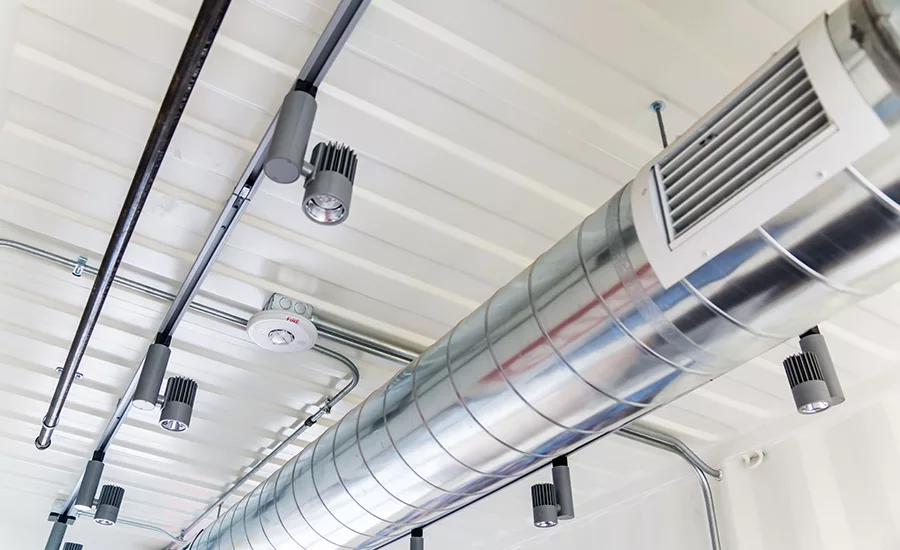
In exposed ductwork installations, a well-thought-out execution of design, fabrication and installation is crucial. Any weak link in the process could undermine the whole job and leave your clients wanting. With some help from Bob Reid at Spiral Pipe of Texas, here’s how to knock exposed ductwork projects out of the park every time.
1. Define appearance
Never settle for “make it look good” when it comes to expectations. Vagueness takes time to figure out, and time is money. Show your client photos from other jobs to give them options and to set clear expectations of what the finished product will be. “If dents and dings are not acceptable, state that in the contract documents,” Reid explains. “I often see projects where a minimum gauge is called for to prevent dents and dings, especially in athletic facilities where expected use involves lots of basketballs hitting the duct. It’s an option available to the design team in all applications, though for the sake of cost you might just want to use standard gauges and make sure everyone is just a little more careful with the duct if you don’t expect mistreatment after installation.”
2. Define features
A ductwork’s features can often affect its appearance. “It should be OK — especially on exposed duct jobs — to insist on specific features or manufacturers,” Reid says. “I confess a preference for the look of noncorrugated versus corrugated spiral duct myself, but I know plenty of people that feel just the opposite. Some duct manufacturers — round, flat-oval and rectangular — have put a lot of thought into ways to make a better looking product. If they have some features you want in your installation, call them out for your client.”
3. Define function
You can’t talk about ductwork features without talking about function. All ductwork must function properly and in accordance to construction codes. This starts with requiring the ductwork to be sealed, Reid explains. “I’ve heard, ‘You don’t have to seal it because it’s in a conditioned space’ many times from contractors that should have stuck with installing window air conditioners. They’re wrong. There is no exposed-duct exception to ASHRAE standard 90.1. It states quite specifically that ductwork and all plenums with pressure class ratings shall be constructed to seal Class A. The function of the duct system is not to simply fill the box with air; it is to place the air so that it provides comfort to the occupants. And those occupants are not sitting in the rafters.”
He adds, “As the industry moves toward more energy efficient systems, eliminating leakage — as well as proper duct design and selection of the right air-projection methods — can help achieve occupant comfort with less volume of conditioned air.”
4. Define cost
It’s important to know where to spend money now in order to save money later. Exposed duct installations can usually be completed for a little more than what a closed duct system would cost. But shipping strategies and backup plans to keep the ductwork in pristine condition before installation can cost money. Think of it as insurance, Reid explains.
“My simple rule is that the longer your field crew touches the duct, the uglier it will be. Labor-reducing features and functions performed in the controlled environment of the shop will almost always recoup far more than their cost on exposed jobs,” he says. “Select a design team that understands what it will take to get the job done right; trust their judgement and hold them accountable for designing and specifying a system that will meet the requirements of both appearance and performance. Finally, be ready to disallow lower prices from designers, fabricators and installers that do not meet the requirements.”
He adds, “Getting ugly duct is one thing. But getting duct that performs poorly will end up costing far more than any momentary savings.”
5. Define the job
Exposed ductwork job practically market themselves because they are, well, exposed. With that in mind, it is simply a good idea to let everyone connected to the job know that this is an exposed ductwork job. It’s a simple step that many contractors overlook, Reid explains.
“This may not be apparent to fabricators, especially if they’re working from your bill of materials,” he says. “I’ve seen countless installations where a supply register blows straight into the return air grille, short-circuiting 25 percent or more of the designed airflow and decreasing duct pressure to the point that downstream registers can no longer perform as designed. I see registers blowing into walls and beams because no one coordinated the layouts. Noise problems, dust problems, mold problems, condensation problems are all avoidable for someone who can visualize the operating duct system in the finished environment, but not so obvious to someone that only sees sizes on a duct calculator or just a bill of materials.”
A successful exposed duct installation requires everyone who touches the job to be on the same page — from start to finish. “I once had a job where the contractor sent a group of helpers to the job site to unload the trucks for the installation crew. When (it came time for) the installation crew to lift the duct in the air, they found long scrapes and dents running the entire length of the bottom of the duct — the side everyone would see,” says Reid. “It turned out that the unloading crew didn’t know anything about the job, didn’t see a forklift they could use, and simply dragged the duct off the back of the truck. A little information would have avoided a big problem.”
Looking for a reprint of this article?
From high-res PDFs to custom plaques, order your copy today!


