Why using spiral duct improves duct design

In 1948, research by R.G. Huebscher established flow resistance for different shapes of ductwork at equal velocities, which allowed the creation of the duct-sizing calculator or “Ductulator” for picking equivalent sizes of rectangular ducts based on the baseline round duct size.
The Ductulator is a shortcut that only works on paper if you reduce the velocity pressure to a negligible factor around 1,500 feet per minute or less in any ductwork system. At the maximum 1,500 fpm, the velocity pressure is 0.14 inches water column and can be dealt with using balancing dampers. The duct calculator works great for low-velocity designs commonly found in residential and light-commercial work.
Grab a duct calculator, read the fine print about round sizes and check out the fixed alternative rectangular sizes. Read that a 16-inch round at 201 square inches in area is equivalent to 15-by-15 inches at 225 square inches, or 20-by-12 inches at 240 square inches. Based on a 16-inch round, 15 by 15 is 10 percent larger, and 20 by 12 is 20 percent larger in cross-section area. The velocities are 10 percent and 20 percent slower, respectively. The only item that is equivalent is the friction loss per 100 feet.
At duct velocities greater than 1,800 fpm, the duct calculator will oversize the ductwork and result in higher brake horsepower motor selection. Ignoring velocity pressure above 1,800 fpm wastes money in oversizing and long-term operating costs. At 2,500 fpm, velocity pressure equals 0.39 inches, and the duct system becomes unpredictable and impossible to balance with dampers. The velocity pressure regains to static pressure on the damper blades, causing excess pressure or noise.
Calculations
Using computer calculations for the step-by-step resizing of all ductwork sections allows the total pressure formula to be accurately used in selecting the best ductwork sizes for flow efficiency and balancing. The multiple section calculations were standard engineering practice before the duct calculator was created. Multiple section calculations repeated for fine-tuning changes are called “static regain” calculations. Each change accounts for the use of the velocity pressure in the total-pressure formula to bring the system layout into balance. It is more accurate and takes more engineering work.
As computers dominate the engineering world of today, powerful computer calculations can be used to optimize the spiral duct sizes and bring the ductwork system into balance with better acoustics, lower brake horsepower and less air leakage.
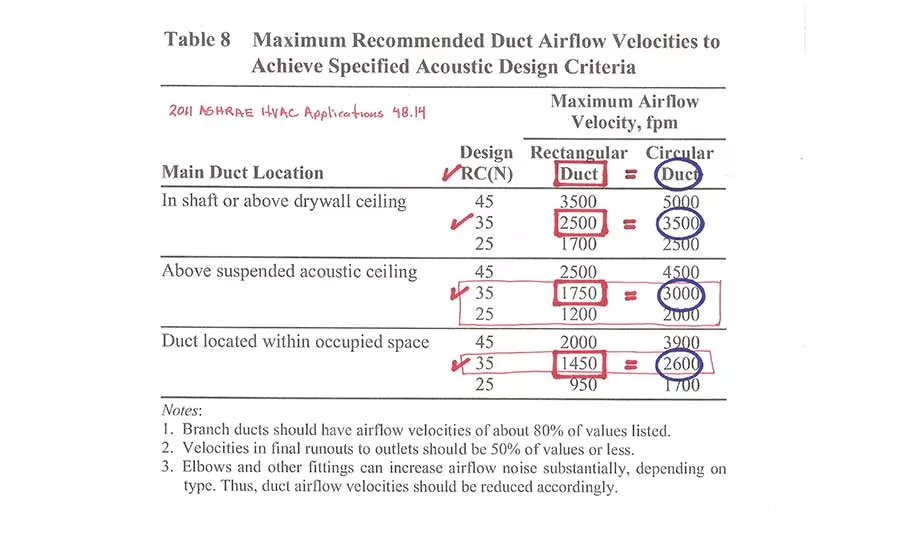
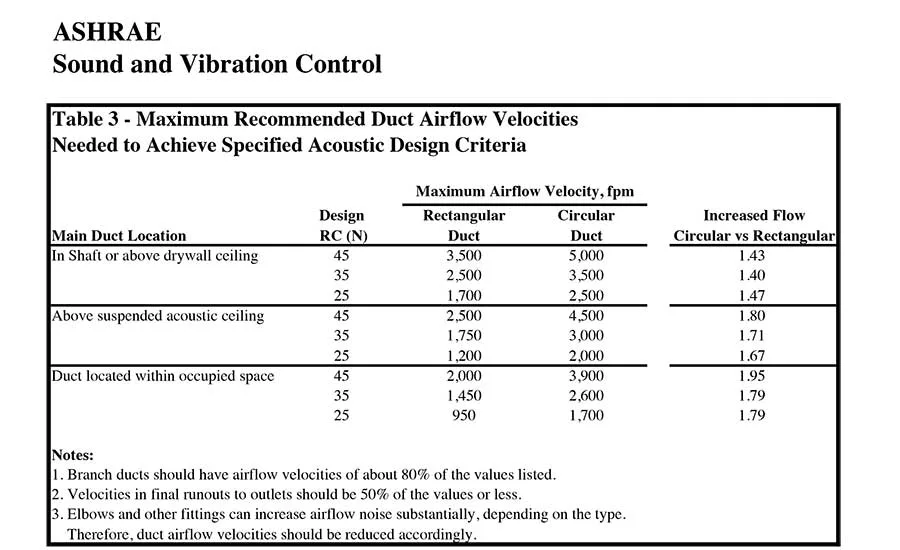
Spiral main ductwork lines can look clean and efficient. Higher velocities are assumed to be noisier in rectangular main ducts. Acoustics tables from the American Society of Heating, Refrigerating and Air-Conditioning Engineers suggest a noise criteria level of 25 (NC25) in the drywall shaft main for rectangular at 1,700 fpm.
Using that guideline, the same NC25 would be for a spiral duct velocity of 2,600 fpm in using two 48-inch main spiral rounds. The use of two 48-inch spiral mains fit the shaft better, allowing multiple spiral duct runs on the floor layouts. If space allowed, a single 56-inch spiral main at 2,600 fpm could have been used.
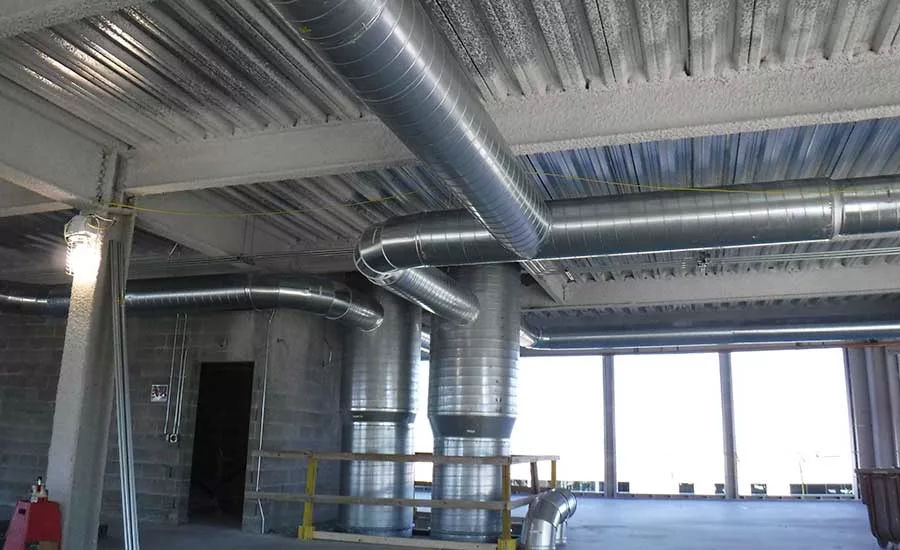
Significant cost savings can be achieved by using spiral duct. The accompanying pictures are from a LaCrosse, Wisconsin, project. The picture of the bottom-up view of the shaft shows two 48-inch spiral mains at the top. It was first engineered with an 84-by-42-inch rectangular main riser, delivering 45,000 cubic fpm air supply at 3-inch external static pressure at a velocity of 1,836 fpm. Using equal friction sizing methods, the 84-by-42 rectangular main is equal to a 66-inch round. By optimizing the main riser with computer modeling calculations, the alternate main became two spiral ducts at 48-inch round, allowing a higher main velocity, but with the optimized total pressure being reduced with the spiral ductwork system.
The contractor estimate for the 84-by-42-inch rectangular tapered main riser for five stories was 2,200 pounds/1,200 square feet at an installed cost of $16,000. The two 48-inch round mains were estimated at 1,400 pounds/900 square feet at an installed cost of $8,000. Add on the reduced 300 square feet of insulation for another $500 savings. The rectangular duct, fabricated to Sheet Metal and Air-Conditioning Contractors’ National Association duct standards, used 20-22 gauge materials with TDC/TDF connectors and the spiral lock-seam SMACNA standard was 22-24 gauge. The gauge change alone saves 10 percent in pounds of material. Spiral lock-seam requires no sealing. Spiral leaks far less than rectangular and is code-exempt from sealing requirements under ASHRAE’s 90.1, which covers energy use for low-rise residential buildings.
Computer modeling made the cost savings and lower total pressure easy to find in the design. Using VariTrane duct design software, the entire supply ductwork layout to the variable-air-volume boxes was rearranged with excellent results using spiral lock-seam round. The 55,000-square-foot floor area had rectangular duct distribution to the VAVs, totaling 28,600 pounds of rectangular, which was replaced by 19,400 pounds of spiral lock-seam ductwork. Estimates vary across the country depending on labor rates, but the national average is a 35 percent reduction in installed cost using optimized spiral versus the traditional rectangular. The round duct was sized by computerized calculations, and the rectangular was sized by the traditional equal friction.
The total pressure of the system was reduced by 10 percent using optimized spiral, and the acoustics were improved by using round shapes. The long-term fan operating cost was reduced by an estimated 30 percent using the fan laws for brake horsepower and reduced leakage from using spiral lock-seam.
Computer modeling adapts well to cumbersome engineering required for accurate duct-sizing work. The laws of physics dictate that total pressure is the sum of velocity pressure plus static pressure — typically written as “TP=Vp + SP” — in any section of ductwork with positive airflow. Give Swiss mathematician Daniel Bernoulli the credit for the formula. All ductwork calculation formulas are done with round shapes as the hydraulic diameter, and the alternate rectangular size is proportional to the wetted perimeter of flat surfaces as tested in 1948.
Looking for a reprint of this article?
From high-res PDFs to custom plaques, order your copy today!