WELDING
Tips for Welding Thin Gauge Sheet Metal
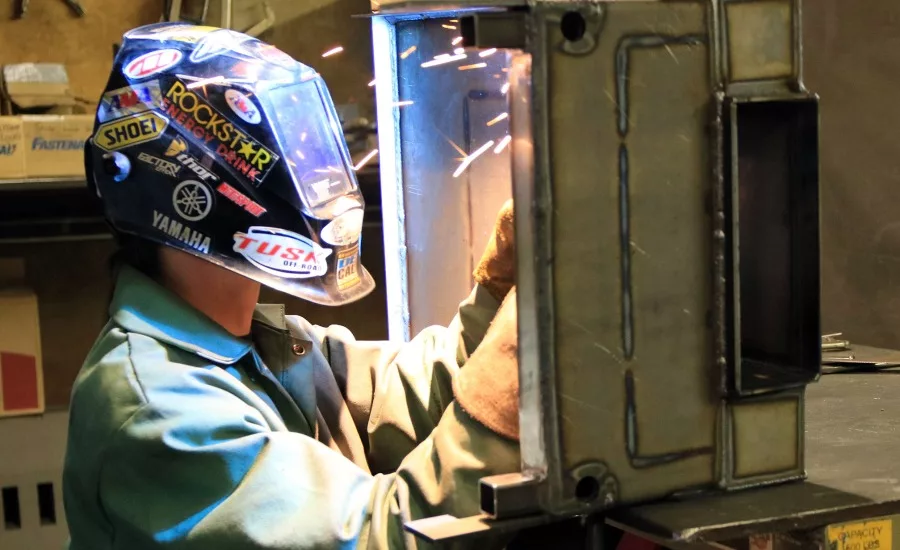
Welding thin sheet metal can be challenging because you need to obtain adequate fusion while preventing distortion and burnthrough. The key skill is to control the heat across the sheet metal to prevent defects. This guide explains some of the ways to help get the best results when welding thin sheet metal.
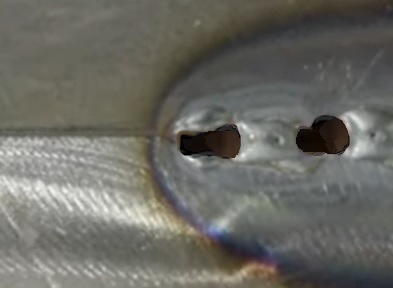
Burnthrough weld
Welding Process
You will need to choose a welding process that allows you to control the heat. The best processes for this are MIG and TIG. It is possible to stick weld on thin sheet metal, but it’s harder to control the heat, it’s messy and it’s hard to master.
Some welding machines also allow for pulsed MIG or TIG. Pulse welding is an advanced variation of MIG and TIG which produces neat welds and helps to avoid welding defects. It is a process where the current fluctuates from low to high instead of a consistent flow. This allows for smooth ripple in the weld bead, faster travel speed and reduced heat input. This reduced heat input can help decrease the risk of distortion.
Skip Welding Technique
When welding thin sheet metal, do not try to run one bead right across the joint. This will cause too much heat to build up. Instead, run a series of short welds at different points in the metal that eventually join together. Leave the metal to cool for a second or two between welds to help the heat dissipate.
Always travel the torch in a straight line at the fastest speed possible that allows for penetration. Don’t weave the torch or move too slowly because it will cause heat to build up. Pushing a torch over pulling will also point the gun at the cooler edge of the weld puddle to help prevent excess heat build up. Keep the arc length and voltage as low as possible. You can always increase the amps slightly if you need more penetration.
Tack Welding Technique
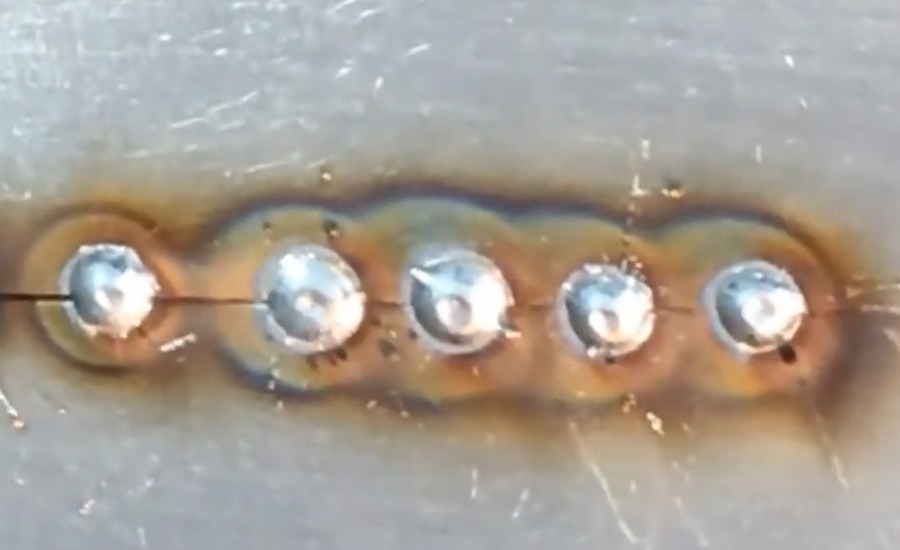
Tack weld
If you are butt welding thin sheet metal, there is a very fine line between adequate penetration and burning holes or distortion. Using a series of tack welds is another common way to keep a low heat and minimize risk of distortion.
You will need to have the two pieces of metal closely butted together, typically around 1mm apart to help avoid burning holes. Then create a small tack weld on the joint, and repeat with a series of tack welds until you have covered the whole joint, with the welds slightly overlapping. Let the metal cool for about half a second between welds. The longer you leave it the less chance you’ll have of burn-through. Weld different sections at a time to prevent heat build up.
If you get too much metal build up, do not grind this down until you have finished otherwise you may grind away too much metal and end up burning through.
MIG Wire
Use the smallest wire diameter possible whilst still ensuring adequate deposition. 0.023 should be fine unless you’re welding 18 gauge or thicker in which case you may need to go up to 0.030. Smaller wire will transfer less heat to the metal because it requires less heat to melt.
TIG Electrode
Use a small electrode less than ⅛ inch. Never use a rod that is thicker than the thickness of the metal. Smaller electrodes perform better at lower amperage and will help prevent burn-through. Grind your electrode to a fine point to run a tight arc.
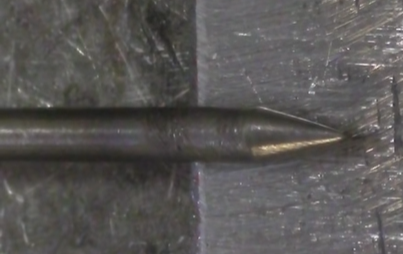
Sharpened tungsten electrode
Backing bars
To help dissipate heat faster you can clamp a backing bar to the work metal. This metal backing bar will usually be made from copper or aluminum and will draw heat out of the work metal to help prevent warping or burn through. Copper melts at a much higher temperature than steel so the weld won’t stick to the copper and you can simply unclamp it after you’ve finished welding. Ensure the backing bar is tight against the work metal and has maximum contact to ensure heat is transferred.
Shielding gas
Use a high-argon based shielding gas such as 75% argon/25% CO2. This is preferable to pure CO2 because argon provides less heat. If you are TIG welding or MIG welding aluminum you will need to use 100% argon shielding gas.
And finally the best thing to do is just keep practicing. It can take a while to get the hang of welding thin sheet without distortion but follow these tips and play around and you’ll soon be getting great results.
Looking for a reprint of this article?
From high-res PDFs to custom plaques, order your copy today!