Fuel Cells May Reshape Home Hvac

A quiet, environmentally friendly energy source not much larger than many home air conditioning condensing units might hold the key to reducing the inconveniences many U.S. consumers experience in summertime and its higher electricity consumption, related largely to air conditioning use. However, this new technology’s reliance on natural gas, now zooming upward in price, may lessen its attraction in many cases.
Dozens of companies seem to be rushing to develop and prove the feasibility of fuel cells in applications ranging from power for your vehicle to basic home energy plants, and in larger applications, for community or regional power-generating stations.
Fuel cells have been used in the U.S. space program since 1965. They convert hydrogen and oxygen into direct current (dc) electricity, heat, and water. The electricity production works in reverse of a popular high school science demonstration, in which battery power separates hydrogen from oxygen contained in water.
A reformer or fuel processor ahead of the fuel cell itself produces the hydrogen from natural gas, propane, methanol, and possibly other sources. The heat produced as a byproduct can be used to heat domestic hot water.
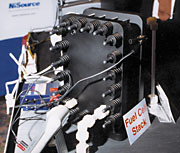
Residential Projects
Home-size fuel cells are being built and installed this year in prototype or demonstration sites in the Midwest and in Oregon. One has been in operation for more than a year in upstate New York.In London, England, Johnson Matthey Plc is working with TXU Europe and Energy Partners on a residential fuel cell project. The project is partly supported by the United Kingdom Department of Trade and Industry fuel cell program. After an 18-month evaluation phase, the partners plan large-scale demonstration programs in Europe and the United States.
“Fuel cells have the potential to provide clean, lower-cost electricity, heating and air conditioning for our homes and offices while dramatically reducing emissions of carbon dioxide,” stated U.K. Trade Department executive director Neil Carson.
(TXU Europe is a unit of U.S. power company TXU Corp.; Energy Partners is a leading developer of polymer electrolyte membrane — PEM — fuel cell systems.)
Fuel cells offer a basic source of home electricity needs independent of the power grid, but may be hooked into the grid as a backup or peak-need source of electricity.
Looking for quick answers on air conditioning, heating and refrigeration topics? Try Ask ACHR NEWS, our new smart AI search tool. Ask ACHR NEWS
ACR Bonuses
Their widespread use could put an end to regional power crises including air conditioning cutoffs or computer crashes, but could also change the concept of power generating units and grids as they exist now.The home-sized units could also lessen the threat of storm-related power blackouts. Since most fuel cells rely on natural gas or propane, a thunderstorm wouldn’t normally disrupt those sources. They would also conceivably keep air conditioning compressors and fans, refrigerators, and freezers operating more efficiently with a more consistent power flow.
Yet another fuel cell plus is providing electricity to rural or remote homes and other sites where stringing wire from the nearest utility is too expensive. That could mean all the comforts of city homes, such as hvac systems, as long as the occasional delivery of propane or methanol can get through, without the noise of a typical engine-powered generator.

Size and Price
Fuel cells such as the home units being installed and demonstrated this year may reach commercial-level production in a few years, at prices now estimated at $3,000 upward.Size may be a price factor.
- The Johnson Matthey “micro CHP” project focuses on producing 3 kW of electrical power as well as useable heat.
- IdaTech (Bend, OR) is building and delivering prototypes to Bonneville Power Administration in the 6-kW range of total energy production, half of that in electricity and half in generated thermal output.
- BG Plc, a British gas company, is working on a smaller microgenerator producing between 500 and 1,000 W, designed to replace a traditional household boiler and produce some of its electrical needs. The BG “MicroGen” unit is seen as producing up to 50% of an average British home’s power needs, a connection to the power grid providing the rest.
- MOSAIC Energy LLC is installing a prototype fuel cell in a new Indiana home that has a gross electrical capacity of 3 kW, according to Roger Gyger, general manager.
(MOSAIC is a joint venture of EnergyUSA, a NiSource Inc. subsidiary, and ENDESCO, a for-profit subsidiary of the Institute of Gas Technology. Prior to his present post at MOSAIC Energy, Gyger was running both the fuel cell and microturbine programs for NiSource.)
- Ballard Generation Systems, a subsidiary of Ballard Power Systems, Vancouver, BC, Canada, has signed an agreement with Tokyo Gas and other entities to develop a natural gas fuel processor for a 1-kW fuel cell power generator aimed at the Japanese residential market. The unit will provide electric power for Japanese homes and apartments, as well as heat for space heating and hot water.
(Fuel cell development seems to have international appeal. Ballard Generation Systems is owned by Ballard Power Systems, GPU International Inc. of New Jersey, ALSTOM SA of France, and Ebara Corp. of Japan.)
Product Predictions
MOSAIC envisions making the first number of commercial units in mid 2002. Gyger says that level of commercial production means thousand-lot quantities. “A year from when we start commercial production — we’re into 2003 now — our target cost for the unit, installed, is about $3,000.” Gyger says such a capital cost, given electricity and natural gas costs at the time of this writing, could mean a five-year payback through combined electricity and heat savings.David Edlund, IdaTech vice president of technology, thinks that price estimate is unrealistically low. “I would expect that in a relatively mature setting, five to seven years out, the cost will be in the $8,000 to $10,000 range.”
IdaTech has already put its prototype fuel cell units into some homes. Permanent installations at several homes in Bend is to take place this summer. Edlund’s own home is one of those sites.
Another player in the emerging fuel cell market is Plug Power Inc., a three-year-old company based in Latham, NY. Plug Power and GE MicroGen announced earlier this year a development agreement with John Vaillant GmbH u. Co. of Remscheid, Germany, a European heating appliance maker.
The agreement is for a combination furnace, hot water heater, and fuel cell system to provide both heat and electricity for homes, with an 80% fuel utilization efficiency. Plug Power is committed to developing and manufacturing fuel cell systems for residential, small business and automotive applications. The company is owned 32.5% by each of its founders, Mechanical Technology and DTE Energy. GE owns a 12.4% stake, and Southern California Gas Co., a unit of Sempra Energy, also owns part of the company.
In June 1998, Plug Power demonstrated its proprietary Plug Power 7000, now named the HomeGen 7000, a 7-kW residential power system at an upstate New York three-bedroom home. The system ran on a regular basis, marking the first time the electricity needs of a home have been provided by a fuel cell, according to Plug Power statements. The upgraded system includes the fuel cell stack, a power conditioner, and a natural gas fuel processor.
Fuel cells’ impact on home comfort systems may become substantial. They can power air conditioning systems, cover domestic hot water needs, and provide much (if not all) of home heating requirements.
Sidebar: Fuel Cells As Energy Producers
As electrical generators, fuel cells are about as efficient as other forms of modern power generation, but with proper use of the heat, they become highly efficient total energy producers.David Edlund, IdaTech, says fuel cells such as his company’s PEM unit could be biased towards more thermal output by capturing thermal output from the fuel processor, the unit that converts natural gas or other typical fuel sources before the hydrogen meets up with oxygen in the fuel cell itself.
Besides, he told The News, the fuel cell system produces very high-quality water, better than the domestic water supply in many cities, including Bend. But capturing or using that water may not be feasible. “On a daily basis, about five to 10 gallons is produced,” he says. “You can recover that water, but at a cost, so the question has to be asked, how much is water worth?”
The systems IdaTech is building and delivering to BPA are prototypes, not commercial models. “Where we think these are headed, at least for residential applications, is toward combined heating and electrical-generating appliances.” The fuel cell system’s heat, captured in the form of hot water at about 110° to 120°F, would be sufficient to provide residential hot water or possibly heated water for space heating.
MOSAIC’s prototype residential fuel cell package would produce a base-load home electrical system, relying on outside power sources (such as the electrical grid) for peak power needs.
“The average single-family home in the U.S. uses about 1.7 kW over the course of the whole year,” Gyger notes. He says the size of his company’s unit eventually may be smaller or larger in capacity than the 3-kW prototype, but not much.
Sidebar: Maintenance Schedules
No matter what the cost, fuel cells will require some regular upkeep. Edlund says that would entail periodic filter changeout and maintenance for pump and fans, “no more frequently than once a year,” but the field tests will demonstrate and verify the maintenance schedules.Publication date: 08/28/2000
Looking for a reprint of this article?
From high-res PDFs to custom plaques, order your copy today!


