Frost on an evaporator coil will prevent the correct amount of airflow across the coil. Anytime the evaporator coil experiences reduced airflow across its face, there will be a reduced heat load on the coil.
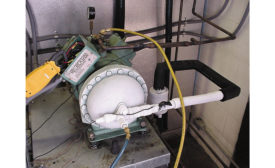
When dealing with refrigeration or air conditioning compressors that employ an oil pump, many service technicians confuse net oil pressure with oil pump discharge pressure.
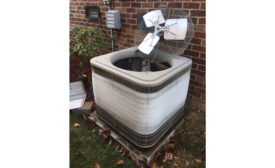
Many air conditioning and refrigeration systems have their condensing units located outdoors for two main reasons. First, this takes advantage of the cooler outdoor ambient temperatures to reject the heat absorbed in the evaporator section, and second, to reduce noise pollution.
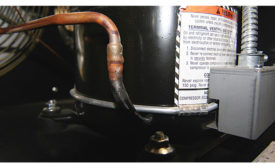
Service technicians will often experience frost on a suction line or on the compressor in some refrigeration applications. Thinking that liquid refrigerant must be present because there is frost is a fallacy in most cases.
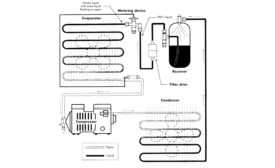
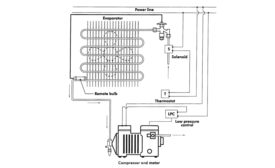
Refrigeration systems are made up of major components in series with one another (see Figure 1). As most of us are well aware, the major components are the compressor, discharge line, condenser, liquid line, metering device, evaporator, and suction line.
Under normal conditions, there will always be a small amount of oil that escapes a compressor’s crankcase and is circulated with the refrigerant throughout the system. It is for this reason that refrigerant oil and the refrigerant itself must be soluble in one another. It is the velocity of the circulated refrigerant that carries the oil back to the compressor’s crankcase. If the two were not soluble in one another, this phenomenon could not happen.
Refrigeration service technicians often run service calls in which they find a compressor with a higher-than-normal suction pressure along with a lower-than-normal head pressure. Many times, the refrigeration equipment is still running, but the product temperature is too warm, which causes product quality and safety to suffer.
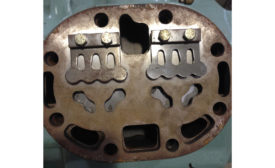
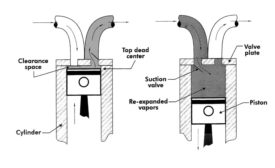
The capacity of a compressor can be affected by a refrigeration system’s ever-changing pressures. In addition, suction pressure entering the compressor will change the density of the suction gasses within the compressor and affect its capacity.