No technology has stirred up more attention in recent years than use of carbon dioxide (CO2) as a refrigerant in both stationary and mobile HVACR applications. And yet the technology has more people head scratching over it in terms of dealing with the pressures, efficiencies, installation costs, and servicing skills.
Whether or not HCs become major refrigerant players in the U.S. depends on who you talk to. Advocates point to extremely lower global warming potential, low cost, and a proven track record in Europe and Asia. Others see the flammability issue, A3 safety rating, and current building and fire codes limiting use to smaller applications.
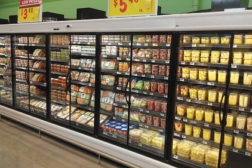
Every time I walk through a supermarket I take a look at the refrigeration and freezer cases. I want to see how well they are holding the temperature they should be holding. But from time to time, I realize that aspect of refrigeration is but a small part of how important it is to keep cold things cold.
In late 2010, Sprouts Farmers Market set out to meet the EPA’s most stringent GreenChill standards with construction of its Thousand Oaks, Calif., store. Sprouts tapped Hill Phoenix to design a refrigeration system that not only would be environmentally friendly, but also energy efficient and cost effective to install and maintain.
The ongoing approval process to bring online an innovative approach to dealing with refrigerants that have reached the end of their useful life has taken another step forward.
While the word “refrigerant” isn’t normally the first thing one thinks of when Thailand is mentioned (can you say “Pad Thai” or “Tom Yum soup”?), interestingly the two intersected at an event.
When mechanical refrigeration came along, refrigerants such as sulfur dioxide and ammonia and the fluorocarbons were introduced. The latter two — ammonia and f-gases — are still being used. Of the fluorocarbons, the choices were pretty simple: CFCs -11, -12, and -502. It is not so simple these days.
Trying to go green — or even stay green — in tough economic times is a challenge. This became especially apparent to me during the month of September when I traveled to a couple of quite diverse industry events.
The ability of a wholesaler to grow a business and gain market share requires a multi-dimensional strategic plan that encompasses generating, managing, and sustaining growth.
Photos from the 2013 ACCA Conference & IE3 Expo in Orlando, Fla.
Podcasts
Cade Clark, assistant vice president of government affairs for the Air-Conditioning, Heating & Refrigeration Institute (AHRI), gives a brief overview of the new version of the Shaheen-Portman bill, what AHRI thinks of the energy-efficiency legislation, and how it might affect the HVACR industry if it becomes law.
With access to over one million professionals and more than 60 industry-specific publications, Clear Seas Research offers relevant insights from those who know your industry best. Let us customize a market research solution that exceeds your marketing goals.
DON'T MISS A THING
Register today for complete access to ACHRNews.com. Get full access to the latest features, Extra Edition, and more.