ACHR News
search
Ask ACHR NEWS AI
cart
facebook twitter instagram linkedin youtube
  • Sign In
  • Subscribe
  • Sign Out
  • My Account
ACHR News
  • NEWS
    • Breaking News
    • New HVAC Products
    • Featured Products
    • Manufacturer Reports
    • HVAC Data
    • Legislation
    • ACHR NEWS Centennial
  • RESIDENTIAL
    • Air Conditioners
    • Furnaces
    • Residential Heat Pumps
    • Ductless
    • Residential IAQ
    • Testing, Monitoring, Tools
    • Components & Accessories
  • COMMERCIAL
    • Air Handlers
    • Rooftop Units
    • Chillers and Cooling Towers
    • Commercial Heat Pumps
    • Boilers and Hydronics
    • VRF/Ductless
    • Commercial IAQ
  • REFRIGERATION
    • Refrigerants
    • Refrigerant Regulations
    • Leak Management
  • CONTRACTOR PRO
    • Geothermal
    • Homeowner Study
    • VRF and VRV Ductless
    • Unitary Trends
  • EDUCATION
    • Training and Education
    • Business Management
    • Service and Maintenance
    • Continuing Education
    • Market Research >
      • HVAC Brand Awareness Report
      • VRV, VRF, VRVZ Report
      • Unitary Trends Report
      • Water Heat Professionals Report
    • Webinars
    • Sponsor Insights
    • eProducts Info
    • White Papers
  • EVENTS
    • HVAC Contractor Forum
    • Industry Events and Webinars
  • MEDIA
    • Videos
    • AHR Expo 2025 Videos
    • Podcasts >
      • ACHR News Podcast
      • HARDI Podcasts
      • AHR Expo Podcasts
      • ACCA Podcasts
    • Interactive Spotlights
    • Quizzes
    • eBooks
    • HVAC Talkback
  • HVAC GROUP
    • ACHR NEWS >
      • Current Issue
      • Digital Edition
      • Subscribe
    • Distribution Trends
    • SNIPS NEWS >
      • Join SNIPS NEWS
    • Engineered Systems News >
      • Join ES News
    • HVACR Directory
    • Contests
    • Newsletters
    • Contact
    • Advertise
    • My Account

Selecting the Right Fan Disconnect Switch

By Greg Mazurkiewicz
July 27, 2001
Disconnect switches, mounted directly to the fan or remotely, are a recommended and necessary safety feature for every fan. According to Kendall Gullo, application engineer in the Fan and Ventilation Department of Greenheck, Schofield, WI, “Disconnect switches provide the best protection against accidental start-up during service or inspection.”

The switches are offered in a variety of shapes and sizes, and are classified under several different NEMA (National Electrical Manu-facturers Association) ratings. For design-build contractors, said Gullo, “Understanding the similarities and differences in disconnect switches will offer dollar savings to the contractor and his customers.”

The most common types are toggle and heavy-duty disconnects. Toggle switches are flipped on and off like a light switch, having a pushbutton or rotary-type handle, noted Gullo. Heavy-duty switches have a flip-arm knife-blade design. The switch may be visible or enclosed in a housing.

“The first decision is what type of enclosure you want,” he said. The enclosure selected depends upon the application, “whether the fan is being mounted outdoors or indoors, or if it’s a hazardous location.” Ratings range from NEMA 1 through 12 and are based on the enclosure’s ability to protect against moisture, dust, corrosion, or explosion.


NonHazardous Enclosures

The following are NEMA enclosures for nonhazardous locations.
  • NEMA 1: Constructed for indoor use to protect personnel against incidental contact with the enclosed equipment and to protect against falling dust.
  • NEMA 3R: Constructed for indoor or outdoor use to protect personnel against incidental contact with the enclosed equipment; to protect against falling dirt, rain, sleet, snow, and windblown dust; and to withstand external formation of ice.
  • NEMA 4: Constructed for indoor or outdoor use to protect personnel against incidental contact with the enclosed equipment; to protect against falling dirt, rain, sleet, snow, windblown dust, splashing water, and hose-directed water; and withstand external formation of ice.
  • NEMA 4X: This enclosure provides the same protection as NEMA 4, but also includes corrosion protection.
  • NEMA 12: This is a heavy-duty enclosure for indoor use designed to protect personnel against incidental contact with the enclosed equipment; to protect against falling dust, circulation dust, lint, fibers, and flyings; and also to protect against dripping and light splashing of liquids.


  • NEMA 3R disconnect.

    Hazardous Enclosures

    The following NEMA enclosures are for use in hazardous environments. Most of these environments require an explosion-resistant enclosure.

    “Explosion-resistant enclosures are designed to contain an explosion, not prevent one,” explained Gullo. They are constructed of cast iron or aluminum and provide limited access, making them undesirable as control system enclosures.

  • NEMA 7: Explosion-resistant; not weatherproof. Intended for indoor use in Class I, Groups A, B, C, or D hazardous locations as defined in the National Electrical Code (NEC). It is capable of withstanding pressures from an internal explosion of specified gases and contain it so that an explosive gas-air mixture in the atmosphere surrounding the enclosure will not be ignited.
  • Enclosed heat-generating devices must not cause external surfaces to reach temperatures capable of igniting explosive gas-air mixtures in the surrounding atmosphere.

  • NEMA 9: Not weatherproof; for Class II, Group E, F, or G hazardous locations. Intended for indoor use and capable of preventing the entrance of dust. Enclosed heat-generating devices must not cause external surfaces to reach temperatures capable of igniting or discoloring dust on the enclosure, or igniting dust-air mixtures in the surrounding atmosphere.
  • The hazardous class, division, and group specifications of these enclosures are designated by the NEC, Gullo said. The following are explanations of different class and division ratings.

    Class I, Division 1 indicates that the disconnect can be operated in locations where flammable gases or vapors are, or may be, present under normal conditions, and which may ignite, explode, or cause failure of electrical equipment. These locations are called “normally hazardous.”

    Looking for quick answers on air conditioning, heating and refrigeration topics? Try Ask ACHR NEWS, our new smart AI search tool. Ask ACHR NEWS →

    Class I, Division 2 indicates disconnects that are “not normally hazardous” because, unlike Division 1, they are normally contained within closed containers or a closed system, or are adjacent to Class I, Division 1 areas.

    Class II, Division 1 covers locations where combustible dust is, or could be, present in the air under normal operating conditions sufficient to produce explosive or ignitable mixtures, or interfere with the normal operation of electrical equipment.

    Class II, Division 2 covers locations where combustible dust is not normally present in the air in sufficient quantities to produce explosive or ignitable mixtures, and the dust is normally insufficient to interfere with the normal operation of electrical equipment.
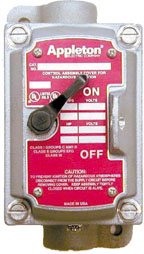


    NEMA 9 disconnect switch.

    Mounting Locations

    The mounting location of a fan-mounted disconnect switch depends on its enclosure and the fan type. Locations, wiring terminology, etc., vary by manufacturer, pointed out Gullo, so for the purposes of an explanation, he described his company’s approach.

    In most cases for involving a NEMA 1 switch, the disconnect will be interior mounted on the fan in the following locations.

  • Centrifugal roof fan: on the support pan;
  • Hooded propeller roof fan: on the fan base next to the access door;
  • Sidewall propeller fan:
  • a. With wall housing — on inside of wall housing;

    b. Without housing — on the fan panel (also when a wall collar is used).

    For NEMA 3R, 4, 4X, and 12 switches, the disconnect will be mounted on the exterior in the following locations.

  • Centrifugal roof fan: on the windband;
  • Hooded propeller roof fan; on the fan base;
  • Sidewall propeller fan:
  • a. On the wall housing —special consideration; wall housing will not pass through the wall opening;

    b. On the wall collar — special consideration; wall collar will not pass through the wall opening;

    c. On the wall fan panel if no housing or collar is present.

    For NEMA 7 and 9 switches, the disconnects are typically hard-piped and mounted next to the motor. On occasion, the location of the fan may not allow the typical mounting for the disconnect switch. In that case, the switch will be mounted in a different area “to avoid interference problems, such as with water piping or other ductwork,” Gullo said.

    Also, a disconnect may be mounted remotely as needed to suit the particular application.


    NEMA 12 heavy-duty switch.

    Wiring Terminology

    When ordering disconnects, it is helpful to understand the wiring terminology, for example, loose; mounted and wired; or mounted, wired, and connected. If requested loose, the disconnect will not be mounted on the fan and the wiring will not be connected.

    Mounted and wired means the disconnect will be mounted on the unit and the wiring will be connected from the motor to the disconnect box. The wires at the disconnect will not be connected to the load side of the switch. The switch is shipped loose to allow external wiring to be connected in the disconnect enclosure without having to remove the switch. This is the standard method of wiring.

    Mounted, wired, and connected applies when an extended wiring pigtail is specified. This means the disconnect will be mounted on the unit, the wiring will be run from the motor to the disconnect, and the wire will be connected to the load side of the switch. The pigtail is also connected to the supply side of the switch.

    For explosion-proof switches, “Wiring is typically done in the field,” noted Gullo, “because codes vary from site to site.”


    Greenheck's CUBE upblast roof fan is shown with an exterior-mounted and factory-wired disconnect.

    Disconnect Characteristics

    In addition to enclosure, switch type, and mounting style, disconnect switches are also selected by several electrical/mechanical characteristics.

  • Speed: Switches are selected to match the number of speeds of the fan motor.
  • Phase: Disconnects are categorized like motors, either single or three phase, and are selected to match the fan motor.
  • Voltage: Disconnects may be single or two speed with high or low voltages. High-voltage ratings for single-phase applications are 208, 220, 230, 240, and 277. Low-voltage ratings are 110, 115, 120, and 127. Three-phase high voltages are 380, 400, 460, and 575. Low voltages are 190, 200, 208, 220, 230, and 240.
  • Overload: Thermal and fused overloads are available as safety features.
  • Horsepower: There are maximum and minimum horsepower designations. The horsepower must fall between these values. The proper disconnect depends on the fan motor’s horsepower.


  • One-Point Wiring

    A convenient, time-saving option is one-point wiring, explained Gullo.

    “By factory-wiring the damper actuator, fan motor, and damper end switch to a single point, the installation of propeller fans is made faster and easier for the contractor.”

    This option is available with NEMA 1 and 3R disconnects. If you need to use a different disconnect, consult the fan manufacturer.

    For more information, Gullo can be reached at 715-355-2216; kendall.gullo@greenheck.com (e-mail).

    Publication date: 07/30/2001

    Share This Story

    Looking for a reprint of this article?
    From high-res PDFs to custom plaques, order your copy today!


    Greg Mazurkiewicz is Web Editor. He can be contacted at 248-244-6459 or gregmazurkiewicz@achrnews.com. Greg handles the day-to-day operations of The NEWS' website, www.achrnews.com, including the Extra Edition page, which offers additional online-exclusive articles. He has 40 years of experience as a writer and editor. He holds a bachelor's degree in Journalism and a master's degree in Business Management.

    Recommended Content

    JOIN TODAY
    To unlock your recommendations.

    Already have an account? Sign In

    • HVAC-enrollment

      The Trades Are Back: HVACR Programs See Nearly 30% Enrollment Spike

      A new wave of future technicians is entering the pipeline.  
      News
      By: Matt Jachman
    • 2025 Top 40 Under 40

      2025 Top 40 Under 40 HVACR Professionals List

      The 11th annual Top 40 Under 40 list highlights those...
      News
      By: Hannah Belloli-Oster
    • LG Ductless Mini-Split Systems

      The 9 Types of Heat Pumps

      As the U.S. moves toward electrification, heat pumps are...
      HVAC Residential Market
      By: Joanna R. Turpin
    Subscription Center
    • Create an Account
    • Start a Subscription
    • Manage My Account
    • Sign Up for Newsletters
    • Visit Customer Service
    • Update Preferences

    More Videos

    Sponsored Content

    Sponsored Content is a special paid section where industry companies provide high quality, objective, non-commercial content around topics of interest to The News audience. All Sponsored Content is supplied by the advertising company and any opinions expressed in this article are those of the author and not necessarily reflect the views of The News or its parent company, BNP Media. Interested in participating in our Sponsored Content section? Contact your local rep!

    close
    • Piggy Bank
      Sponsored byWatercress Financial

      Energy Prices, Inflation, and HVAC: What Today’s Homeowners Care About

    • Refrigerated Food
      Sponsored bySolstice Advanced Materials

      R-455A Refrigeration: A Cold Storage Solution for the Future

    • Airex Rooftop Units
      Sponsored byAirex Manufacturing Inc

      Consolidating Roof Penetrations: A Growing Trend in Multifamily HVAC Design

    Popular Stories

    HVAC-Price-Increase-graphic

    HVAC Price Increase List: June 2026

    Trump-Section-232.jpg

    Trump Reduces Section 232 Tariffs on HVAC Equipment to 15%

    R410A-Refrigerant-Cylinder.jpg

    Refrigerant Recovery is a Revenue Opportunity

    Heat-pump-cutaway.jpg

    PFAS Rules and A2L Building Codes Continue to Evolve

    Kroger.jpg

    Kroger to Spend $100 Million to Reduce Refrigerant Leaks

    View The ACHR NEWS
    Centennial Anniversary Timeline

    The ACHR News Timeline Chart
    Submit a Letter
    Submit a letter to our editors.

    Events

    November 6, 2025

    Next-Gen Data Center Cooling: HVAC Innovation and Real-World Solutions

    On Demand As AI workloads and high-density computing push traditional cooling methods to their limits, the data center industry is accelerating the adoption of next-generation HVAC technologies.

    June 9, 2026

    Before You Go All In on AI: Set Up Your Business to Actually Win

    In this webinar, we'll walk you through exactly what to get in place before you add AI to your business. You'll leave with a clear picture of where you stand today and a practical action plan to set yourself up for real results.

    View All Submit An Event

    Poll

    Summer Staff

    Are you fully staffed for the summer season?
    View Results Poll Archive

    Products

    BNI Mechanical/Electrical Square Foot Costbook, 2026 Edition

    BNI Mechanical/Electrical Square Foot Costbook, 2026 Edition

    See More Products
    A2L Refrigerants - Free Webinar - May 21, 2026

    Related Articles

    • Tips On Selecting The Right Software

      See More
    • Marchese Compressor Photo

      Selecting the Right Stub Connection for Replacement Compressors

      See More
    • Single Steam Pressure

      Selecting the Right Steam Control Mechanism

      See More

    Related Products

    See More Products
    • fanfelaysdvd.jpg

      Understanding Fan Relays and Multiple Speed Motors

    • The ACHR News - November 17, 2025

      ACHR NEWS November 17, 2025, Issue

    See More Products

    Related Directories

    • ZOO Fans

      Destratification fans for open ceilings and drop ceilings, HVLS fans, Garage transfer fans. ZOO Fans save energy and increase comfort for efficiency and performance.
    ×

    Sign Up. Stay Informed.

    The #1 trusted source for the HVACR industry since 1926

    SUBSCRIBE
    • RESOURCES
      • Advertise
      • Contact Us
      • Advisory Board
      • Classifieds
      • Submit a Letter
      • Directories
      • Store
    • ACCOUNT CENTER
      • Create an Account
      • Start a Subscription
      • Manage My Account
      • Sign Up for Newsletters
      • Visit Customer Service
      • Update Preferences
    • SERVICES
      • Marketing Services
      • Reprints
      • Market Research
      • List Rental
      • Survey/Respondent Access
    • STAY CONNECTED
      • LinkedIn
      • Facebook
      • Instagram
      • YouTube
      • X (Twitter)
    • PRIVACY
      • PRIVACY POLICY
      • TERMS & CONDITIONS
      • DO NOT SELL MY PERSONAL INFORMATION
      • PRIVACY REQUEST
      • ACCESSIBILITY

    Copyright ©2026. All Rights Reserved BNP Media, Inc. and BNP Media II, LLC.

    Design, CMS, Hosting & Web Development :: ePublishing