Much Ado About Ductwork and IAQ

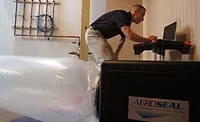
NADCA member Ken Hosyradt, CVI and ASCS, Twins Air Duct Cleaning, Waynesboro, Va., cleans lined duct work with a contact vacuum. (Feature photos courtesy of NADCA.)
Numerous studies link newly diagnosed ailments such as pulmonary disease, as well as old enemies like asthma and allergies, to the effects of poor ventilation and exposure to unhealthy indoor air quality (IAQ). The Environmental Protection Agency (EPA) lists IAQ as one of the top-five modern day environmental health concerns, and improving the quality of indoor environments is a key component of most green building certification plans.
Furthermore, the American Lung Association reports that exposure to poor indoor air can cause symptoms including headaches, dry eyes, nasal congestion and fatigue. Being that the EPA estimates most individuals spend as much as 90 percent of their existence indoors (Statistical Source: www.epa.gov), it only makes sense that the air being blown through our ventilation systems and taken into our lungs be of a healthier nature.
NADCA
The National Air Duct Cleaners Association (NADCA) was founded in 1989 to promote source removal techniques for air duct cleaning. Source removal means removing contaminants (dust and debris) from the ductwork, as opposed to encapsulating these contaminants in the ductwork. According to John Schulte, executive director for NADCA, based out of the association’s Washington, D.C. headquarters, this focus on source removal was instrumental in establishing professional practices in the industry.“HVAC cleaning has been around since at least the 1930s, starting with commercial systems where removal of contaminants was necessary for fire prevention reasons,” Schulte said. “Today, NADCA represents more than 1,000 HVAC system cleaning contractors in 30 countries around the world specializing in commercial, institutional, and residential HVAC system inspection, maintenance (cleaning) and restoration.”
In 2008, NADCA adopted a new tag line - “The HVAC Inspection, Maintenance & Restoration Association.” According to Schulte, this descriptor better reflects the types of services provided by NADCA members, including HVAC cleanliness inspections, maintenance (cleaning), and restoration of various HVAC components such as drain pans, insulation, and other activities designed to restore HVAC systems to good working condition. Some HVAC system cleaning contractors also apply antimicrobial products where needed to address microbial contamination.

Fall protection is a major concern to technicians involved with duct cleaning, and safety must come first. Shown here, Russell Diehl, ASCS, harnesses up to perform a fiberglass/duct-liner replacement project as Tim Hoysradt, owner of Twins Air Duct Cleaning, watches on.
PLACING THE ONUS ON PROPER CLEANING
Most HVAC system cleaning contractors work in partnership with HVAC contractors, passing along leads for projects where major repairs or new system installations are needed, Schulte said. Referrals are also passed along by HVAC contractors when systems are in need of cleaning or restoration. This reciprocal relationship is profitable for NADCA members and their HVAC contractor partners - the parties rely on the expertise and capabilities of the other to optimally serve clients.NADCA is focused strictly on the cleaning side of things. With 1,000+ member companies, world-wide, less than 10 percent of members are HVAC contractors, Schulte said. The association does have some who engage in both, but for the most part, HVAC contractors hire NADCA members and affiliates to handle the cleaning side of things. Occasionally, said Schulte, an HVAC guy will make the foray into cleaning, but - due to the profit margin being smaller, etc. - most HVAC contractors will partner with a cleaning company specializing in that service.
Regarding ductwork, specifically, per Schulte, NADCA members provide services designed to repair or replace damaged fiberglass ductwork. “There are coatings that can be applied in liquid form that, when dried, create a hard-surface shell within the ductwork. (See photo at left.) This can be a cost-effective alternative to expensive replacement of difficult to reach ductwork,” Schulte said.
Robert “Buck” Sheppard is operations manager of AAA Heating and Cooling, Portland, Ore., and president of NADCA. An HVAC industry lifer with more than 40 years of involvement within the HVACR sector, Sheppard is also president of the Air Conditioning Contractors of America local chapter in his area, ORACCA. With his company, which has been in business since 1961, Sheppard is involved in residential retrofits, commercial and light industrial retrofits, duct cleaning and IAQ concerns, and said that a healthy portion of AAA Heating and Cooling’s revenue stems from duct cleaning, both residential and commercial.
“The duct cleaning adjunct is a natural offshoot - so many are dirty, yet are out of sight/out of mind,” Sheppard said. “When we go in for a retrofit, that entire system gets cleaned up, so when starting a new job it is able to: A. handle intended airflows, and, B., not contribute to further pollutants and irritants in the system.”
“If you put a new fan on an old system, and increase air flow, the chances of breaking through non-adhered material and blowing into the thermal envelope greatly increase,” Sheppard said. “It’s kind of like changing the oil in your car and not changing the filter at the same time. If you’re putting in new equipment, take the entire system up to the intended design parameters without completely redoing a duct system.”
BACKGROUND AND CERTIFICATIONS
NADCA published the world’s first standard for cleaning HVAC systems in 1992. This standard has continued to evolve over time, and emphasizes cleanliness of the entire HVAC system - all of the air-side surfaces within the system. The current edition: Assessment, Cleaning & Restoration of HVAC Systems (ACR 2006, available for download at www.nadca.org), is specified in HVAC cleaning projects around the world. According to Schulte, NADCA is currently developing a new standard under the ANSI process.“With NADCA, we are inspection, maintenance and restoration professionals,” Sheppard said. “We are developing a certification system to take cleaning to a new level in regard to clean rooms, water manufacturing plants, healthcare facilities, intensive care units, healthcare suites … . We are starting to write items for certification testing and developing an education program in parallel with that.”
NADCA also certifies industry professionals who demonstrate qualifications for providing services in accordance with NADCA’s standard. The Air Systems Cleaning Specialist (ASCS) certification is held by more than 1,600 professionals, worldwide. NADCA also offers a Ventilation System Mold Remediator (VSMR) certification and a Certified Ventilation Inspection (CVI) credential. The association is currently developing a new Ventilation Maintenance and Restoration Professional certification targeting more experienced professionals. This new certification will cover NADCA’s expanded scope of HVAC inspection, maintenance (specifically, the cleaning aspects of maintenance) and restoration, Shulte said.
IMPORTANCE OF IAQ
According to NADCA, the issue of IAQ has been at a high profile for more than 20 years. “When talking IAQ, you could be talking a lot of different pollutants, or thermal comfort. From a NADCA standpoint, the big issue is airborne particulates,” Schulte said. “When we talk about those very, very small/fine particles, which stay airborne for a long time after being stirred up - these are most important from a health standpoint.”“The biggest driver for this industry for many years has been the desire for improved indoor air quality” Schulte said. More recently, the interest for energy efficiency is driving some aspects of the industry, including coil cleaning and duct sealing. “NADCA has done an extensive amount of training related to coil cleaning using a variety of techniques and approaches. Duct sealing is becoming more popular among NADCA members who are searching for new services to offer their customers.”
“There are companies out there that claim ‘air duct cleaning makes you healthier.’ NADCA is conservative regarding these types of claims,” Shulte said.
IAQ was indeed a buzzword for a long time. According to Sheppard, IAQ is still an integral part of the HVAC industry. Essentially, it entails “dealing with the safety, comfort and health of human beings,” Sheppard said. “The bigger the building (say, 40-story, 40,000 people, for example), what the system is imparting to the building through outside returns, impacts comfort level and health. It’s important to not impart detrimental elements to inhabitants. Not building up CO2 … , this will lead toward increased productivity.”
More and more, the HVAC and duct cleaning industries are moving toward sustainability and efficiency goals. Contractors and cleaning services are automatically addressing the elements of enhanced IAQ through better, more efficient mechanical systems, and the subsequent/requisite maintenance being properly - and regularly - performed.
All of these factors contribute to sustainability, longevity, efficiency and improved IAQ.
THE FUTURE AND NADCA
In light of recent developments, including a position paper issued by the World Health Organization (WHO), this could be a pivotal time for the cleaning industry, based on research studies pointing to airborne particulates linked to certain health problems. Not just allergies and asthma - pulmonary problems and greater health concerns than previously identified are examined in studies like the recently issued “WHO Guidelines for Indoor Air Quality: Dampness and Mold (www.euro.who.int/document/E92645.pdf).“For a group like the WHO to make a statement of this magnitude, this is potentially big news for the HVAC industry and the need to clean and restore HVAC systems. This is big on NADCA’s radar,” Schulte said.
In regard to current developments and initiatives, Schulte said that NADCA is jointly conducting a quarter-million dollar research study with Colorado University to quantify the energy savings attainable through proper HVAC cleaning. The results of this study are scheduled for release in 2010.
“One of the deliverables for this project is a spreadsheet that will allow industry professionals to project energy savings based on data collected through pressure drop tests on a given system,” Schulte said. “We believe this project will ultimately change the dynamic for HVAC cleaning. Building owners and facility managers will pursue HVAC cleaning as a means of achieving energy savings, while realizing better indoor air quality (reductions in airborne particulate) as an added bonus.”
CHALLENGES
Regarding obstacles or challenges in establishing protocol for cleaning duct systems, both Sheppard and Schulte cite increasing consumer awareness as a familiar roadblock. “The number one concern for us is generating awareness regarding the need for maintaining and restoring HVAC systems,” Schulte said, “cleaning and restoring.”“Bringing awareness to the general public has always been a problem,” Sheppard said.
“Most don’t see it. Even fewer understand it. Therefore, it is incumbent upon technicians to make sure proper duct cleaning items are addressed and customers understand it.”
“The biggest advice I’d give an HVAC contractor - and a lot of them already take this to heart: Take into consideration that the system is part of a holistic environment.
“By designing more efficient systems, ask yourself: Are we using these resources correctly and making the use of materials in a sustainable manner? Are we improving lives overall?” said Sheppard. “We should be.”
The NADCA Annual Meeting and Exposition will be March 27-30, 2010, in Tucson, Ariz. The meeting provides opportunities for HVAC cleaning contractors to discuss best practices and opportunities for building a profitable business. For more information on NADCA, visit www.nadca.com.
Publication date: 10/05/2009
Looking for a reprint of this article?
From high-res PDFs to custom plaques, order your copy today!