ACHR News
search
Ask ACHR NEWS AI
cart
facebook twitter instagram linkedin youtube
  • Sign In
  • Subscribe
  • Sign Out
  • My Account
ACHR News
  • NEWS
    • Breaking News
    • New HVAC Products
    • Featured Products
    • Manufacturer Reports
    • HVAC Data
    • Legislation
    • ACHR NEWS Centennial
  • RESIDENTIAL
    • Air Conditioners
    • Furnaces
    • Residential Heat Pumps
    • Ductless
    • Residential IAQ
    • Testing, Monitoring, Tools
    • Components & Accessories
  • COMMERCIAL
    • Air Handlers
    • Rooftop Units
    • Chillers and Cooling Towers
    • Commercial Heat Pumps
    • Boilers and Hydronics
    • VRF/Ductless
    • Commercial IAQ
  • REFRIGERATION
    • Refrigerants
    • Refrigerant Regulations
    • Leak Management
  • CONTRACTOR PRO
    • Geothermal
    • Homeowner Study
    • VRF and VRV Ductless
    • Unitary Trends
  • EDUCATION
    • Training and Education
    • Business Management
    • Service and Maintenance
    • Continuing Education
    • Market Research >
      • HVAC Brand Awareness Report
      • VRV, VRF, VRVZ Report
      • Unitary Trends Report
      • Water Heat Professionals Report
    • Webinars
    • Sponsor Insights
    • eProducts Info
    • White Papers
  • EVENTS
    • HVAC Contractor Forum
    • Industry Events and Webinars
  • MEDIA
    • Videos
    • AHR Expo 2025 Videos
    • Podcasts >
      • ACHR News Podcast
      • HARDI Podcasts
      • AHR Expo Podcasts
      • ACCA Podcasts
    • Interactive Spotlights
    • Quizzes
    • eBooks
    • HVAC Talkback
  • HVAC GROUP
    • ACHR NEWS >
      • Current Issue
      • Digital Edition
      • Subscribe
    • Distribution Trends
    • SNIPS NEWS >
      • Join SNIPS NEWS
    • Engineered Systems News >
      • Join ES News
    • HVACR Directory
    • Contests
    • Newsletters
    • Contact
    • Advertise
    • My Account

How to Choose an HVAC Air Filter

By Rick Peckham
April 2, 2007
Rick Peckham

There are many issues and variables to consider when selecting an air filter or an air filtration system. One of the most basic is whether the goal is to focus primarily on protecting the air movement equipment or on protecting the people in the building. That may seem like an oversimplification but it’s really not. Low to medium efficiency filters are meant to keep equipment clean and higher efficiency filters can be a significant asset in providing a healthier and safer work environment.

Better Testing Methods

For years the American Society of Heating, Refrigerating and Air-Conditioning Engineers (ASHRAE) provided a test standard/procedure for determining the performance of an air filter. Adopted in 1968 as Standard 52-68 it went through revisions in 1976 and again in 1992. Its current title is ASHRAE Standard 52.1-1992. This test, while valuable, was difficult to explain and, as a result, could be somewhat confusing. In an attempt to provide more specific information that was easier to understand, ASHRAE created a new document titled ASHRAE Standard 52.2 which identifies a filter’s performance on specific particle size ranges. The results are reported as Minimum Efficiency Reporting Value (MERV) levels.

The MERV levels provide a clear understanding of what removal percentage can be expected for specific particle size ranges. Range E1 is for particles in the 0.3 – 1.0 micron* range. E2 is for particles 1.0 – 3.0 microns in size and E3 is for particles 3.0 – 10.0 microns. The filter is tested on all three ranges and based on its performance is rated numerically from 1 – 16. Becoming familiar with the MERV level of a filter being considered for use will ensure that a minimum performance standard can be planned for and counted on. It is a good idea to consult with a local filter expert to review and explain the various MERV levels as they relate to the filters being considered.

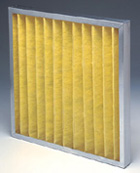
A low efficiency filter.

Better Filters

The filter industry has come a long way in developing a wide array of user friendly products. Low efficiency panel filters (both pleated and non-pleated with MERV levels generally below 12) have been around a long time and are generally low in cost and low in resistance to airflow. Of course, they are lower in performance and dust removal capabilities as well. High efficiency filters (generally above MERV 12) have also been around for a long time but have historically been so much more restrictive to airflow that upgrading from a panel to a more efficient filter was often not feasible without major equipment modifications. Fortunately, with improvements in media and filter design that is no longer true.

A new generation of high efficiency products provides much higher performance while operating at resistance levels closer to those of panel filters. Some of these new products offer unique media pack designs which reduce configuration losses through the filter. Others offer thinner media packs which also enable the air to pass through with lower resistance.

The filter industry is also stepping up with many user friendly sizes to enable most systems to be improved quickly and easily. Previously, if a system was designed for panel filters, it was very difficult to upgrade to something better without removing the existing framing system and replacing it with something more universal. The focus is now to provide products that will fit exiting equipment without modifications.
A medium efficiency filter.

Better Filtration Systems

Given all this new information, how do you choose which air filter is best for you? There are some key questions that need to be asked and answered before making a choice.

• Is the current filter system performing in an acceptable manner?

• Is there an interest in keeping the air handling equipment cleaner?

• Is there an interest in making the air safer and healthier for building occupants?

Let’s take them one at a time. If the current filter system is performing well, then changing the MERV level may not be desired. However, there are good options available that will lower energy costs resulting in lower annual operating costs. Choosing a filter that operates at a lower pressure drop will normally lead to reduced energy consumption. It’s important that the maintenance department communicates with building management to identify and quantify the amount of energy dollars saved. In addition, the use of longer lasting filters can and will reduce maintenance costs through a reduction of annual filter changeouts. Eliminating even one periodic filter change saves man-hours which saves money while maintaining or improving existing performance levels.

If the goal is to keep the air handling equipment cleaner, there are many options. Once the MERV level of existing filters is identified, it is easy to consider upgrades. Taking the example of an owner using a MERV 6 product - it makes sense to consider at least a MERV 7 or even a MERV 8. The highest performance that can be expected from a MERV 6 is 49.9 percent removal of 3.0 – 10.0 micron size particles. Upgrading to a MERV 8 increases this upper end efficiency to 84.9 percent for the same particle size range. That is a 70 percent improvement in efficiency and the difference in product cost between a MERV 6 and a MERV 8 is relatively small. Keeping the equipment cleaner offers many benefits; one of the most important is operating with cleaner coils. Coils laden with an insulating layer of dust and dirt are much less efficient when transferring heat or cooling to the circulating air. This results in the system having to run longer to provide the desired temperature, which wastes energy. It is so easy to improve that part of the air handling equation by simply using a higher MERV level product. In general, filters up to MERV 11 are primarily focused on protecting equipment.
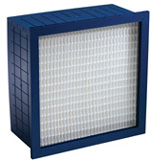
A high efficiency filter.

If the concern is for improving the health and safety of building occupants, then the use of a MERV 13 level filter or higher must be considered. If the building was designed for the use of at least a MERV 13, then the occupants are already enjoying the benefits of cleaner air. The issue can be more difficult if the building was designed for something less. Many times buildings are equipped with panel filters only - generally in the range of MERV 6 or MERV 7. It is in this situation that the new generation of high efficiency products provides options not previously available. What that means to the building owner/operator is that he or she can now upgrade the filter system with relative ease. Because these new products also come in convenient sizes, fitting a MERV 13 or MERV 14 product into the existing framing system is no longer a problem.

It is important to note that smaller particles are more difficult to expel from the lungs than larger ones, so removing a higher number of the smallest particles from the supply air is required to improve indoor air quality and human health. A MERV 13 filter removes at least 90 percent of all particles 1.0 – 10.0 microns and under 75 percent of the 0.3 – 1.0 micron particles. A MERV 14 filter also removes at least 90 percent of 1.0 – 10.0 micron particles but also removes between 75 percent – 84.9 percent of 0.3 – 1.0 micron particles as well. This is even better for improving health issues related to indoor air quality! It is noteworthy that the U.S. Green Building Council via the LEED Certification Program identifies MERV 13 as the minimum level required to earn points toward LEED certification.

Remember that all of this improvement is possible without a high price tag in terms of energy consumption. The new products have been designed to specifically work in the range of 0.30 - 0.45 inches of initial static pressure at normal rated airflow (500 fpm). These resistance levels are very close to the 0.25 - 0.35 inch range common with the family of lower efficiency panel filters. The older generation MERV 13 and 14 products generally operated in the range of 0.50 - 0.75 inches. In most cases, this prohibited them from being used to upgrade lower efficiency systems.

Commentary on choosing an air filter wouldn’t be complete without noting that reducing the filter efficiency originally designed for a building is not advisable. The engineering firm that specified the building equipment is normally responsible for setting the filtration level. Reducing that specified level could result in unwanted liability issues.

In conclusion, it is important to use the products that best fit your needs/goals. Talk to a filter expert, pay attention to the MERV level, and make your choices. There is a useful axiom that applies to the use of HVAC air filters. “Good things happen when more efficient filters are used.” Whether for keeping coils and fans cleaner or for improving indoor air quality, the use of better filters is a very good idea!

* Micron - a measurement which equals one millionth of a meter or 1/25,400 of an inch. A human hair is approximately 100 microns in diameter.

Share This Story

Looking for a reprint of this article?
From high-res PDFs to custom plaques, order your copy today!


Rick Peckham is director of sales-West, CLARCOR Air Filtration Products Inc. CLARCOR’s filter brands are Airguard and Purolator. For more information, visit www.airguard.com and www.purolatorair.com. For customer service and tech support, call 502-969-2304, ext. 1.

Recommended Content

JOIN TODAY
To unlock your recommendations.

Already have an account? Sign In

  • HVAC-enrollment

    The Trades Are Back: HVACR Programs See Nearly 30% Enrollment Spike

    A new wave of future technicians is entering the pipeline.  
    News
    By: Matt Jachman
  • 2025 Top 40 Under 40

    2025 Top 40 Under 40 HVACR Professionals List

    The 11th annual Top 40 Under 40 list highlights those...
    HVAC Commercial Market
    By: Hannah Belloli-Oster
  • LG Ductless Mini-Split Systems

    The 9 Types of Heat Pumps

    As the U.S. moves toward electrification, heat pumps are...
    Ground Source Heat Pumps
    By: Joanna R. Turpin
Subscription Center
  • Create an Account
  • Start a Subscription
  • Manage My Account
  • Sign Up for Newsletters
  • Visit Customer Service
  • Update Preferences

More Videos

Sponsored Content

Sponsored Content is a special paid section where industry companies provide high quality, objective, non-commercial content around topics of interest to The News audience. All Sponsored Content is supplied by the advertising company and any opinions expressed in this article are those of the author and not necessarily reflect the views of The News or its parent company, BNP Media. Interested in participating in our Sponsored Content section? Contact your local rep!

close
  • Piggy Bank
    Sponsored byWatercress Financial

    Energy Prices, Inflation, and HVAC: What Today’s Homeowners Care About

  • Refrigerated Food
    Sponsored bySolstice Advanced Materials

    R-455A Refrigeration: A Cold Storage Solution for the Future

  • Airex Rooftop Units
    Sponsored byAirex Manufacturing Inc

    Consolidating Roof Penetrations: A Growing Trend in Multifamily HVAC Design

Popular Stories

HVAC-Price-Increase-graphic

HVAC Price Increase List: June 2026

Trump-Section-232.jpg

Trump Reduces Section 232 Tariffs on HVAC Equipment to 15%

R410A-Refrigerant-Cylinder.jpg

Refrigerant Recovery is a Revenue Opportunity

Heat-pump-cutaway.jpg

PFAS Rules and A2L Building Codes Continue to Evolve

Kroger.jpg

Kroger to Spend $100 Million to Reduce Refrigerant Leaks

View The ACHR NEWS
Centennial Anniversary Timeline

The ACHR News Timeline Chart
Submit a Letter
Submit a letter to our editors.

Events

November 6, 2025

Next-Gen Data Center Cooling: HVAC Innovation and Real-World Solutions

On Demand As AI workloads and high-density computing push traditional cooling methods to their limits, the data center industry is accelerating the adoption of next-generation HVAC technologies.

June 9, 2026

Before You Go All In on AI: Set Up Your Business to Actually Win

In this webinar, we'll walk you through exactly what to get in place before you add AI to your business. You'll leave with a clear picture of where you stand today and a practical action plan to set yourself up for real results.

View All Submit An Event

Poll

Summer Staff

Are you fully staffed for the summer season?
View Results Poll Archive

Products

BNI Mechanical/Electrical Square Foot Costbook, 2026 Edition

BNI Mechanical/Electrical Square Foot Costbook, 2026 Edition

See More Products
A2L Refrigerants - Free Webinar - May 21, 2026

Related Articles

  • How to Create Additional Energy Savings by Choosing the Right HVAC Air Filter

    See More
  • WE_gears

    Calling All Franchisors: How to Choose the Right Technology for Your HVAC Franchisees

    See More
  • Shurtape

    How to Choose the Right HVAC Tape

    See More

Related Products

See More Products
  • front cover only.jpg

    How to Market Your HVAC Business

  • HVAC Air Duct Leakage Test Manual, 2nd Edition

  • 9781482255676.jpg

    Testing and Balancing HVAC Air and Water Systems, Fifth Edition

See More Products

Events

View AllSubmit An Event
  • June 10, 2025

    HVAC and Plumbing Marketing 101: How to Stand Out, Get Hired, and Get More Jobs

    On Demand It’s not enough to just get more leads. You need to get more of your ideal customers. And this webinar will show you how.
View AllSubmit An Event

Related Directories

  • Air Sponge Filter Co.

    The Air Sponge Filter Company is a family-owned air filter manufacturing company that began in 1993. Over the years, we have received multiple patents for our innovations in the indoor air quality industry.
×

Sign Up. Stay Informed.

The #1 trusted source for the HVACR industry since 1926

SUBSCRIBE
  • RESOURCES
    • Advertise
    • Contact Us
    • Advisory Board
    • Classifieds
    • Submit a Letter
    • Directories
    • Store
  • ACCOUNT CENTER
    • Create an Account
    • Start a Subscription
    • Manage My Account
    • Sign Up for Newsletters
    • Visit Customer Service
    • Update Preferences
  • SERVICES
    • Marketing Services
    • Reprints
    • Market Research
    • List Rental
    • Survey/Respondent Access
  • STAY CONNECTED
    • LinkedIn
    • Facebook
    • Instagram
    • YouTube
    • X (Twitter)
  • PRIVACY
    • PRIVACY POLICY
    • TERMS & CONDITIONS
    • DO NOT SELL MY PERSONAL INFORMATION
    • PRIVACY REQUEST
    • ACCESSIBILITY

Copyright ©2026. All Rights Reserved BNP Media, Inc. and BNP Media II, LLC.

Design, CMS, Hosting & Web Development :: ePublishing