ACHR News
search
Ask ACHR NEWS AI
cart
facebook twitter instagram linkedin youtube
  • Sign In
  • Subscribe
  • Sign Out
  • My Account
ACHR News
  • NEWS
    • Breaking News
    • New HVAC Products
    • Featured Products
    • Manufacturer Reports
    • HVAC Data
    • Legislation
    • ACHR NEWS Centennial
  • RESIDENTIAL
    • Air Conditioners
    • Furnaces
    • Residential Heat Pumps
    • Ductless
    • Residential IAQ
    • Testing, Monitoring, Tools
    • Components & Accessories
  • COMMERCIAL
    • Air Handlers
    • Rooftop Units
    • Chillers and Cooling Towers
    • Commercial Heat Pumps
    • Boilers and Hydronics
    • VRF/Ductless
    • Commercial IAQ
  • REFRIGERATION
    • Refrigerants
    • Refrigerant Regulations
    • Leak Management
  • CONTRACTOR PRO
    • Geothermal
    • Homeowner Study
    • VRF and VRV Ductless
    • Unitary Trends
  • EDUCATION
    • Training and Education
    • Business Management
    • Service and Maintenance
    • Continuing Education
    • Market Research >
      • HVAC Brand Awareness Report
      • VRV, VRF, VRVZ Report
      • Unitary Trends Report
      • Water Heat Professionals Report
    • Webinars
    • Sponsor Insights
    • eProducts Info
    • White Papers
  • EVENTS
    • HVAC Contractor Forum
    • Industry Events and Webinars
  • MEDIA
    • Videos
    • AHR Expo 2025 Videos
    • Podcasts >
      • ACHR News Podcast
      • HARDI Podcasts
      • AHR Expo Podcasts
      • ACCA Podcasts
    • Interactive Spotlights
    • Quizzes
    • eBooks
    • HVAC Talkback
  • HVAC GROUP
    • ACHR NEWS >
      • Current Issue
      • Digital Edition
      • Subscribe
    • Distribution Trends
    • SNIPS NEWS >
      • Join SNIPS NEWS
    • Engineered Systems News >
      • Join ES News
    • HVACR Directory
    • Contests
    • Newsletters
    • Contact
    • Advertise
    • My Account
HVAC ContractingTechnical

Get Up to Speed on Motor Selection

October 23, 2006
Condenser fan motor.
There's more to selecting a motor than meets the eye. Motors typically are grouped into three categories.

General-purpose motors are designed around industry standards and feature standard operating characteristics.

Definite-purpose motors are designed to meet specific application requirements with specific standards. Pump motors would be one example of a definite-purpose motor.

Special-purpose motors are designed around a specific application and must meet specific requirements. A vacuum motor is a prime example.

When selecting a motor, the three primary factors to think about are performance, electrical, and mechanical considerations.

PERFORMANCE

Performance considerations include motor type (shaded pole, permanent split capacitor, split phase, capacitor start, three-phase), horsepower, speed, and service factor. In some applications more than one motor type may work. In other applications an exact replacement will not be found, but a similar motor with slight differences in mechanical and electrical features will provide reliable operation.

Three-phase motor.

ELECTRICAL

Electrical considerations include power, phase, and voltage. These criteria must be an exact match to the existing unit in the replacement motor. Insulation class and nameplate amperage are also electrical considerations but do not need to be an exact match. A good rule of thumb for the installer is to get a match as close as possible. It's okay for the replacement motor to have a lower nameplate amperage value. Should the replacement motor have a higher value, checking the ability of the electrical system to handle the added load is recommended.

Insulation class (Class A, B, F, and H) refers to the thermal capacity of the materials used in the construction of the motor. Most motors used in today's HVAC applications are Class B designs. Contractors may come across a motor with a Class A rating, which is typically found in older motor designs. In general, it's okay to interchange Class A insulation systems with Class B insulation systems. You should give careful consideration and review when substituting a Class F or Class H rated motor in an application that used a Class B rated motor.
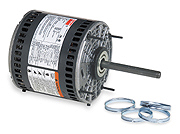
Direct drive blower motor.

MECHANICAL

Mechanical considerations are further divided into three separate areas: frame size, enclosure, and bearing system.

Frame Size
The National Electrical Manufacturers Association (NEMA) has developed industry standards on frame size for general- and definite-purpose motors, including motor mounting dimensions, shaft dimensions, and any special callouts. Contractors should match the designated nameplate frame rating and then check the replacement motor's overall dimensions to make sure it will fit in the application. It is important to remember the NEMA frame size has no reference to the motor's overall size.

Enclosure
A motor's enclosure refers to its protective design and its ability to protect windings, bearings, and other internal components. There are two basic enclosure designs: open and enclosed. Open motors allow a free exchange of air to help control the motor's operating temperature, whereas enclosed motors prevent a free exchange of air. It is not uncommon to see both open and enclosed motor applications in HVAC applications. If the environment is somewhat clean, an open-type design for indoor applications is common, while enclosed designs are used primarily in outdoor applications. Dirty and dusty environments will use enclosed or enclosed fan cooled motors. Dirt and moisture must be kept from entering a motor. If the application exposes a motor to these conditions, then consider upgrading the motor's enclosure. Remember, it's always best to match the original motor's enclosure.

Looking for quick answers on air conditioning, heating and refrigeration topics? Try Ask ACHR NEWS, our new smart AI search tool. Ask ACHR NEWS →

Bearing System
Ball and sleeve are two basic bearing designs. At one time sleeve bearing motors provided some cost savings as opposed to ball bearing designs, but that may not always be the case in today's market. Bearing and lubrication technology has improved so much through the years that the service life of the two motors are basically the same.

In fact, contractors can usually interchange bearing systems when looking for a replacement motor. Keep in mind for fractional HVAC applications of less than one horsepower, a sleeve bearing design works best if the application is sensitive to noise. Additionally, ensure the lubrication matches the manufacturer's specifications, and do not overfill when relubricating. This can cause a siphoning condition, which can result in the bearing system losing its oil. Sleeve bearing designs tend to run quieter than ball bearing designs. In fan applications, the air noise will typically mask any bearing noise; blower applications may be a little more sensitive to noise.

SELECTION AND INSTALLATION TIPS

  • The capacitor rating should never be changed without first checking with the manufacturer. Increasing the capacitor value strengthens the motor, but will also increase the current and temperature, possibly to the point of overheating. On the other hand, reducing the capacitor value weakens the motor, possibly to the point it may not be able to start the load.

  • When installing a poly phase or three-phase motor it is always important to check the power between each leg. The output power of a three-phase motor can be substantially decreased if the voltages at each leg are not equal. On a three-phase system the voltages between legs 1-2, 2-3, and 1-3 should be very close. A variation of 20 percent between the legs can reduce motor output by as much as 25 percent.

  • Proper alignment of a motor in its application will extend the life of the motor and the equipment it's driving. Improper alignment will not only lead to shortened bearing life but can contribute to noise, vibration, and loss in system performance.

  • Always inspect the foundation or base where the motor is mounted to make sure it is sound and offers proper, level support. If the application is a direct drive, it's necessary to make sure the driven device is sitting level as well. Check motor height to the driven device by carefully aligning the coupling yokes to see if the height matches. Once the height is proper, connect the motor to the driven device by the coupling assembly and rotate the shaft by hand, paying attention to the coupling and uneven gaps as it is rotating. Uneven gaps indicate misalignment and adjustments need to be made.

  • Connect motor per its nameplate diagram - voltage and frequency should match the motor nameplate ratings. Motors will typically operate within specifications plus or minus 10 percent of nameplate voltage.

  • All wiring should comply with the National Electrical Code and local codes. Under-sized wiring will limit a motor's performance and life.

  • Although most motors can be mounted in many positions, drip proof motors must be mounted in the horizontal position to meet the enclosure standards.

  • Always mount a motor to a secure rigid or flat surface.

  • Sleeve bearing motors should be mounted with oil ports up and accessible.

  • Use a straight edge to check for proper alignment on belt applications. Adjust belt tension to about 1/2 inch of belt deflections when hand finger force is applied halfway between the pulleys. Use a V-belt tension checker.

    Reprinted with permission from On the Job, October 2006, Grainger's quarterly newsletter for professional contractors. For more information, visit www.grainger.com/contractor.

    Note: This information has been checked for suitability. However, a successful solution depends on individual accuracy, skill, and caution. For this reason, W.W. Grainger Inc. does not guarantee the result of procedure compliance or assume responsibility for personal injury or property damage to persons following these procedures.

    Publication date: 10/23/2006

  • Share This Story

    Looking for a reprint of this article?
    From high-res PDFs to custom plaques, order your copy today!


    Recommended Content

    JOIN TODAY
    To unlock your recommendations.

    Already have an account? Sign In

    • HVAC-enrollment

      The Trades Are Back: HVACR Programs See Nearly 30% Enrollment Spike

      A new wave of future technicians is entering the pipeline.  
      Training and Education
      By: Matt Jachman
    • 2025 Top 40 Under 40

      2025 Top 40 Under 40 HVACR Professionals List

      The 11th annual Top 40 Under 40 list highlights those...
      News
      By: Hannah Belloli-Oster
    • LG Ductless Mini-Split Systems

      The 9 Types of Heat Pumps

      As the U.S. moves toward electrification, heat pumps are...
      News
      By: Joanna R. Turpin
    Subscription Center
    • Create an Account
    • Start a Subscription
    • Manage My Account
    • Sign Up for Newsletters
    • Visit Customer Service
    • Update Preferences

    More Videos

    Sponsored Content

    Sponsored Content is a special paid section where industry companies provide high quality, objective, non-commercial content around topics of interest to The News audience. All Sponsored Content is supplied by the advertising company and any opinions expressed in this article are those of the author and not necessarily reflect the views of The News or its parent company, BNP Media. Interested in participating in our Sponsored Content section? Contact your local rep!

    close
    • Piggy Bank
      Sponsored byWatercress Financial

      Energy Prices, Inflation, and HVAC: What Today’s Homeowners Care About

    • Refrigerated Food
      Sponsored bySolstice Advanced Materials

      R-455A Refrigeration: A Cold Storage Solution for the Future

    • Airex Rooftop Units
      Sponsored byAirex Manufacturing Inc

      Consolidating Roof Penetrations: A Growing Trend in Multifamily HVAC Design

    Popular Stories

    HVAC-Price-Increase-graphic

    HVAC Price Increase List: June 2026

    Trump-Section-232.jpg

    Trump Reduces Section 232 Tariffs on HVAC Equipment to 15%

    R410A-Refrigerant-Cylinder.jpg

    Refrigerant Recovery is a Revenue Opportunity

    Heat-pump-cutaway.jpg

    PFAS Rules and A2L Building Codes Continue to Evolve

    Kroger.jpg

    Kroger to Spend $100 Million to Reduce Refrigerant Leaks

    View The ACHR NEWS
    Centennial Anniversary Timeline

    The ACHR News Timeline Chart
    Submit a Letter
    Submit a letter to our editors.

    Events

    November 6, 2025

    Next-Gen Data Center Cooling: HVAC Innovation and Real-World Solutions

    On Demand As AI workloads and high-density computing push traditional cooling methods to their limits, the data center industry is accelerating the adoption of next-generation HVAC technologies.

    June 17, 2026

    Decarbonization Without Disruption

    This webinar will explore practical HVAC decarbonization strategies that minimize disruption while maximizing long-term performance and ROI.

    View All Submit An Event

    Poll

    Summer Staff

    Are you fully staffed for the summer season?
    View Results Poll Archive

    Products

    BNI Mechanical/Electrical Square Foot Costbook, 2026 Edition

    BNI Mechanical/Electrical Square Foot Costbook, 2026 Edition

    See More Products
    A2L Refrigerants - Free Webinar - May 21, 2026

    Related Articles

    • AANA Member

      Getting Up to Speed on Cooling Tower Designs

      See More
    • Get Up to Date on Data Logging

      See More
    • Motor Won't Come Up To Speed

      See More

    Related Products

    See More Products
    • Uncomplicating The Heat Pump: Refrigeration & Air Flow Systems DVD

    • Manual S.jpg

      Manual S® - Residential Equipment Selection (2nd Edition) [ANSI/ACCA 3 Manual S - 2014]

    • fanfelaysdvd.jpg

      Understanding Fan Relays and Multiple Speed Motors

    See More Products

    Events

    View AllSubmit An Event
    • June 9, 2026

      Before You Go All In on AI: Set Up Your Business to Actually Win

      On Demand In this webinar, we'll walk you through exactly what to get in place before you add AI to your business. You'll leave with a clear picture of where you stand today and a practical action plan to set yourself up for real results.
    View AllSubmit An Event

    Related Directories

    • SpeedClean

      SpeedClean manufactures and markets HVAC maintenance tools like portable coil cleaning systems, biodegradable coil cleaners, tube cleaners, mini-split cleaning systems and much more.
    ×

    Sign Up. Stay Informed.

    The #1 trusted source for the HVACR industry since 1926

    SUBSCRIBE
    • RESOURCES
      • Advertise
      • Contact Us
      • Advisory Board
      • Classifieds
      • Submit a Letter
      • Directories
      • Store
    • ACCOUNT CENTER
      • Create an Account
      • Start a Subscription
      • Manage My Account
      • Sign Up for Newsletters
      • Visit Customer Service
      • Update Preferences
    • SERVICES
      • Marketing Services
      • Reprints
      • Market Research
      • List Rental
      • Survey/Respondent Access
    • STAY CONNECTED
      • LinkedIn
      • Facebook
      • Instagram
      • YouTube
      • X (Twitter)
    • PRIVACY
      • PRIVACY POLICY
      • TERMS & CONDITIONS
      • DO NOT SELL MY PERSONAL INFORMATION
      • PRIVACY REQUEST
      • ACCESSIBILITY

    Copyright ©2026. All Rights Reserved BNP Media, Inc. and BNP Media II, LLC.

    Design, CMS, Hosting & Web Development :: ePublishing