Fixing Subway Leaks

WJW HVACR President William Wolanin and son Liam.
During her fifth year in business, Rico faced some refrigeration challenges. The suburban Long Island store’s walk-in freezer had developed a leak that two previous refrigeration service companies charged for, but never remedied, she said. Aside from service calls she had already paid for, Rico was faced with a component replacement cost and with no guarantee the leak was repaired.
“With refrigeration equipment repair, you’re at the mercy of a service company,” said Rico. “The first two companies either didn’t want to fix it right or didn’t know how to fix them at a minimal cost to their customer.”
Upon a friend’s recommendation, she tried her third service company, which proved to be the charm. WJW HVAC/R, West Babylon, N.Y., did the repair to the customer’s satisfaction. One year later the three-ton, R-404a walk-in freezer was still operating at the manufacturer’s original specification pressures and hasn’t needed any additional refrigerant charges or repair.
IMPRESSED
Rico was so impressed she recommended WJW HVAC/R to her 80-store district headquarters and now the five-year-old refrigeration service contractor is getting additional Subway work throughout Long Island. “I really feel lucky I ended up with a service tech that’s an honest, down-to-earth family man who isn’t into gouging customers,” Rico said.WJW HVAC/R’s President William Wolanin said one aspect of the Subway solution was the use of newer refrigerant sealants. Prior to 2000, before refrigeration sealants came on the market, about the only solution was component replacement. But, he said, sealants have become a last resort solution for phantom or inaccessible refrigeration system leaks. Sealants not only give older or damaged equipment an extended life, but they also prevent refrigerant leaks into the environment, he said.
Wolanin has been using Super Seal by Cliplight Mfg. which is a patented formula of organosilanes that is injected into a system’s low side refrigeration and remains a nonreactive liquid indefinitely until it leaks out of an exit hole with escaping refrigerant. The sealant reacts with moisture found in the atmosphere and then permanently bonds around the leaking hole. Wolanin, who has 30 years of experience, services everything from high-end residential a/c to commercial absorbers and chillers. He said he has been using sealants for four years when leaks can’t be found or are inaccessible in order to save a customer the cost of equipment replacement.
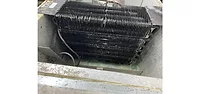
In Rico’s case, Wolanin suspected a short-lived copper discharge line had suffered from galvanic corrosion in a condensate pan - a common occurrence in low-temp freezers. Rico’s choices were having Wolanin cut out the piece and replacing it, or having the commercial sealant applied for about one-third the cost of replacing the section. Additionally, there was the possibility of replacing the component but the system still leaking such as in the evaporator coil. “You never know if there’s more than one leak until you start fixing them or replacing suspected components,” said Wolanin. “I knew the sealant would fix any other leak too, so the chances of a callback were greatly reduced.”
Wolanin has since fixed a leaking small reach-in cooler with Super Seal HVAC/R, which is designed for systems between 1.5 and 5 tons of refrigeration. The former R-22 reach-in cooler uses R-409a refrigerant and was bought used by Rico.
TRIAL TESTS
Wolanin’s first trial of sealants was on a condemned 3-ton a/c residential split system in a residence. The condenser definitely needed replacement, but other service companies wanted to replace the entire system, which would require extensive construction subcontracting because the air handler was built into a section of the basement. Instead, Wolanin saw an opportunity to try a sealant. For the cost of a service call and sealant application, plus the cost of a condenser replacement, the homeowner got a working system that hasn’t needed refrigerant since it was repaired four years ago. “The ironic part of this was the homeowner was a mechanical engineer, so he had a great appreciation for the fact that even though we couldn’t find the leak, we saved him a lot of money,” Wolanin said.Using a sealant is Wolanin’s last resort when the aforementioned leak detection tests fail and the system can’t be repaired conventionally. “Service techs who say all leaks can be repaired are wrong because I’ve been in this business 30 years, and some leaks are just too difficult or too costly to find for the equipment owner,” said Wolanin. “Using a sealant saves the client money and helps retain their trust in your services.”
Sidebar: Tips for Dealing with Leaks
According to William Wolanin, these are steps for detecting leaks.
1. Perform a quick soap bubble test to spot easily found leaks.
2. Pressure test the system with nitrogen for audible signs of a leak and then fix the leak conventionally, if it’s accessible.
3. Perform an electronic sniffer test.
4. Use a halide torch test.
5. Inject dye and use an ultraviolet light test.
Next, here are his tips for working with sealants.
1. Recover the refrigerant with a refrigerant recovery machine.
2. Replace filter/driers.
3. Evacuate the system down to 30 microns with a vacuum pump at least two times to boil off any moisture in the system. “I use a micron gauge because it’s more accurate than refrigeration gauges, but it’s not mandatory,” said Wolanin.
4. Recharge the system with refrigerant.
5. Inject the sealant into the low side after first evacuating the charging hose of possible contaminants. System refrigerant rushes into the vacuum-packed sealant can, mixes with the several ounces of sealant, and transports it into the system.
6. Run the system. The sealant stays in a liquid state before bonding from atmospheric moisture only when leaving an exit hole with the escaping refrigerant.
7. Check system pressures. If possible, return after a week to check system pressures again.
Publication date: 01/26/2009
1. Perform a quick soap bubble test to spot easily found leaks.
2. Pressure test the system with nitrogen for audible signs of a leak and then fix the leak conventionally, if it’s accessible.
3. Perform an electronic sniffer test.
4. Use a halide torch test.
5. Inject dye and use an ultraviolet light test.
Next, here are his tips for working with sealants.
1. Recover the refrigerant with a refrigerant recovery machine.
2. Replace filter/driers.
3. Evacuate the system down to 30 microns with a vacuum pump at least two times to boil off any moisture in the system. “I use a micron gauge because it’s more accurate than refrigeration gauges, but it’s not mandatory,” said Wolanin.
4. Recharge the system with refrigerant.
5. Inject the sealant into the low side after first evacuating the charging hose of possible contaminants. System refrigerant rushes into the vacuum-packed sealant can, mixes with the several ounces of sealant, and transports it into the system.
6. Run the system. The sealant stays in a liquid state before bonding from atmospheric moisture only when leaving an exit hole with the escaping refrigerant.
7. Check system pressures. If possible, return after a week to check system pressures again.
Publication date: 01/26/2009
Looking for a reprint of this article?
From high-res PDFs to custom plaques, order your copy today!