ACHR News
search
Ask ACHR NEWS AI
cart
facebook twitter instagram linkedin youtube
  • Sign In
  • Subscribe
  • Sign Out
  • My Account
ACHR News
  • NEWS
    • Breaking News
    • New HVAC Products
    • Featured Products
    • Manufacturer Reports
    • HVAC Data
    • Legislation
    • ACHR NEWS Centennial
  • RESIDENTIAL
    • Air Conditioners
    • Furnaces
    • Residential Heat Pumps
    • Ductless
    • Residential IAQ
    • Testing, Monitoring, Tools
    • Components & Accessories
  • COMMERCIAL
    • Air Handlers
    • Rooftop Units
    • Chillers and Cooling Towers
    • Commercial Heat Pumps
    • Boilers and Hydronics
    • VRF/Ductless
    • Commercial IAQ
  • REFRIGERATION
    • Refrigerants
    • Refrigerant Regulations
    • Leak Management
  • CONTRACTOR PRO
    • Geothermal
    • Homeowner Study
    • VRF and VRV Ductless
    • Unitary Trends
  • EDUCATION
    • Training and Education
    • Business Management
    • Service and Maintenance
    • Continuing Education
    • Market Research >
      • HVAC Brand Awareness Report
      • VRV, VRF, VRVZ Report
      • Unitary Trends Report
      • Water Heat Professionals Report
    • Webinars
    • Sponsor Insights
    • eProducts Info
    • White Papers
  • EVENTS
    • HVAC Contractor Forum
    • Industry Events and Webinars
  • MEDIA
    • Videos
    • AHR Expo 2025 Videos
    • Podcasts >
      • ACHR News Podcast
      • HARDI Podcasts
      • AHR Expo Podcasts
      • ACCA Podcasts
    • Interactive Spotlights
    • Quizzes
    • eBooks
    • HVAC Talkback
  • HVAC GROUP
    • ACHR NEWS >
      • Current Issue
      • Digital Edition
      • Subscribe
    • Distribution Trends
    • SNIPS NEWS >
      • Join SNIPS NEWS
    • Engineered Systems News >
      • Join ES News
    • HVACR Directory
    • Contests
    • Newsletters
    • Contact
    • Advertise
    • My Account

Automatic Pumpdown Systems

October 31, 2001
The automatic pumpdown cycle is the only sure remedy for refrigerant migration to a compressor during the off cycle. The cycle will also prevent slugging of liquid refrigerant or oil caused from a severe migration problem and at cycle start-ups.

The automatic pumpdown system consists of a normally closed liquid-line solenoid valve installed in the liquid line of a refrigeration system. The solenoid is a normally closed electric shut-off valve that is controlled by a thermostat. The thermostat is located somewhere in the refrigerated space.
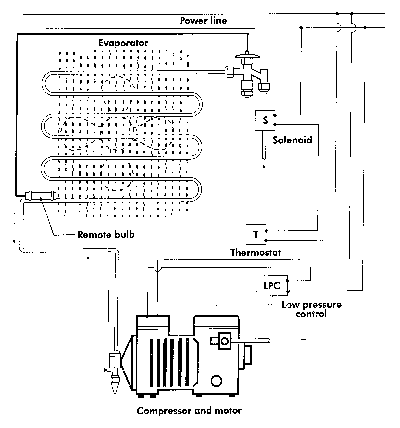
Figure 1. When the desired box temperature is reached, the thermostate opens and de-energizes the liquid-line solenoid valve, closing the valve.

The Pumpdown Cycle

When the desired box temperature is reached in the space, the thermostat will open and de-energize the liquid-line solenoid valve (Figure 1), closing the valve.

The compressor will continue to run and will evacuate any refrigerant from the solenoid valve’s outlet, up to and including the compressor. This includes part of the liquid line, evaporator, suction line, and crankcase.

This refrigerant will be stored in the condenser and receiver on the high side of the refrigeration system. Most of the refrigerant will be stored in the receiver. (Automatic pumpdown systems do not need a larger receiver, since the receiver is designed to hold all of the refrigerant in the entire system and still have a 20% vapor head for safety.)

The compressor will be shut off by the action of a low-pressure switch set to open at about 5 to 10 psig. This will ensure that no refrigerant will migrate to the compressor during the off cycle.

The practice years ago was to pump the compressor down to 0 psig. This practice has proven to be hard on compressors because of reaching such low compression ratios at 0-psig suction pressure. Also, on refrigerant-cooled compressors, the compressor would be starved of refrigerant every time it pumped down and could suffer possible damage from overheating.

On a call for cooling, the thermostat will close and energize the liquid-line solenoid valve. This action will send liquid refrigerant to the expansion valve and into the empty evaporator, thus increasing the evaporator pressure.

Once the cut-in pressure of the low-pressure control is reached, the compressor will easily start and resume a normal refrigeration cycle.

Looking for quick answers on air conditioning, heating and refrigeration topics? Try Ask ACHR NEWS, our new smart AI search tool. Ask ACHR NEWS →

The cut-in pressure of the low-pressure control should be set at a high enough pressure to ensure that the system will not short-cycle if residual pressure remains in the low side of the system once it’s pumped down.

Compressor short-cycling can be devastating to motor windings and starting controls because of overheating. However, the cut-in pressure has to be low enough to ensure that the system will cut in once the liquid-line solenoid is energized by the thermostat to start the next on cycle. These pressures are dependent on refrigerant type and the box temperature desired. Please consult the case manufacturer for specific cut-in pressure settings.


Automatic Pumpdown

Automatic pumpdown systems are not used on systems that have only small amounts of oil or refrigerant; there is not enough refrigerant to migrate to the oil and cause any damage if migration does occur.

A good example of this would be a domestic refrigerator or freezer. Often these refrigerators/freezers will have a refrigerant charge of only 8 to 16 oz, and their oil charge will be from 12 to 20 oz. There is often more oil than refrigerant in these systems. Even if all of the refrigerant migrated to the crankcase during the off cycle, no real damage will be done since the refrigerant flashes off during the next on cycle.

If the refrigerant-to-oil ratio is large, automatic pumpdown systems should be employed. It’s a good practice to install automatic pumpdown systems on all refrigeration systems employing large amounts of refrigerant and oil.

Listed below are three main reasons an automatic pumpdown system would be used on a refrigeration system:

1. The pumpdown rids the evaporator, suction line, and crankcase of refrigerant before reaching the off cycle and defrost cycle, so migration of refrigerant to the compressor and/or crankcase cannot occur.

2. The pumpdown prevents surges of liquid refrigerant from entering the suction port of the compressor (slugging) during start-ups.

3. It rids the crankcase of refrigerant, preventing foaming of oil on start-ups, which robs the compressor’s mechanical parts of lubrication.

In next month’s column, we will look at types of automatic pumpdown control systems.

Tomczyk is a professor of hvac at Ferris State University, Big Rapids, MI, and author of Troubleshooting and Servicing Modern Air Conditioning & Refrigeration Systems, published by ESCO Press. To order, call 800-726-9696. Tomczyk can be reached at tomczykj@tucker-usa.com.

Sidebar: Rooftop Garden Designed To Save Energy

CHICAGO, IL — Reducing heating and air conditioning costs by putting a garden on the roof of an office building has become a reality here.

In late spring, officials showed off the garden atop the 12-story City Hall. Later this year, they hope to have a reading on how well the project did in curbing ac costs. By next spring, they want to get results on possible heating savings.

The project took close to a year to reach reality. The entire roof was covered with a lightweight planting mix rather than conventional planters due to weight considerations.

Nevertheless, the garden did weigh in at 350-tons, and assembly required the aid of a 7-ton crane. The custom mixture included humus and vermiculite. The garden has columbine and artemisia growing from the planting mix, which is covered with biodegradable green mesh and irrigated by drip hoses.

The use of plants, which eventually will include 150 varieties, is designed to help battle ozone pollution as well as curb energy costs.

The project is mainly in response to the ozone and energy issues. The site is not accessible to the public as the only way up is through the boiler room.

Publication date: 11/05/2001

Share This Story

Looking for a reprint of this article?
From high-res PDFs to custom plaques, order your copy today!


Recommended Content

JOIN TODAY
To unlock your recommendations.

Already have an account? Sign In

  • HVAC-enrollment

    The Trades Are Back: HVACR Programs See Nearly 30% Enrollment Spike

    A new wave of future technicians is entering the pipeline.  
    News
    By: Matt Jachman
  • 2025 Top 40 Under 40

    2025 Top 40 Under 40 HVACR Professionals List

    The 11th annual Top 40 Under 40 list highlights those...
    HVAC Contracting
    By: Hannah Belloli-Oster
  • LG Ductless Mini-Split Systems

    The 9 Types of Heat Pumps

    As the U.S. moves toward electrification, heat pumps are...
    HVAC Commercial Market
    By: Joanna R. Turpin
Subscription Center
  • Create an Account
  • Start a Subscription
  • Manage My Account
  • Sign Up for Newsletters
  • Visit Customer Service
  • Update Preferences

More Videos

Sponsored Content

Sponsored Content is a special paid section where industry companies provide high quality, objective, non-commercial content around topics of interest to The News audience. All Sponsored Content is supplied by the advertising company and any opinions expressed in this article are those of the author and not necessarily reflect the views of The News or its parent company, BNP Media. Interested in participating in our Sponsored Content section? Contact your local rep!

close
  • Piggy Bank
    Sponsored byWatercress Financial

    Energy Prices, Inflation, and HVAC: What Today’s Homeowners Care About

  • Refrigerated Food
    Sponsored bySolstice Advanced Materials

    R-455A Refrigeration: A Cold Storage Solution for the Future

  • Airex Rooftop Units
    Sponsored byAirex Manufacturing Inc

    Consolidating Roof Penetrations: A Growing Trend in Multifamily HVAC Design

Popular Stories

HVAC-Price-Increase-graphic

HVAC Price Increase List: June 2026

Trump-Section-232.jpg

Trump Reduces Section 232 Tariffs on HVAC Equipment to 15%

R410A-Refrigerant-Cylinder.jpg

Refrigerant Recovery is a Revenue Opportunity

Heat-pump-cutaway.jpg

PFAS Rules and A2L Building Codes Continue to Evolve

Kroger.jpg

Kroger to Spend $100 Million to Reduce Refrigerant Leaks

View The ACHR NEWS
Centennial Anniversary Timeline

The ACHR News Timeline Chart
Submit a Letter
Submit a letter to our editors.

Events

November 6, 2025

Next-Gen Data Center Cooling: HVAC Innovation and Real-World Solutions

On Demand As AI workloads and high-density computing push traditional cooling methods to their limits, the data center industry is accelerating the adoption of next-generation HVAC technologies.

June 9, 2026

Before You Go All In on AI: Set Up Your Business to Actually Win

In this webinar, we'll walk you through exactly what to get in place before you add AI to your business. You'll leave with a clear picture of where you stand today and a practical action plan to set yourself up for real results.

View All Submit An Event

Poll

Summer Staff

Are you fully staffed for the summer season?
View Results Poll Archive

Products

BNI Mechanical/Electrical Square Foot Costbook, 2026 Edition

BNI Mechanical/Electrical Square Foot Costbook, 2026 Edition

See More Products
A2L Refrigerants - Free Webinar - May 21, 2026

Related Articles

  • Types Of Automatic Pumpdown Control Systems

    See More
  • Zero Gravity Filters: Automatic Liquid Filtration Systems

    See More
  • Manufacturers: Ingersoll-Rand; Met-Coil Systems; Formek; Nordic Air Inc.; Danfoss Automatic Controls; Airsopure Inc.

    See More

Related Products

See More Products
  • Troubleshooting Tips for Servicing Refrigeration Systems

  • 9781482255676.jpg

    Testing and Balancing HVAC Air and Water Systems, Fifth Edition

  • ShowISBNImage.jpg

    Electricity, Electronics, and Control Systems for HVAC, 4/e

See More Products

Events

View AllSubmit An Event
  • November 19, 2025

    Balance Cost and Efficiency with Self-contained Systems

    On Demand Discover the newest advancements in self-contained systems, including new technologies and design improvements. We will delve into the principles and applications of self-contained Variable Air Volume (VAV) system design, highlighting their benefits and implementation strategies.
View AllSubmit An Event

Related Directories

  • Shop Data Systems Inc. (Manufacturer)

    HVAC CAD/CAM software with extensive library, automatic nesting, on-site training, 24/7 telephone support, round and rectangle templates, Field Orders online, and over 30 years in the business.
×

Sign Up. Stay Informed.

The #1 trusted source for the HVACR industry since 1926

SUBSCRIBE
  • RESOURCES
    • Advertise
    • Contact Us
    • Advisory Board
    • Classifieds
    • Submit a Letter
    • Directories
    • Store
  • ACCOUNT CENTER
    • Create an Account
    • Start a Subscription
    • Manage My Account
    • Sign Up for Newsletters
    • Visit Customer Service
    • Update Preferences
  • SERVICES
    • Marketing Services
    • Reprints
    • Market Research
    • List Rental
    • Survey/Respondent Access
  • STAY CONNECTED
    • LinkedIn
    • Facebook
    • Instagram
    • YouTube
    • X (Twitter)
  • PRIVACY
    • PRIVACY POLICY
    • TERMS & CONDITIONS
    • DO NOT SELL MY PERSONAL INFORMATION
    • PRIVACY REQUEST
    • ACCESSIBILITY

Copyright ©2026. All Rights Reserved BNP Media, Inc. and BNP Media II, LLC.

Design, CMS, Hosting & Web Development :: ePublishing