The Professor: Controlling Evaporator, Defrost Efficiency
 The evaporator is where heat is absorbed into the refrigeration system. An evaporator is basically a heat exchanger with refrigerant tubes and extended surfaces. The extended surfaces are often referred to as fins. The evaporator’s function is to efficiently transfer heat from the surrounding area to the phase-changing refrigerant flowing through the evaporator. The refrigerant will be phase changing from a liquid to a vapor as it travels through the evaporator, absorbing heat. As the evaporator’s heat load changes, an expansion-type metering device, at the entrance of the evaporator, will control the flow of refrigerant through the evaporator. The metering device will also ensure that all of the liquid in the evaporator has fully vaporized before exiting the evaporator.
The Evaporator and Energy Savings
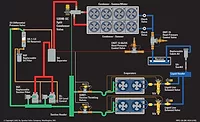
The evaporator is a major component in the refrigeration system, and an efficient evaporator plays a key role in saving energy. Many commercial and industrial evaporator assemblies consist of an evaporator coil, an expansion device, fans, defrost heaters, and a liquid line solenoid valve. By carefully timing, managing, and controlling each of these components with an evaporator-efficiency controller (Figure 1), the evaporator is able to provide the maximum output, with the minimum amount of energy input.
Frost
Although frost is unavoidable on an evaporator, it is the most common cause of inefficiency in evaporator coils. When the evaporator’s coil temperature drops below the dew point temperature, dew will begin to collect on the evaporator’s cool surface. The dew point temperature is the temperature where dew starts to form. If the temperature of the evaporator coil continues to drop below the freezing point of water, the moisture on the evaporator’s coil will begin to solidify, forming a thin layer of ice.
The first thin layer of ice on the evaporator coil will actually enhance the evaporator’s efficiency. This initial ice layer is very hard, boasting the consistency of an ice cube. Not only is this first layer of solid ice around the evaporator coil a good conductor of heat, but it will also increase the surface area of the evaporator tubes. Thus, heat transfer into the evaporator’s coil will be increased. Now that the evaporator tubes have an increased surface area, the area for airflow around the tubes will be reduced. This will cause a slight increase in the air’s velocity through the coil, which will also increase heat transfer to the evaporator.
Depending on humidity, evaporator temperature, and airflow, the subsequent layers of frost that accumulate on the evaporator may be more crystalline or snow-like. These layers of frost will hold more entrained air and will be very porous. This type of frost will insulate the evaporator and severely reduce its heat-absorbing ability. This type of frost is often referred to as radiant frost or hoar frost. The performance of an evaporator is enhanced initially, but declines over time as more hoar frost accumulates on the coil and creates an insulating effect on the coil (Figure 2). As the hoar frost accumulates, the evaporator will see less heat from the refrigerated space. This will cause the evaporator or suction pressure to drop and the evaporator coil will become colder.
Higher compression ratios cause lower compressor volumetric efficiencies, less dense refrigerant-return gases entering the compressor, reduced mass-flow rates of refrigerant, and loss of system capacity. A result of this insulating effect is the temperature of the evaporator coil must be reduced to maintain the same desired refrigerated-space temperature. Now, the temperature difference (TD) between the evaporator coil and the refrigerated space will be greater.
Pumpdown Cycle
The control system is based around a refrigerant pumpdown cycle. Once the refrigerated space temperature is satisfied, the controller de-energizes (closes) the liquid line solenoid valve and turns the evaporator fans off. The compressor continues to run until any liquid refrigerant in the evaporator and suction line is fully vaporized and pumped to the high side of the refrigeration system. During this refrigerant pumpdown, the temperature of the evaporator coil will continue to drop because of the low pressure created in the coil from the pumpdown process, and from the refrigeration effect of the vaporizing refrigerant remaining in the evaporator coil during pumpdown.
Looking for quick answers on air conditioning, heating and refrigeration topics? Try Ask ACHR NEWS, our new smart AI search tool. Ask ACHR NEWS
This residual refrigeration effect, or flywheel effect, will drop the coil temperature below the refrigerated space temperature. The evaporator’s controller is able to capture this energy and give it back to the refrigeration system by controlling the evaporator fans. The controller will now cycle the evaporator fans back on without starting the compressor. The refrigerated-space temperature is now maintained by only the fans blowing air over a very cold evaporator coil. This greatly reduces the amount of energy used to maintain the refrigerated space temperature. Only when this stored flywheel-effect energy is depleted out of the evaporator coil will the compressor be cycled back on. By cycling the fans, the evaporator controller extends the time between compressor run times, thus saving energy.
Frost Removal by Sublimation
During pumpdown, the evaporator fans are blowing air through a very cold evaporator coil with frost accumulated on its surfaces. The frost will phase change to a vapor through the process of sublimation. Sublimation is a process where a solid is phase changed directly to a vapor, skipping the liquid phase. This sublimation process reduces the frost on the coil naturally. The frost being phase changed to a vapor also returns valuable moisture to the refrigerated space. Higher humidity levels maintained in the refrigerated space reduce product shrinkage. Most defrost systems run the melted frost and residual energy down a drain and out of the refrigerated case. Also, many traditional defrost systems use three or four defrosts per day and may last 45-60 minutes. When melting frost comes in contact with a 300˚F defrost heater, it can flash into steam, creating a fogging effect throughout the refrigerated case. This fog will re-condense on other cold surfaces in the refrigerated room, causing unwanted ice (Figure 3). This can be dealt with in a walk-in refrigerated space with an evaporator efficiency controller with an advanced defrost control algorithm installed.
Evaporator Efficiency Controller, Temp Difference
The evaporator controller described here uses a proprietary defrost control algorithm which eliminates the dependency on time for defrost initiation. Instead, the evaporator controller monitors evaporator coil efficiency to initiate defrost and also minimizes the effects of defrost on space temperature. Maintaining a lower evaporator TD between the evaporator coil and the refrigerated case throughout the runtime will reduce the rate of frost formation on the coil. This will lead to extended time between defrosts and save energy. Here are some important functions of the evaporator efficiency controller:
• Monitors evaporator efficiency and performance.
• Creates an initial evaporator profile from a series of measurements.
• Identifies the temperature relationship between the evaporator coil and refrigerated space temperature through two sensor locations.
• Once the evaporator coil efficiency is less than 90 percent, the controller initiates defrost.
• Once in defrost, the controller monitors coil temperature. Once a predetermined temperature is reached, the heaters are turned off allowing the heat in the heater elements to be transferred to the evaporator coil. Once the heat is dissipated, the heaters are again energized to continue defrost. This saves energy, quickens defrost time, and eliminates fogging.
• Have Ethernet network devices supporting industry-standard protocols.
Publication date: 4/1/2013
Looking for a reprint of this article?
From high-res PDFs to custom plaques, order your copy today!