ACHR News
search
Ask ACHR NEWS AI
cart
facebook twitter instagram linkedin youtube
  • Sign In
  • Subscribe
  • Sign Out
  • My Account
ACHR News
  • NEWS
    • Breaking News
    • New HVAC Products
    • Featured Products
    • Manufacturer Reports
    • HVAC Data
    • Legislation
    • ACHR NEWS Centennial
  • RESIDENTIAL
    • Air Conditioners
    • Furnaces
    • Residential Heat Pumps
    • Ductless
    • Residential IAQ
    • Testing, Monitoring, Tools
    • Components & Accessories
  • COMMERCIAL
    • Air Handlers
    • Rooftop Units
    • Chillers and Cooling Towers
    • Commercial Heat Pumps
    • Boilers and Hydronics
    • VRF/Ductless
    • Commercial IAQ
  • REFRIGERATION
    • Refrigerants
    • Refrigerant Regulations
    • Leak Management
  • CONTRACTOR PRO
    • Geothermal
    • Homeowner Study
    • VRF and VRV Ductless
    • Unitary Trends
  • EDUCATION
    • Training and Education
    • Business Management
    • Service and Maintenance
    • Continuing Education
    • Market Research >
      • HVAC Brand Awareness Report
      • VRV, VRF, VRVZ Report
      • Unitary Trends Report
      • Water Heat Professionals Report
    • Webinars
    • Sponsor Insights
    • eProducts Info
    • White Papers
  • EVENTS
    • HVAC Contractor Forum
    • Industry Events and Webinars
  • MEDIA
    • Videos
    • AHR Expo 2025 Videos
    • Podcasts >
      • ACHR News Podcast
      • HARDI Podcasts
      • AHR Expo Podcasts
      • ACCA Podcasts
    • Interactive Spotlights
    • Quizzes
    • eBooks
    • HVAC Talkback
  • HVAC GROUP
    • ACHR NEWS >
      • Current Issue
      • Digital Edition
      • Subscribe
    • Distribution Trends
    • SNIPS NEWS >
      • Join SNIPS NEWS
    • Engineered Systems News >
      • Join ES News
    • HVACR Directory
    • Contests
    • Newsletters
    • Contact
    • Advertise
    • My Account
Training and Education for Contractors

Study: More Hands-On Training Needed
By Jen Anesi
March 18, 2013
Fluke IB
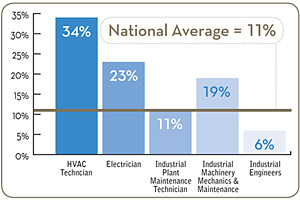
Forecasted annual job growth, according to the Bureau of Labor Statistics’ Occupational Outlook Handbook 2012-2013.

While the number of HVAC technician jobs continues to grow exponentially, Fluke Corp. has found a considerable gap between the number of candidates needed for those jobs and those who are qualified to do them.

In its 2012 Workforce Trends survey — which polled 1,608 industry professionals, educators, and employers — Fluke reported that 85 percent of employers found it difficult or very difficult to find entry-level workers with acceptable skills.

“We felt the data showed there was not enough mentoring and continuous training happening in the field,” said Leah Friberg, public relations manager for Fluke. “There still wasn’t enough hands-on training, which translated to a significant gap in the number of qualified workers.”

A Look at the Numbers

According to the U.S. Bureau of Labor Statistics Occupational Outlook Handbook 2012-2013, the number of HVAC technician jobs is forecast to grow at a rate of 34 percent — triple the national average of 11 percent. In fact, Air-Conditioning, Heating & Refrigeration Institute (AHRI) director of education, Warren Lupson, said the HVAC industry will need 27,000 new workers each year just to replace those who are retiring.

But Fluke’s survey also showed many of those entering the workforce simply do not have the skills or experience employers expect and want. “We saw a need for more internships and apprenticeships in a rotational format,” Friberg said, adding that, as more and more buildings upgrade to newer equipment, hands-on training is needed more than ever in order to be able to work on the more complicated systems.

In the survey, 38 percent of employers said candidates lacked an applicable degree or certification, and 53 percent said they lacked on-the-job experience, with the average minimum required experience expected at 3.4 years.

But while employers say HVAC job candidates are ill prepared out of school, 95 percent of educators and trainers surveyed said students that graduated from their programs possessed enough skill using electrical tools to meet entry-level qualifications.

Looking for quick answers on air conditioning, heating and refrigeration topics? Try Ask ACHR NEWS, our new smart AI search tool. Ask ACHR NEWS →

The Blame Game

So, who is responsible for the gap between what candidates know how to do and what employers expect them to be able to do? The answer is not clean-cut, Friberg said, but there are things both educators and employers can do to help close the gap.

To help get the tools themselves into students’ hands, Fluke offers tubs of test tools with a sample set-up, Friberg said. For just the cost of shipping, educators can check out the tubs and let students use them to gain practical skills through hands-on training. Fluke also offers a 25 percent discount to educators on all of its tools, and a student discount “helps students get the right tools at the beginning,” Friberg said.

For those training programs that can prove economic hardship, Friberg said Fluke will sometimes donate tools with which students can practice. “We try to work with the nonprofit associations,” Friberg said.

Howard Weiss, marketing director for HVAC Excellence, said both educators and employers need to step up to provide more hands-on training for students.

“If you’re going to a full-time day program, it’s between 800 and 1,100 hours,” Weiss said. “In 800 hours, can I train someone? Contractors want them to be van-ready, but that’s not going to happen.”

Weiss said schools, in just a couple of years, simply don’t have the time to teach technicians everything their future employers expect them to know. “What you can teach them is the fundamentals, and we need to teach them troubleshooting,” he added.

How Employers Can Help

The way to bridge the gap between students’ training and employers’ expectations, Weiss said, lies, in part, in the hands of the educators. “A program is only as good as the quality of the instructor,” he said. “If you have the wrong person running the program, the students won’t learn anything.”

Just as important, however, is employer involvement in local schools. Expecting potential employees to have a certain competence upon leaving school, but not contributing to that competence or making your expectations known, simply does not make sense, Weiss said. Employers need to take a more active role in their potential employees’ education.

“Get involved,” Weiss said. “Go visit your local trade school. They’re required to have an advisory meeting twice a year where they’ll tell you about what they’re doing and give you a tour. Then they ask you specifically what they’re not doing.”

That opportunity to give input can help shape the program, Weiss said, which can result in students coming out of school with the skills a future employer desires. Employers can also go one step further by donating equipment to local programs. “If you’re pulling equipment out of a house or building, you can donate it,” Weiss said. He added, “The opportunity is there, and what contractors need to understand is what they’re being taught, and what they’re not being taught, and then work with the schools.”

The Next Generation

More helpful than all of that, though, is simply getting the next generation of HVAC technicians interested in those careers. With the industry growing so rapidly, and with the baby boomer generation sliding into retirement at an increasingly rapid pace, finding enough students to take their place in the industry may prove a challenge in itself.

“More than 65 percent of the people who will be in the HVAC industry in 2020 are not in it in 2010, and contractors can take a preemptive strike by going into high schools and trying to recruit students,” Weiss said. “I think people misunderstand what this industry is and what you can make.”

Concentrating on the future generation of HVAC employees, Weiss said, could also be the key to fixing a lot of the problems facing the industry now.

“Maybe this is an opportunity to train the next generation even better,” he said. “About 72 percent of residential systems are improperly sized, 68 percent are improperly charged, 70 percent have improper airflow, and 91 percent have never had a combustion analysis check. What does that mean? If you’re a consumer, you’re paying too much to run your equipment. If you’re a contractor, you’re going to get a callback because it wasn’t installed correctly. These are a few things that, if they are taught, would fix a lot of the problems in the industry.”

For more information about Fluke Corp. and its Workforce Trends 2012 survey, visit www.fluke.com.

Publication date: 3/18/2013

KEYWORDS: Bureau of Labor Statistics Workforce

Share This Story

Looking for a reprint of this article?
From high-res PDFs to custom plaques, order your copy today!


Jen anesi headshot small

Jen Anesi is Legislation Editor. She can be contacted at 248-244-6495 or jenanesi@achrnews.com. Jen’s responsibilities include covering state and federal legislative and regulatory actions relevant to the HVACR industry, running the annual Best Instructor and Best Trainer contests, managing the Regulatory Update section of The NEWS, and producing the monthly Tech of the Month feature. She has six years of writing and editing experience, holds a bachelor’s degree in journalism from Oakland University, and is currently working toward her MA in English at Wayne State University.

Recommended Content

JOIN TODAY
To unlock your recommendations.

Already have an account? Sign In

  • HVAC-enrollment

    The Trades Are Back: HVACR Programs See Nearly 30% Enrollment Spike

    A new wave of future technicians is entering the pipeline.  
    News
    By: Matt Jachman
  • 2025 Top 40 Under 40

    2025 Top 40 Under 40 HVACR Professionals List

    The 11th annual Top 40 Under 40 list highlights those...
    HVAC Contracting
    By: Hannah Belloli-Oster
  • LG Ductless Mini-Split Systems

    The 9 Types of Heat Pumps

    As the U.S. moves toward electrification, heat pumps are...
    Heat Pumps
    By: Joanna R. Turpin
Subscription Center
  • Create an Account
  • Start a Subscription
  • Manage My Account
  • Sign Up for Newsletters
  • Visit Customer Service
  • Update Preferences

More Videos

Sponsored Content

Sponsored Content is a special paid section where industry companies provide high quality, objective, non-commercial content around topics of interest to The News audience. All Sponsored Content is supplied by the advertising company and any opinions expressed in this article are those of the author and not necessarily reflect the views of The News or its parent company, BNP Media. Interested in participating in our Sponsored Content section? Contact your local rep!

close
  • Piggy Bank
    Sponsored byWatercress Financial

    Energy Prices, Inflation, and HVAC: What Today’s Homeowners Care About

  • Refrigerated Food
    Sponsored bySolstice Advanced Materials

    R-455A Refrigeration: A Cold Storage Solution for the Future

  • Airex Rooftop Units
    Sponsored byAirex Manufacturing Inc

    Consolidating Roof Penetrations: A Growing Trend in Multifamily HVAC Design

Popular Stories

HVAC-Price-Increase-graphic

HVAC Price Increase List: June 2026

Trump-Section-232.jpg

Trump Reduces Section 232 Tariffs on HVAC Equipment to 15%

R410A-Refrigerant-Cylinder.jpg

Refrigerant Recovery is a Revenue Opportunity

Heat-pump-cutaway.jpg

PFAS Rules and A2L Building Codes Continue to Evolve

Kroger.jpg

Kroger to Spend $100 Million to Reduce Refrigerant Leaks

View The ACHR NEWS
Centennial Anniversary Timeline

The ACHR News Timeline Chart
Submit a Letter
Submit a letter to our editors.

Events

November 6, 2025

Next-Gen Data Center Cooling: HVAC Innovation and Real-World Solutions

On Demand As AI workloads and high-density computing push traditional cooling methods to their limits, the data center industry is accelerating the adoption of next-generation HVAC technologies.

June 9, 2026

Before You Go All In on AI: Set Up Your Business to Actually Win

In this webinar, we'll walk you through exactly what to get in place before you add AI to your business. You'll leave with a clear picture of where you stand today and a practical action plan to set yourself up for real results.

View All Submit An Event

Poll

Summer Staff

Are you fully staffed for the summer season?
View Results Poll Archive

Products

BNI Mechanical/Electrical Square Foot Costbook, 2026 Edition

BNI Mechanical/Electrical Square Foot Costbook, 2026 Edition

See More Products
A2L Refrigerants - Free Webinar - May 21, 2026

Related Articles

  • Steamfitters UA Local No. 602

    Apprentice Steamfitters Use Donated Cooling Tower for Hands-on Training and Troubleshooting

    See More
  • Training-Center

    Russelectric, a Siemens Business, Unveils Hands-On Training Center

    See More
  • NASRC Training Event

    Free Hands-On Training Offered For CO₂, R-290 Systems

    See More

Related Products

See More Products
  • hvacLstudyguide3e.jpg

    HVAC Licensing Study Guide, Third Edition

  • HVAC/R Electrical Troubleshooting: Component Testing Training Kit

  • HVACR Electrical Troubleshooting: Deciding Where To Begin Training Kit

See More Products
×

Sign Up. Stay Informed.

The #1 trusted source for the HVACR industry since 1926

SUBSCRIBE
  • RESOURCES
    • Advertise
    • Contact Us
    • Advisory Board
    • Classifieds
    • Submit a Letter
    • Directories
    • Store
  • ACCOUNT CENTER
    • Create an Account
    • Start a Subscription
    • Manage My Account
    • Sign Up for Newsletters
    • Visit Customer Service
    • Update Preferences
  • SERVICES
    • Marketing Services
    • Reprints
    • Market Research
    • List Rental
    • Survey/Respondent Access
  • STAY CONNECTED
    • LinkedIn
    • Facebook
    • Instagram
    • YouTube
    • X (Twitter)
  • PRIVACY
    • PRIVACY POLICY
    • TERMS & CONDITIONS
    • DO NOT SELL MY PERSONAL INFORMATION
    • PRIVACY REQUEST
    • ACCESSIBILITY

Copyright ©2026. All Rights Reserved BNP Media, Inc. and BNP Media II, LLC.

Design, CMS, Hosting & Web Development :: ePublishing