ACHR News
search
Ask ACHR NEWS AI
cart
facebook twitter instagram linkedin youtube
  • Sign In
  • Subscribe
  • Sign Out
  • My Account
ACHR News
  • NEWS
    • Breaking News
    • New HVAC Products
    • Featured Products
    • Manufacturer Reports
    • HVAC Data
    • Legislation
    • ACHR NEWS Centennial
  • RESIDENTIAL
    • Air Conditioners
    • Furnaces
    • Residential Heat Pumps
    • Ductless
    • Residential IAQ
    • Testing, Monitoring, Tools
    • Components & Accessories
  • COMMERCIAL
    • Air Handlers
    • Rooftop Units
    • Chillers and Cooling Towers
    • Commercial Heat Pumps
    • Boilers and Hydronics
    • VRF/Ductless
    • Commercial IAQ
  • REFRIGERATION
    • Refrigerants
    • Refrigerant Regulations
    • Leak Management
  • CONTRACTOR PRO
    • Geothermal
    • Homeowner Study
    • VRF and VRV Ductless
    • Unitary Trends
  • EDUCATION
    • Training and Education
    • Business Management
    • Service and Maintenance
    • Continuing Education
    • Market Research >
      • HVAC Brand Awareness Report
      • VRV, VRF, VRVZ Report
      • Unitary Trends Report
      • Water Heat Professionals Report
    • Webinars
    • Sponsor Insights
    • eProducts Info
    • White Papers
  • EVENTS
    • HVAC Contractor Forum
    • Industry Events and Webinars
  • MEDIA
    • Videos
    • AHR Expo 2025 Videos
    • Podcasts >
      • ACHR News Podcast
      • HARDI Podcasts
      • AHR Expo Podcasts
      • ACCA Podcasts
    • Interactive Spotlights
    • Quizzes
    • eBooks
    • HVAC Talkback
  • HVAC GROUP
    • ACHR NEWS >
      • Current Issue
      • Digital Edition
      • Subscribe
    • Distribution Trends
    • SNIPS NEWS >
      • Join SNIPS NEWS
    • Engineered Systems News >
      • Join ES News
    • HVACR Directory
    • Contests
    • Newsletters
    • Contact
    • Advertise
    • My Account
HVAC ContractingService and Maintenance

Btu Buddy 119: Low Heat and a Hot Furnace

By Bill Johnson
February 18, 2013
Bob is a service technician who is well trained and nationally certified. However, he has sometimes suffered from the same confusion that all technicians occasionally do — the facts that he gathers may or may not point to the obvious cause of the problem or the best solution. But Bob has had something that no one else has. He recalled his long-time HVACR mentor and imagines him accompanying him as “Btu Buddy,” someone who reminded him to take time to stop and think before rushing to judgment, helping keep him on the right track, even with facts that are confusing.

Now, Bob’s company has promoted him to help train a new employee, right out of a school specializing in HVAC, just like Bob was. Bob is now Tim’s Btu Buddy. Tim is anxious to travel with Bob. Tim realizes that he is right out of school, with the theory and lab work that he accomplished in school, but still needs help. He knows that he worked with many of the components of the systems in the school, under ideal conditions with good light and air conditioning. Now it is into the field, sometimes under the house with poor lighting, or out on the rooftop in the sun, where the real action is. He is naturally and normally reluctant, but he has Bob to help guide him.

Bob and Tim were on their way to a “low heat” call at a residence when the dispatcher called them back and told them that the homeowner had called and explained that the furnace was hot, but the home was cold. The dispatcher had told the owner to shut the furnace off until Bob and Tim arrived. Bob said, “That was a good idea. There was probably no danger because of all of the safety devices on all heating equipment.”

Tim asked, “Do safety devices ever fail to protect the owner?”

Bob said, “When a control manufacturer designs a safety device, like a high limit control, a motor over temperature control, or a low pressure safety control, they put the control through thousands of duty cycles to prove the control is reliable before they go into manufacturing the control. The manufacturer also tries to make them fail-safe. For example, a high pressure control should always fail to open the contacts in order to stop the equipment if it is over-stressed.”

When they arrived, they talked to the customer and she said, “The furnace comes on from time to time, but the house is cold.”

Bob told Tim to turn on the furnace and they would observe its operation. The gas furnace started normally and in a few minutes, the fan started as it should, so they continued to watch to see what happened. The furnace was blowing hot air and everything was looking good when all of a sudden the furnace shut down, but the fan kept blowing.

Tim said, “The thermostat is set at 72°F, but the house temperature is 63°. I don’t get what is happening. Why is the furnace heat source shutting down?”

Looking for quick answers on air conditioning, heating and refrigeration topics? Try Ask ACHR NEWS, our new smart AI search tool. Ask ACHR NEWS →

Bob said, “Either we have a weak high limit switch or the furnace is overheating. The key to the problem is, the heat source is shutting down before the thermostat is satisfied.”

Tim asked, “How do we tell which one is the cause?”

Bob said, “Get the temperature tester and let’s measure the air temperature rise across the furnace.”

They placed a temperature lead in the return air and one in the duct leaving the furnace (Figure 1).

Bob said, “Look on the furnace nameplate and see what the allowable temperature rise is for this furnace.”

Tim looked and said, “A 40° to 70° rise is what it says. What does that mean?”

Bob explained, “Let’s only look at the maximum rise for now. That is 70°. If the return air temperature is 63° + 70° maximum temperature rise, the maximum air temperature should be 133°. What is it?”

Tim said, “It is 160°. Now what is the problem?”

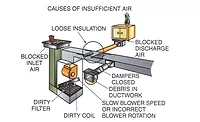
Bob said, “The temperature rise across any furnace tells us the amount of airflow, providing there is a good heat exchange. We now know that there is either not enough airflow or the heat exchanger is not transferring enough heat to the air for some reason. Soot is a common cause if the flame is smoking. Soot will build up in the heat exchanger and act as an insulator. All heat exchangers must have the heat removed as it is heated, or they will overheat.”

Time said, “This problem is getting deeper and deeper. What is next?”

Bob responded, “This is a gas furnace; they are not likely to smoke. Let’s look at the inside of the heat exchanger with a mirror and see what the flame looks like.”

Tim said, “The flame is nice and blue, as it should be. When I use the flash light and mirror, the heat exchanger looks clean; no soot is visible. So I guess there is not enough airflow. What do we look for next?”

Bob said, “Let’s go first examine the furnace filter. This house has no regular service contract with our company. We have no idea what kind of condition the air side of the system is in.”

As they examined the system, Tim said, “The air filter is very dirty and I changed it.”

Bob now said, “With that much dirt in the air filter, I bet the squirrel cage fan blades (Figure 2) are dirty and the cooling coil is probably dirty. What you can always bet on is if the fan blades are dirty from air that passes through the filters, the cooling coil is dirty. The cooling coil is wet in the summer and is a natural filter of small particles that slip through the air filter.”

They cleaned the fan blades and the coil and started the furnace again and checked the air temperature rise across the furnace. It was still too much and Bob said, “I think there are some air registers blocked. Let’s go and see.”

They went through the house and found there were 12 air discharge registers and five of them were closed to keep from heating unused rooms.

Bob said, “Probably the owner could close three registers without causing a problem, but we have to open at least two of the closed registers to keep from having problems.”

They opened two registers and the air temperature rise was 65°.

Bob said, “That looks much better. The system will now heat the house without shutting off because of high limit and we have 5° for the filter to get dirty without having a problem.”

Tim said, “This business gets bigger and bigger all of the time. You really don’t need a college degree to become good in this field; you get all you need in technical school.”

Bob said, “I make a great income, comparable to a four-year college degree, with my technical college education. And a great thing about this career is that you can keep on learning and expanding your knowledge and advancement forever.”

Tim said, “That is a point well taken.”

Publication date: 2/19/2013

KEYWORDS: furnace troubleshooting service calls troubleshooting and HVACR

Share This Story

Looking for a reprint of this article?
From high-res PDFs to custom plaques, order your copy today!


Active in the HVACR industry since the 1950s, Bill Johnson graduated in gas fuel technology and refrigeration from the Southern Technical Institute, a branch of Georgia Tech (now known as Southern Polytechnic Institute). He taught HVAC classes at Coosa Valley Vocational & Technical Institute for four years. He moved on to become service manager for Layne Trane, Charlotte, N.C. He taught for 15 years at Central Piedmont Community College, part of this time as program director. He had his own business for five years doing installation and service work. Now retired, he is the author of Practical Heating Technology and Practical Cooling Technology, and continues as a co-author of Refrigeration & Air Conditioning Technology, seventh edition, all published by Delmar Cengage Learning. For more information, he can be reached at 704-968-0000 or thebillj1@gmail.com.

Btu Buddy Notebook is a collection of more than 50 service call scenarios in book form covering both cooling season and heating season troubleshooting. For more information and to purchase the book, visit the HVACR Industry Store.

Recommended Content

JOIN TODAY
To unlock your recommendations.

Already have an account? Sign In

  • HVAC-enrollment

    The Trades Are Back: HVACR Programs See Nearly 30% Enrollment Spike

    A new wave of future technicians is entering the pipeline.  
    News
    By: Matt Jachman
  • 2025 Top 40 Under 40

    2025 Top 40 Under 40 HVACR Professionals List

    The 11th annual Top 40 Under 40 list highlights those...
    HVAC Residential Market
    By: Hannah Belloli-Oster
  • LG Ductless Mini-Split Systems

    The 9 Types of Heat Pumps

    As the U.S. moves toward electrification, heat pumps are...
    Ground Source Heat Pumps
    By: Joanna R. Turpin
Subscription Center
  • Create an Account
  • Start a Subscription
  • Manage My Account
  • Sign Up for Newsletters
  • Visit Customer Service
  • Update Preferences

More Videos

Sponsored Content

Sponsored Content is a special paid section where industry companies provide high quality, objective, non-commercial content around topics of interest to The News audience. All Sponsored Content is supplied by the advertising company and any opinions expressed in this article are those of the author and not necessarily reflect the views of The News or its parent company, BNP Media. Interested in participating in our Sponsored Content section? Contact your local rep!

close
  • Piggy Bank
    Sponsored byWatercress Financial

    Energy Prices, Inflation, and HVAC: What Today’s Homeowners Care About

  • Refrigerated Food
    Sponsored bySolstice Advanced Materials

    R-455A Refrigeration: A Cold Storage Solution for the Future

  • Airex Rooftop Units
    Sponsored byAirex Manufacturing Inc

    Consolidating Roof Penetrations: A Growing Trend in Multifamily HVAC Design

Popular Stories

HVAC-Price-Increase-graphic

HVAC Price Increase List: June 2026

Trump-Section-232.jpg

Trump Reduces Section 232 Tariffs on HVAC Equipment to 15%

R410A-Refrigerant-Cylinder.jpg

Refrigerant Recovery is a Revenue Opportunity

Heat-pump-cutaway.jpg

PFAS Rules and A2L Building Codes Continue to Evolve

Kroger.jpg

Kroger to Spend $100 Million to Reduce Refrigerant Leaks

View The ACHR NEWS
Centennial Anniversary Timeline

The ACHR News Timeline Chart
Submit a Letter
Submit a letter to our editors.

Events

November 6, 2025

Next-Gen Data Center Cooling: HVAC Innovation and Real-World Solutions

On Demand As AI workloads and high-density computing push traditional cooling methods to their limits, the data center industry is accelerating the adoption of next-generation HVAC technologies.

June 9, 2026

Before You Go All In on AI: Set Up Your Business to Actually Win

In this webinar, we'll walk you through exactly what to get in place before you add AI to your business. You'll leave with a clear picture of where you stand today and a practical action plan to set yourself up for real results.

View All Submit An Event

Poll

Summer Staff

Are you fully staffed for the summer season?
View Results Poll Archive

Products

BNI Mechanical/Electrical Square Foot Costbook, 2026 Edition

BNI Mechanical/Electrical Square Foot Costbook, 2026 Edition

See More Products
A2L Refrigerants - Free Webinar - May 21, 2026

Related Articles

  • Btu Buddy Fig 1

    Btu Buddy 167: Heat Pump Low Heat Call

    See More
  • Btu Buddy 46: Air in a Hot Water Heating System

    See More
  • Btu Buddy 63: Cleaning and Filling a Hot Water System

    See More

Related Products

See More Products
  • A-Heat-Pump-Thats-Not-Delivering-Any-Air-DVD-Cover-218x300.jpg

    A Heat Pump That’s Not Delivering Any Air

  • A-Heat-Pump-That-Won__t-Cool-DVD-Cover-214x300.jpg

    A Heat Pump That Won't Cool

  • Manual Q.jpg

    Manual Q - Low Pressure, Low Velocity Duct System Design

See More Products
×

Sign Up. Stay Informed.

The #1 trusted source for the HVACR industry since 1926

SUBSCRIBE
  • RESOURCES
    • Advertise
    • Contact Us
    • Advisory Board
    • Classifieds
    • Submit a Letter
    • Directories
    • Store
  • ACCOUNT CENTER
    • Create an Account
    • Start a Subscription
    • Manage My Account
    • Sign Up for Newsletters
    • Visit Customer Service
    • Update Preferences
  • SERVICES
    • Marketing Services
    • Reprints
    • Market Research
    • List Rental
    • Survey/Respondent Access
  • STAY CONNECTED
    • LinkedIn
    • Facebook
    • Instagram
    • YouTube
    • X (Twitter)
  • PRIVACY
    • PRIVACY POLICY
    • TERMS & CONDITIONS
    • DO NOT SELL MY PERSONAL INFORMATION
    • PRIVACY REQUEST
    • ACCESSIBILITY

Copyright ©2026. All Rights Reserved BNP Media, Inc. and BNP Media II, LLC.

Design, CMS, Hosting & Web Development :: ePublishing