ACHR News
search
Ask ACHR NEWS AI
cart
facebook twitter instagram linkedin youtube
  • Sign In
  • Subscribe
  • Sign Out
  • My Account
ACHR News
  • NEWS
    • Breaking News
    • New HVAC Products
    • Featured Products
    • Manufacturer Reports
    • HVAC Data
    • Legislation
    • ACHR NEWS Centennial
  • RESIDENTIAL
    • Air Conditioners
    • Furnaces
    • Residential Heat Pumps
    • Ductless
    • Residential IAQ
    • Testing, Monitoring, Tools
    • Components & Accessories
  • COMMERCIAL
    • Air Handlers
    • Rooftop Units
    • Chillers and Cooling Towers
    • Commercial Heat Pumps
    • Boilers and Hydronics
    • VRF/Ductless
    • Commercial IAQ
  • REFRIGERATION
    • Refrigerants
    • Refrigerant Regulations
    • Leak Management
  • CONTRACTOR PRO
    • Geothermal
    • Homeowner Study
    • VRF and VRV Ductless
    • Unitary Trends
  • EDUCATION
    • Training and Education
    • Business Management
    • Service and Maintenance
    • Continuing Education
    • Market Research >
      • HVAC Brand Awareness Report
      • VRV, VRF, VRVZ Report
      • Unitary Trends Report
      • Water Heat Professionals Report
    • Webinars
    • Sponsor Insights
    • eProducts Info
    • White Papers
  • EVENTS
    • HVAC Contractor Forum
    • Industry Events and Webinars
  • MEDIA
    • Videos
    • AHR Expo 2025 Videos
    • Podcasts >
      • ACHR News Podcast
      • HARDI Podcasts
      • AHR Expo Podcasts
      • ACCA Podcasts
    • Interactive Spotlights
    • Quizzes
    • eBooks
    • HVAC Talkback
  • HVAC GROUP
    • ACHR NEWS >
      • Current Issue
      • Digital Edition
      • Subscribe
    • Distribution Trends
    • SNIPS NEWS >
      • Join SNIPS NEWS
    • Engineered Systems News >
      • Join ES News
    • HVACR Directory
    • Contests
    • Newsletters
    • Contact
    • Advertise
    • My Account
Refrigeration

The Professor: Superheat Amounts and Total Superheat
By John Tomczyk
December 3, 2012
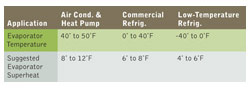
superheat tableThe amount of evaporator superheat that is required for a certain application will vary. Some commercial icemakers call for 3-5 degrees of evaporator superheat to fill out their ice sheets.

However, suction line accumulators are often employed on these systems for added protection. This will help ensure that all refrigerant entering the compressor is liquid free. This will also help keep a fully active evaporator. Lower temperature applications generally utilize lower evaporator superheats than medium- and high-temperature applications. Please consult the case and/or appliance manufacturer if in doubt. (In the absence of manufacturer’s data, the chart on page 17 shows guidelines for evaporator superheat settings.)

There will always be a time when the evaporator sees a light load and the TXV may lose control of its evaporator superheat due to limitations of the valve and to system instability. This is where total superheat comes into play.

Total Superheat

Total superheat is all the superheat in the low side of the refrigeration system. It starts at the 100 percent saturated vapor point in the evaporator and ends at the compressor inlet. It is sometimes referred to as compressor superheat. Total superheat consists of evaporator superheat plus suction line superheat. A technician can measure total superheat by placing a thermistor or thermocouple at the compressor’s inlet and taking the temperature. A pressure reading will also be needed at this same location.

Example: HFC-134a system with low side pressure at compressor of 20 psig or 23˚F. (Refer to a R-134a pressure/temperature relationship chart). The compressor inlet temperature = 50˚.

Here’s the total superheat calculation: 50˚ compressor in temperature – 23˚ saturation temperature = 27˚ total superheat.

In the example, the total superheat was calculated to be 27˚. It is possible to have a TXV that is adjusted to control superheat at the coil (evaporator superheat) and still return liquid refrigerant to the compressor at certain low load conditions. If so, the conditions causing the floodback should be found and corrected. It is recommended that all TXV controlled refrigeration systems have some compressor superheat to ensure that the compressor will not see liquid refrigerant flood or slug at low evaporator loads. The TXV, however, should be set to maintain proper superheat for the evaporator, not for the compressor.

Air-cooled compressors are more vulnerable to slugging and valve damage because the returning suction line gases are not heated by the motor windings. The gases enter the sidewall of the compressor and go directly to the valves. Compressor or total superheat will be a buffer in case the TXV loses control of superheat at these low loads. (However, the evaporator superheat must still be maintained by the guidelines in the chart.)

Looking for quick answers on air conditioning, heating and refrigeration topics? Try Ask ACHR NEWS, our new smart AI search tool. Ask ACHR NEWS →

A buffer of compressor superheat will also make sure that the refrigerant vapor entering the compressor is not too dense. Too high of density vapors entering the compressor will cause the compressor to have a higher than normal amp draw. This will overload the compressor in many instances and open thermal overloads. On the other hand, excess suction gas superheat and/or long periods of low mass flow rate (e.g., an unloaded compressor or variable capacity compressor at lower capacities) can result in insufficient cooling of the rotor, motor, and stator and open the internal protectors.

Always consult the compressor manufacturer for the maximum return gas temperature the compressor can handle to prevent compressor overheating. Many appliance and refrigerated case manufacturers are working with compressor manufacturers to determine the optimum amount of compressor superheat so as not to overheat compressors. The proper amount of compressor superheat will ensure a cool running compressor and at the same time ensure the proper density suction gases for good capacities.

Remember, the TXV controls evaporator superheat. To obtain more total superheat, one may add a liquid/suction heat exchanger, or even run a bit longer suction line to allow heat gains from the surrounding temperature to heat the suction line.

It is not recommended to take the insulation off of the suction line to increase total superheat. This will cause the suction line to sweat from water vapor in the air reaching its dewpoint on the suction line. Freezing of this condensation may also occur if suction line temperatures are below 32˚. Water damage can occur. If at all possible, do not sacrifice (raise) evaporator superheat to get the amount of total superheat needed. This will not maintain an active evaporator and system capacity will suffer.

TXVs often lose control of evaporator superheat at evaporator loads. Low evaporator loads can be caused from many different situations. The following are some causes for low load conditions on evaporator coils:

• Evaporator fan motor not operating

• Iced up or dirty coil

• Dirty filter before evaporator

• Defrost circuit malfunction causing coil icing

• End of the refrigeration cycle

• Low air flow across evaporator coil

• Low on refrigerant charge

Any time the evaporator coil sees a reduced heat load than that it is designed to see, a TXV can lose control and hunt. Hunting is nothing but the valve overfeeding and then underfeeding trying to find itself. Hunting occurs during periods of system unbalance (e.g. low loads) when temperatures and pressures become unstable. The TXV tends to overfeed and underfeed in response to these rapidly changing values until the system conditions settle out, and the TXV can stabilize. It is this overfeeding condition that hurts compressors. Too low evaporator superheat setting also causes the TXV to hunt.

Publication date: 12/3/2012

KEYWORDS: superheat and subcooling

Share This Story

Looking for a reprint of this article?
From high-res PDFs to custom plaques, order your copy today!


John Tomczyk is HVACR professor emeritus, Ferris State University, Big Rapids, Michigan, and coauthor of Refrigeration & Air Conditioning Technology, published by Cengage Learning. Contact him at tomczykjohn@gmail.com.

Recommended Content

JOIN TODAY
To unlock your recommendations.

Already have an account? Sign In

  • HVAC-enrollment

    The Trades Are Back: HVACR Programs See Nearly 30% Enrollment Spike

    A new wave of future technicians is entering the pipeline.  
    News
    By: Matt Jachman
  • 2025 Top 40 Under 40

    2025 Top 40 Under 40 HVACR Professionals List

    The 11th annual Top 40 Under 40 list highlights those...
    HVAC Light Commercial Market
    By: Hannah Belloli-Oster
  • LG Ductless Mini-Split Systems

    The 9 Types of Heat Pumps

    As the U.S. moves toward electrification, heat pumps are...
    Ground Source Heat Pumps
    By: Joanna R. Turpin
Subscription Center
  • Create an Account
  • Start a Subscription
  • Manage My Account
  • Sign Up for Newsletters
  • Visit Customer Service
  • Update Preferences

More Videos

Sponsored Content

Sponsored Content is a special paid section where industry companies provide high quality, objective, non-commercial content around topics of interest to The News audience. All Sponsored Content is supplied by the advertising company and any opinions expressed in this article are those of the author and not necessarily reflect the views of The News or its parent company, BNP Media. Interested in participating in our Sponsored Content section? Contact your local rep!

close
  • Piggy Bank
    Sponsored byWatercress Financial

    Energy Prices, Inflation, and HVAC: What Today’s Homeowners Care About

  • Refrigerated Food
    Sponsored bySolstice Advanced Materials

    R-455A Refrigeration: A Cold Storage Solution for the Future

  • Airex Rooftop Units
    Sponsored byAirex Manufacturing Inc

    Consolidating Roof Penetrations: A Growing Trend in Multifamily HVAC Design

Popular Stories

HVAC-Price-Increase-graphic

HVAC Price Increase List: June 2026

Trump-Section-232.jpg

Trump Reduces Section 232 Tariffs on HVAC Equipment to 15%

R410A-Refrigerant-Cylinder.jpg

Refrigerant Recovery is a Revenue Opportunity

Heat-pump-cutaway.jpg

PFAS Rules and A2L Building Codes Continue to Evolve

Kroger.jpg

Kroger to Spend $100 Million to Reduce Refrigerant Leaks

View The ACHR NEWS
Centennial Anniversary Timeline

The ACHR News Timeline Chart
Submit a Letter
Submit a letter to our editors.

Events

November 6, 2025

Next-Gen Data Center Cooling: HVAC Innovation and Real-World Solutions

On Demand As AI workloads and high-density computing push traditional cooling methods to their limits, the data center industry is accelerating the adoption of next-generation HVAC technologies.

June 9, 2026

Before You Go All In on AI: Set Up Your Business to Actually Win

In this webinar, we'll walk you through exactly what to get in place before you add AI to your business. You'll leave with a clear picture of where you stand today and a practical action plan to set yourself up for real results.

View All Submit An Event

Poll

Summer Staff

Are you fully staffed for the summer season?
View Results Poll Archive

Products

BNI Mechanical/Electrical Square Foot Costbook, 2026 Edition

BNI Mechanical/Electrical Square Foot Costbook, 2026 Edition

See More Products
A2L Refrigerants - Free Webinar - May 21, 2026

Related Articles

  • The Professor: Superheat

    See More
  • The Professor: Wireless Superheat and Subcooling Checks

    See More
  • Total System Superheat

    See More

Related Products

See More Products
  • Understanding TXV Refrigeration Systems: Superheat and Subcooling DVD

  • Uncomplicating The Heat Pump: Refrigeration & Air Flow Systems DVD

See More Products

Related Directories

  • DunAn Microstaq Inc.

    DMQ's closed loop control solutions optimize HVACR system performance via precise superheat control and rapid response. Electronic expansion valves; valve controllers; sensors, superheat, pressure, temperature.
  • Total Home Supply

    Total Home Supply specializes in unique solutions for heating and cooling. We are your #1 source for PTACs, VTACs, and more.
×

Sign Up. Stay Informed.

The #1 trusted source for the HVACR industry since 1926

SUBSCRIBE
  • RESOURCES
    • Advertise
    • Contact Us
    • Advisory Board
    • Classifieds
    • Submit a Letter
    • Directories
    • Store
  • ACCOUNT CENTER
    • Create an Account
    • Start a Subscription
    • Manage My Account
    • Sign Up for Newsletters
    • Visit Customer Service
    • Update Preferences
  • SERVICES
    • Marketing Services
    • Reprints
    • Market Research
    • List Rental
    • Survey/Respondent Access
  • STAY CONNECTED
    • LinkedIn
    • Facebook
    • Instagram
    • YouTube
    • X (Twitter)
  • PRIVACY
    • PRIVACY POLICY
    • TERMS & CONDITIONS
    • DO NOT SELL MY PERSONAL INFORMATION
    • PRIVACY REQUEST
    • ACCESSIBILITY

Copyright ©2026. All Rights Reserved BNP Media, Inc. and BNP Media II, LLC.

Design, CMS, Hosting & Web Development :: ePublishing