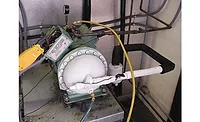
The Professor: Suction Line Accumulators
Floodback will dilute the compressor’s oil with liquid refrigerant and cause foaming in the compressor’s crankcase, causing bearing wash. There are times when low evaporator heat loads, just ended defrost periods, failing or misadjusted mechanical valves, or simply lack of system maintenance can cause compressor floodback.
If there is no way to prevent these unexpected, maybe even short, periods of liquid floodback to the compressor, a suction line accumulator is needed on the system.
Listed below are more causes that trigger liquid to flood a compressor’s crankcase:
• Wrong TXV setting (low or no compressor superheat);
• Overcharge of refrigerant;
• Evaporator fan motor out;
• Low heat load on the evaporator;
• End of cycle (lowest heat load on the evaporator);
Looking for quick answers on air conditioning, heating and refrigeration topics? Try Ask ACHR NEWS, our new smart AI search tool. Ask ACHR NEWS
• Defrost clock or defrost heater out (iced coil);
• Dirty or blocked evaporator coil;
• Capillary tube overfeeding evaporator;
• Capillary tube system overcharged;
• Expansion bulb loose on evaporator outlet;
• Oversized expansion valve;
• Flooding after hot gas termination;
• Heat pump changeover; and
• Defrost termination.
Suction line accumulators are designed as compressor protection devices when flooding and migration do occur. They should be installed between the evaporator and the compressor on the suction line. They are usually installed in the suction line as close to the compressor as possible. In reverse cycle systems like heat pumps, they should be installed in the suction line between the compressor and the reversing valve. Accumulators can also act as suction line mufflers to quiet compressor pulsation noises.
Purpose of Accumulators
Accumulators simply act as a temporary reservoir for a liquid refrigerant and/or oil. They are vessels that collect liquids from the suction line and hold them until they evaporate and return to the compressor naturally. Their outlet tubes to the compressor are located at the highest point in the accumulator to only let refrigerant vapor enter the compressor. Hopefully, the refrigerant liquid level never reaches this highest point.
Most accumulators are also designed to meter both the liquid refrigerant and oil back to the compressor at an acceptable rate that will not damage compressor parts or cause oil foaming in the crankcase. This is done while the compressor is running with a small metering orifice at the bottom of the outlet tube. This small orifice is mainly designed for oil return. However, liquid refrigerant can be slowly metered and vaporized through it also.
Another small orifice located near the top of the outlet tube going to the compressor is often referred to as the pressure equalization orifice. Refrigerant liquid and vapor may move from the evaporator and suction line into the accumulator during the off cycle. The refrigerant vapor may condense and form liquid. This liquid refrigerant will flow into the small metering orifice at the bottom of the u-tube and fill the u-tube with liquid refrigerant. The liquid refrigerant will seek its own level with the liquid already in the accumulator.
Now the u-tube inside the accumulator will have a column of liquid in it. When the compressor starts up, this column of liquid refrigerant will be sucked out of the u-tube and into the compressor if it were not for the pressurization orifice at the outlet of the accumulator. This orifice will equalize pressure on both sides of the liquid column whether the compressor is on or off and prevent the entire column of liquid from entering the compressor. In other words, the liquid column will have accumulator pressure on both sides of it because of the orifice. The column of liquid will now slowly turn to vapor and enter the compressor without causing damage.
It is important the refrigerant systems be kept clean and free of sludge. Sludge is formed from a combination of acid, moisture, oil, and excessive heat. Sludge will clog these important orifices in the accumulator and render the accumulator useless. Compressor damage will surely follow.
Some accumulators use electric heaters or liquid line heat sources to evaporate liquid refrigerant in the accumulator. However, any heat source that boils off liquid refrigerant causes the refrigerant gas to be saturated. This means the gas contains no superheat as it leaves the accumulator.
High-Amp Draw
Compressors often experience high-amp draws from near-saturated vapors being compressed. The density of saturated or near-saturated vapors are much greater than superheated vapors and will often cause a higher mass flow rate than the compressor can handle. The results are high-amp draw and often overheating of the compressor. This happens because before a vapor can be superheated, the vapor must be removed from contact with the vaporizing liquid. However, if there is no liquid being vaporized in the accumulator, the gases can become superheated. If the gases are superheated too far, inefficient compressor cooling can result. In refrigerant-cooled compressors, it is the returning refrigerant gas that cools the compressor. Always refer to the compressor manufacturer’s specifications for the maximum return gas temperature allowed for any specific compressor.
Many indoor compressor installations have problems with suction accumulators sweating and dripping on floors. The only way around this problem is to insulate the accumulator. The accumulator must be insulated completely and vapor-sealed to prevent condensate from forming under the insulation. Rusting problems can result if the accumulator is exposed to moisture for any long period of time. Even though manufacturers do supply accumulators with rust preventive paints, during the welding processes these paints can be burned off, leaving exposed metals.
Since compressors are extremely susceptible to liquid coming back to their crankcases or valves, accumulators add an extra safety precaution. Suction accumulators can assist in flooding and migration conditions.
However, if flooding or migration problems are severe, suction line accumulators have been known to flood with compressor damage still occurring. This is why the only 100 percent safe accumulator is one that can hold 100 percent of the entire system’s refrigerant charge.
Suction Line Accumulator Selection Considerations
Accumulators should be selected with three basic considerations in mind.
1. The accumulator should have adequate liquid holding capacity. This should not be less than 50 percent of the entire system charge.
2. The accumulator should not add excessive pressure drop to the system.
3. Never base the accumulator on the line size of the suction line. Many times the accumulator will not have the same line size as the suction line.
Please consult with the manufacturer for specific catalog numbers and tonnage ratings.
Publication date: 10/1/2012
Looking for a reprint of this article?
From high-res PDFs to custom plaques, order your copy today!