Refrigerant Leak Detection

Refrigerant leak detection is key to customers’ comfort. The gravity of refrigerant leakage has evoked a stern warning from the Environmental Protection Agency authorizing fines up to $25,000 per day for each violation for contractors. (Feature photos courtesy of Spectronics Corp.)
In the United States, the gravity of refrigerant leakage has evoked a stern warning from the Environmental Protection Agency (EPA) authorizing fines up to $25,000 per day for each violation for contractors and service people who vent chlorofluorocarbons (CFCs), hydrochlorofluorocarbons (HCFCs), or hydrofluorocarbons (HFCs). The unfortunate reality is that refrigerant leak sites are usually discovered only after there has been a loss of cooling due to discomfort, spoilage, or production difficulty. Repairing refrigerant leaks is not the problem - finding them is.
A single leak detection method that locates every leak in every possible situation simply does not exist. So, how do we determine which method is most appropriate for different air conditioning and refrigeration systems?
To answer that question, let’s look at some of the more common leak detection methods available. Armed with that knowledge, you should be able to make an informed decision about selecting the one that’s best for your particular application.
LEAK DETECTION METHODS
• Bubble Solutions. The oldest method of leak detection is the bubble solution. In a nutshell, soap solution is applied at suspected leak points, usually with a squeeze bottle, brush, or dauber. Theoretically, the escaping refrigerant will produce bubbles at the leak sites. However, very small leaks or windy conditions may make this method ineffective.• Halide Torches. Halide torches are more sophisticated than bubble solutions. This method is based on the fact that the torch’s flame will turn green when exposed to refrigerants containing chlorine atoms (CFCs and HCFCs). However, not all refrigerants contain chlorine atoms. Caution is needed where such a torch is used, as in an attic, for example.
• Electronic Detectors (Sniffers). There are two basic types of electronic detectors used to test for escaping refrigerant: corona-suppression and heated diode.
Corona-suppression technology measures variations in the conductivity of gases passing between two electrodes. The instrument creates a high-voltage dc spark that jumps from one point to another in the sensor, establishing a baseline current between the two points. A drop in current between the two points indicates the presence of an insulating gas. The greater the current drop, the higher the concentration of gas.
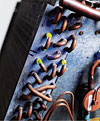
One advantage of fluorescent leak detection is its ability to accurately pinpoint multiple leak sites in a system. Once the dye has circulated, inspection can begin with the system off or running.
• Ultrasonic Detectors. Using highly sensitive microphones, these ac- or battery-powered devices “listen” for a high-pitched, inaudible sound caused by the turbulence that results when refrigerant escapes from a leak site. Once detected, an audiovisual alarm is sounded. Better ultrasonic detectors convert and amplify the inaudible sound of a leak into a more natural sound the human ear can easily identify.
• Fluorescent Leak Detection. This method requires adding a fluorescent dye to the air conditioning or refrigeration system. The dye then mixes with the lubricant and circulates with the refrigerant throughout the system. Wherever refrigerant leaks out, so does the dye. When the system is scanned with an ultraviolet (UV) or blue light lamp, the dye glows a bright yellow-green color, pinpointing the location of the leak.
It is important for a contractor to use an OEM-approved dye that is compatible with the system’s lubricant. Be wary of dyes containing cosolvents because they can adversely affect the lubrication qualities of the system’s oil, which can lead to premature compressor failure.
When using fluorescent leak detection, it is best to select a UV or blue light lamp that produces high-intensity output. The greater the light intensity, the brighter the dye will glow, making it easier to find leaks. Depending on the lamp, the glowing dye can be seen from as far away as 20 feet, which enables technicians to spot leaks in overhead systems. In addition, fluorescent leak detection can be used in preventive maintenance because the dye remains in the system until the lubricant is changed. Checking the system periodically is wise so you can catch leaks before substantial amounts of refrigerant are lost.

Quality high-intensity inspection lamps cause fluorescent dye to glow brighter.
SYSTEMS FACTORS
The type of refrigerant being used is important when choosing a leak detection method. Not all methods work well with all types of refrigerants. Also, system size and configuration must be considered. There are tremendous differences between a small refrigerator unit, a medium-sized food processing plant refrigeration system, and a large industrial system running on ammonia.Large systems are more likely to develop multiple leaks, possibly hundreds of feet apart. In a small unit, multiple leaks are more likely to be next to one another. But every leak still must be precisely located.
Whatever the system size, its configuration can make finding leaks challenging. In a small unit, tight space limitations may make the job difficult. In a large system, the technician may need to be hoisted up to reach piping in the ceiling. He may also need to check behind walls and around other barriers to locate any additional problems. Accuracy, leak size, and the quantity of leaks also are factors. (A quality fluorescent dye and inspection lamp should be able to pinpoint virtually every leak, regardless of size.) In an indoor system, a large leak can raise refrigerant concentration in the air high enough to set off an area monitor or electronic sniffer. By then, it may be impossible to find the exact source of the leak. Also, small leaks can be masked by larger ones and may be missed until a larger leak is repaired and the system is reinspected - obviously a waste of time and labor.
If multiple leaks exist, consider what should be done if one is found in an area where there are several leak sites close together. Will a large leak hide smaller leaks from detection until after the large one is repaired? Will the detector be able to precisely identify two or more leaks that are close to each other?

Better ultrasonic detectors convert and amplify inaudible refrigerant leaks into a natural sound the human ear can pick up. Quality headphones are important because they drown out background noise.
ENVIRONMENTAL FACTORS
Wind and air currents affect the accuracy of electronic detectors and halide torches, which depend on sampling and testing the air in the vicinity of leaks. In outdoor systems, wind or occasional breezes can lead to a missed leak or false alarm. Wind also interferes with the accuracy of bubble solutions.Indoors, ventilation fans and convection currents lead to similar problems. Shutting down fans may eliminate air currents, but convection currents can disrupt readings and cause problems.
Ambient light can wash out the response of visual detectors such as fluorescent leak detectors and halide torches, making leaks difficult or impossible to see. Using high-intensity UV and blue light lamps will help minimize this problem.
Ambient sound, other than that caused by leaks, can adversely affect the performance of some ultrasonic detectors. Noisy environments, such as parallel-rack refrigeration systems, might fool this type of detector as well. A good set of quality headphones can help minimize this shortcoming.
HUMAN FACTORS
Ease of use and maintenance are also important considerations when choosing a leak detection method. Experience is the best teacher for finding leaks, but the easier a leak detection method is to use and maintain, the better the chances are of pinpointing leaks quickly and accurately.Training requirements vary from method to method. Decide whether a detection method requires special knowledge or experience and use one that provides the desired level of accuracy with a minimum amount of training.
Due to the high costs of refrigerants, equipment repair, and the time and effort needed to locate leaks, proper preventive maintenance of air conditioning and refrigeration systems is essential. It is advisable to select a leak detection method that pinpoints leaks quickly and accurately so refrigerant losses are kept to a minimum. By finding and repairing minor leaks early, headaches can often be avoided later.
This story was prepared with help from the leak detection specialists at Spectronics Corp. For more information, visit www.spectroline.com.
Publication date: 03/07/2011
Looking for a reprint of this article?
From high-res PDFs to custom plaques, order your copy today!