Focused Cooling Using Cold Aisle Containment
INTRODUCTION
Cooling is the hot topic in data center circles today. As heat densities and cooling costs rise, data center professionals are looking for more efficient cooling solutions. Aisle containment can improve cooling performance of a data center, assuming it is arranged in a hot aisle/cold aisle configuration. Gartner reports that a 2007 Pacific Gas and Electric study estimated that containment could save 20 percent in chiller operating costs. Further, a 2007 study by Lawrence Berkeley National Laboratory found that the electricity used to move the cold supply air could be reduced 75 percent by implementing cold aisle containment.1As an addition to a conventional precision cooling system, cold aisle containment consistently separates cold and warm areas without requiring structural changes to the data center. A cold aisle retrofit can be implemented easily and quickly, carries a payback time from weeks to a few months - depending on whether energy utility rebates were available to help with funding - and can reduce cooling related energy costs by as much as 30 percent.2
CONVENTIONAL COOLING
The conventional cooling method circulates cold air from computer room precision air conditioning (CRAC) units via a plenum under a raised floor. The CRAC units are located outside the rack rows around the perimeter of the data center.Arranging racks into a hot aisle/cold aisle configuration is a cooling best practice that has been implemented to improve the efficiency of raised floor data centers. However, the hot air can diffuse into the cold air near the top of the racks and on the end of the cold aisles. The resulting mixed air temperatures can in some cases be unacceptably high for the servers at the top of the racks and at the end of the aisles.
The mixing of hot and cold air can be aggravated by a poor balance between the total cold air demand to the racks in the aisle and the total supply from the perforated floor tiles in the aisle. Increasing the airflow in the cold aisles may help overcome the unbalanced conditions, but doing so will increase energy use, making it a less efficient solution.
Aisle containment works to remedy this situation. Before installing aisle containment, however, measures should be taken to improve overall cooling system energy efficiency.
PICK THE LOW-HANGING FRUIT
The first step to take is implementing certain basic measures to increase cooling efficiency, save money, and improve a data center’s carbon footprint.Seal the Data Center Environment
Minimize the latent (moisture related) cooling load by making sure the data center has a good vapor barrier, no leaks around doors, windows, etc., and minimal outside air intake. Sealing out moisture will help ensure that the total available cooling can be used to cool the computer heat load, which is 100 percent sensible (no moisture content).
Optimize Airflow
Several techniques can help optimize airflow in the data center.
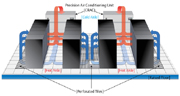
Figure 1. Hot aisle/cold aisle configuration with raised floor.
(Click on the image for an enlarged view.)
Install blanking panels in and between the racks. Blanking panels prevent the hot air from circulating to the front of the rack where the electronic equipment air intakes are located.
Place the CRAC units correctly in the room. The CRACs should be located at the end of the hot aisles to reduce air travel and prevent hot air from being pulled down into the cold aisles as it returns to the air conditioner. Alternatively, use the overhead plenum for hot air return to the CRACs.
Seal the raised floor. Make sure that there are no leaks at cable penetrations, perimeter penetrations, and raised floor tile joints.
Minimize cables and pipes under the raised floor. As the saying goes, old cables never die. If cables have to be in the raised floor or cannot be removed, they should be under the hot aisle running parallel with the aisle.
Minimize cables in the back of the rack. Use a cable management system in the racks so cables do not obstruct the exhaust air from the servers.
Optimize perforated tile locations. Conducting a thermal assessment of the data center using computational fluid dynamics (CFD) is a good way to optimize the location of perforated tiles.
Adjust Air Supply Temperatures
In many data centers it is possible to raise the air temperature and still remain within the ASHRAE recommendations of 64.4°F (18°C) to 80.6°F (27°C).3 Raising the temperature reduces the overall energy required for cooling.
Follow Proper Operating Guidelines
Make sure that method of procedures (MOP) and other process documents covering maintenance, installation of new equipment, replacements, new cabling, access to rooms, and other aspects of routine operation are current regarding energy efficiency, and that they are followed.
Implement System Monitoring
Monitoring can predict needed preventive maintenance/actions, such as filter replacement, which help ensure the cooling system is operating efficiently.
IMPLEMENT AN AISLE CONTAINMENT SYSTEM
Beyond implementing these baseline measures, a data center can further improve energy efficiency by separating the hot and cold air streams. Aisle containment, as this solution is called, is possible once the server racks have been arranged in the hot aisle/cold aisle configuration.With aisle containment, the aisle is sealed off so the cold air is not mixed with the warm air in the data center. This is typically accomplished using ceiling panels above the aisle between adjoining racks and installing doors at the ends of the aisle.
Pressurized aisles and using plastic curtains are aisle containment approaches that do not contain the aisle completely. The pressurized aisle approach has doors at the ends of the aisle and cooling modules located above or on top of the racks. The modules take hot air from the hot aisle, cool it and supply cold air down into the cold aisle.
One approach utilizes plastic curtains (fire code approved) installed at the ends of the aisle and between the top of the racks and the ceiling in the room. Plastic curtains can separate the hot and the cold air, but not as efficiently as solid panels and doors.
Aisle Containment Benefits
Aisle containment has two distinct advantages. First, it increases the cooling capacity and energy efficiency of the cooling unit ensuring that the return air temperature to the cooling unit is high. Second, the increased capacity, together with the separation of hot and cold air, makes it possible to cool higher heat loads per rack.
Additionally, with hotter air returning to the cooling coil, the cooling capacity available for cooling the sensible heat generated by the electronic equipment is increased. Under these conditions the cool supply air temperature is almost always above the dew point. Consequently, there is minimal moisture removal (latent cooling), which saves energy by allocating more of the total cooling capacity to dissipate the 100 percent sensible electronic heat load. The minimal latent cooling also increases the total energy efficiency because of less demand for re-humidification of the air.

Figure 2. Side view of cold aisle containment and hot aisle
containment with raised floor. (Click on the image for an enlarged view.)
Aisle containment can be implemented as either cold aisle containment (CAC) or hot aisle containment (HAC), configured as shown in Figure 2.
The primary difference between HAC and CAC is that HAC is trying to contain the hot air to make sure that the return air temperature to the cooling unit is high, while the focus of CAC is on supplying cold air to the cold aisle where the equipment air intakes are located. The HAC approach can result in high efficiency of the cooling unit, but because the cold air distribution to the servers is open and exposed to disturbances from the room, it has a higher risk of not providing the server with its required input temperature.
Similar to HAC, CAC yields high air temperature to the cooling unit to increase capacity and efficiency. However, with its focused cooling, CAC supplies the high heat density racks with cold air with minimal impact from the surroundings. Therefore, it can enable a higher air temperature leaving the cooling unit, which increases the capacity/efficiency of the unit while supplying air temperature to the servers within the ASHRAE recommendations.
Both cold aisle containment and hot aisle containment can be accomplished in two principally different ways:
• With the external cooling method, the cooling unit is located outside the containment (typically a raised floor system with perimeter-located CRAC units).
• With the internal cooling method, the cooling unit is located inside the containment (typically above or between the racks).
Potential Drawbacks to Aisle Containment
Aisle containment can save considerable money for cooling the data center and also enable cooling of higher heat loads per rack, but there may be some drawbacks. The following are the most common objections to aisle containment.
Potential code issues regarding fire protection - Contact the local fire authority to discuss any aisle containment plans to make sure that codes are followed.
Aesthetics and accessibility - Aisle containment will challenge the traditional image of a data center with open spaces and open access to racks and equipment.
Environment for personnel - Because the contained aisle approach separates the cold and hot air, the temperatures in the room will change. Additionally, the sound level can change. The sound from the servers, and from the cooling units inside the containment if the internal cooling method is used, will be lower in the room outside the containment because of the sound-dampening aisle containment. However, inside the containment space, it will seem louder because of the containment.
Expandability - Racks inside the aisle containment must be expanded in even numbers. Additional aisle panels must be installed and the door modules must be relocated.
Requires hot aisle/cold aisle rack configuration - This entails lining up server racks in alternating rows with cold-air intakes all facing one aisle, hot-air exhausts the other. The aisle containment approach does not work with rear door heat exchangers that cool the rack exhaust air before it enters the room.

Figure 3. Computational fluid dynamics (CFD) top view (5 feet
above the floor) example of air temperatures in a room with high heat density
racks cooled by traditional raised floor cooling, shows isolated, uniform
cooling in the cold aisles with CAC compared to without CAC. Average return air
temperature to the CRACs without CAC is 75°F (23.9°C) and with CAC it is 85°F
(29.4°C). The room with CAC requires two fewer CRAC units. (Click on the image
for an enlarged view.)
In a data center with aisle containment, the temperature to the racks will rise faster in case of a power failure because of the smaller contained air volume. Full scale tests show that with no containment in large rooms and low heat densities, the time to server shut down can be 30 minutes or longer; high heat densities in a contained aisle installation can give just a few minutes of thermal ride-through time.
It should be noted that thermal ride-through time for CAC and HAC will be similar in a power failure situation where the cooling system, including the air circulating fans, is not running. In a CAC installation, the exhaust side of a rack is open while the inlet side is a closed limited air volume; therefore, server fans will not be able to move air through the servers in the racks. In an HAC installation, the inlet side of a rack is open but the rack exhaust side is a closed limited air volume, resulting in the same inability of the server fans to move air through the servers in the racks. The closed limited air volume is similar for HAC and CAC.
Computational Fluid Dynamics (CFD) of Air Temperatures With and Without CAC
Figure 3 shows the improvements in air temperatures accomplished with cold aisle containment in a room with high heat density racks cooled by traditional raised floor cooling.
COLD AISLE VS. HOT AISLE CONTAINMENT
As mentioned previously, both containment methods will address high heat densities and improve cooling efficiency. However, they bear significant functional differences that should be kept in mind when selecting a containment solution for the data center.Hot Aisle Containment with External Cooling
(Cooling unit outside the containment, typically raised floor application.)
Hot aisle containment offers efficiency improvements compared to traditional non-contained cooling approaches, but it also exhibits some limitations:
Cooling is not focused cooling - In HAC, the cold air distribution from the cooling unit that exhausts to the server rack inlet is “open” and dependent on surrounding area conditions and equipment. The open air distribution increases the risk of providing the servers with input air that is not the required temperature.
Air temperatures potentially are high - Because of the containment of the hot aisle, which limits the mixing/leaking of cold air into the hot aisle, air temperatures can exceed acceptable levels for personnel working in the aisle.
Requires complete hot air ducting - For HAC to work correctly and avoid mixing hot and cold air, the hot return air must be ducted all the way from the HAC to the air inlet of the CRAC. This typically entails using the overhead plenum for return air (if possible), ducting between the HAC and ceiling plenum, and ducting between the ceiling plenum and the CRACs.
Requires overhead space - Overhead space is needed for the hot return air plenum/ducts.
Creates additional cooling load - Using a ceiling plenum and additional return air ducts gives additional pressure drop in the air circulation that needs to be handled by larger fans that consume more power and add cooling load to the room.
Limits ability to retrofit - HAC can be difficult to install as a retrofit, especially without interrupting data center operation, because of the additional required ducting.
Inefficiency of chimney rack - One version of hot aisle containment is called the chimney rack. This is a rack with a separate rear chimney for the hot air exhaust. The chimney is connected to a hot air return plenum/ducting in the ceiling. Typically this approach limits flexibility, uses extra overhead space, and also requires exhaust fans at each rack. These fans consume significant energy and add cooling load to the room. Also, the airflow can only work properly if the servers are sealed in place. If a server or blanking panel is removed for service, the chimney flow can be interrupted causing hot air to escape back into the cold side of the rack.
Hot Aisle Containment with Internal Cooling
(Cooling unit inside the containment.)
From an efficiency perspective, HAC with internal cooling can be more advantageous than with external cooling. However, several limitations still exist:
Cooling is not focused cooling - As with HAC with external cooling, in HAC with internal cooling, the cold air distribution from the cooling unit that exhausts to the server rack inlet is “open” and dependent on surrounding area conditions and equipment. The open air distribution increases the risk of providing the servers with input air that is not the required temperature.
Air temperatures potentially are high - Because of the containment of the hot aisle, which limits the mixing/leaking of cold air into the hot aisle, air temperatures can exceed acceptable levels for personnel working in the aisle.
Takes up floor space - Cooling units are typically floor mounted between the racks in the middle of the data center, taking up premium floor space.
Does not work in conjunction with raised floor cooling - Can be used in a raised floor installation but typically not in conjunction with raised floor cooling. In a room with both raised floor cooling and HAC, the raised floor cooling should not be expected to provide cooling for the racks included in the HAC system unless the HAC, in addition to the internal cooling, also has complete hot air ducting all the way to the air inlet of the CRAC.
Requires piping for chilled water or DX-based cooling - Each cooling unit requires pipes/connections for chilled water or direct expansion applications. The data center needs humidity control and, if dehumidification (latent cooling) and humidification are provided in the row-located cooling unit, both water drain and water supply piping are required in the heart of the data center. Without a raised floor, the water piping for the cooling units inside the HAC typically must be installed above the electronic equipment.
Cold Aisle Containment with External Cooling
(Cooling unit outside the containment, typically raised floor application.)

Figure 4. Cold aisle containment deployed in a traditional raised
floor environment. (Click on the image for an enlarged view.)
The CAC approach encloses the cold aisle with ceiling panels above the aisle between adjoining racks and with doors at the end of the aisle, so the cold air from the perforated floor tiles in front of the cabinets is contained and delivered to the electronic equipment air inlets. The CAC prevents cold air from mixing with warm air or being obstructed by surrounding equipment/sources before it reaches the servers. Because CAC possesses this ability, it is called focused cooling.
Cold aisle containment with external cooling can typically cool 10 to 15kW heat load per rack. However, maximum capacity depends on site-specific factors such as raised floor height, rack layout, distance from CRACs, and others.
In addition to its ability to cool high heat densities, the focused CAC approach also:
Increases cooling capacity and efficiency - Minimizes cold and hot air mixing so the return temperature to the cooling unit is higher. This enables increased cooling unit capacity and increased efficiency. Also, because of the focused cooling approach, CAC can enable a higher air temperature leaving the cooling unit (and still supply air temperature to the servers within the ASHRAE recommendations), which will further increase the sensible capacity/efficiency of the unit. In order to achieve optimal efficiency, the CAC can be done with airflow control of the CRAC units based on the server needs.
Retrofits easily - Most importantly, unlike hot aisle containment, CAC is easy to install in an existing data center. Adding CAC to an existing raised floor installation only entails adding cover panels above the aisles and doors at the end of the aisles. Typically this can be accomplished quickly without a shutdown. Space requirements for CAC are almost negligible.
Uses the existing raised floor cooling infrastructure - Most data centers are using raised floor cooling and CAC can extend the raised floor performance with only a minor investment.
Cold Aisle Containment with Internal Cooling
(Cooling unit inside the containment, typically above or between the racks.)
Cold aisle containment with internal cooling can be deployed in a traditional raised floor environment or on a slab. Similar to CAC with external cooling, CAC with internal cooling has a focused cooling approach and contains the cold air by enclosing the cold aisle using top ceiling panels and doors at the end of the aisle. However, with internal cooling, the cold air is delivered to the contained aisle from cooling units located inside the containment, above or between the racks. The cooling units take the hot air directly from the hot aisle, cool it and deliver it to the cold aisle. In order to achieve optimal efficiency, the CAC can be done with airflow control of the internal cooling units based on the server needs.

Figure 5. Cold aisle containment with Liebert XDV units mounted
on top of the racks and raised floor cooling working in tandem. (Click on the
image for an enlarged view.)
Increased cooling capacity and efficiency - Mixing of cold and hot air is minimized so the return temperature to the cooling unit is higher. In addition, the location of the cooling unit close to the heat source gives a higher return air temperature to the coil, compared to when the cooling unit is located outside the containment. This further increases the cooling unit capacity and efficiency. In addition, because the cooling unit is in close proximity to the heat generating racks, much less energy is required for air movement compared to cooling approaches with the cooling unit located outside the containment. The savings in energy required for air movement is typically at least 75 percent and, for a complete system, at least 30 percent.
Also, because of the focused cooling approach, CAC can enable a higher air temperature leaving the cooling unit (and still supply air temperature to the servers within the ASHRAE recommended guidelines), which will further increase the capacity/efficiency of the unit.
Can be used with a raised floor - Unlike HAC, the CAC can be used in conjunction with raised floor cooling. The CAC with internal cooling works in tandem with raised floor cooling to provide the contained cold aisle with cold air, as illustrated in Figure 5.
CONCLUSION
While hot aisle and cold aisle containment systems both are capable of increasing efficiency and cooling today’s high heat data centers, cold aisle containment better addresses the task of separating hot and cold air while supplying cold air to the servers. Cold aisle containment has a focused cooling approach and can be used with or without conventional raised floor cooling. It is easily retrofitted into existing raised floor data centers, can be done with airflow control of the cooling units based on the server needs, and will create highly efficient cooling solutions when used in tandem with raised floor and/or extreme density cooling systems.References
1., 2. Gartner, 2008. McGuckin, Paul. Cool More With Less in Your Data Center.3. 2008 ASHRAE Environmental Guidelines for Datacom Equipment - Expanding the Recommended Environmental Envelope.
Reprinted and adapted with permission from the Emerson Network Power white paper “Focused Cooling Using Cold Aisle Containment.” For more information, visit www.emersonnetworkpower.com.
Publication date: 03/23/2009
Looking for a reprint of this article?
From high-res PDFs to custom plaques, order your copy today!