Clean Boiler Waterside Heat Transfer Surfaces
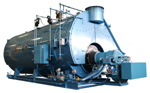
Scale creates a problem because it typically possesses a thermal conductivity an order of magnitude less than the corresponding value for bare steel. Even thin layers of scale serve as an effective insulator and retard heat transfer. The result is overheating of boiler tube metal, tube failures, and loss of energy efficiency.

EXAMPLE
A boiler annually uses 450,000 million Btu (MMBtu) of fuel while operating for 8,000 hours at its rated capacity of 45,000 pounds per hour (lb/hr) of 150-pounds-per-square-inch-gauge (psig) steam. If scale 1/32nd of an inch thick is allowed to form on the boiler tubes, and the scale is of “normal” composition, the table indicates a fuel loss of 2 percent. The increase in operating costs, assuming energy is priced at $8.00 per million Btu ($8.00/MMBtu), is:Annual Operating Cost Increase = 450,000 MMBtu/yr x $8.00/MMBtu x 0.02 = $72,000
MONITOR FLUE GAS TEMPERATURE
An indirect indicator of scale or deposit formation is flue gas temperature. If the flue gas temperature rises (with boiler load and excess air held constant), the effect is possibly due to the presence of scale.PERFORM VISUAL INSPECTIONS
Visually inspect boiler tubes when the unit is shut down for maintenance. Scale removal can be achieved by mechanical means or acid cleaning. If scale is present, consult with your local water treatment specialist and consider modifying your feedwater treatment or chemical additives schedule.Suggested Actions
Any scale in a boiler is undesirable. The best way to deal with scale is not to let it form in the first place. Prevent scale formation by:• Pretreating of boiler makeup water (using water softeners, demineralizers, and reverse osmosis to remove scale-forming minerals).
• Injecting chemicals into the boiler feedwater.
• Adopting proper boiler blowdown practices.
Resources
U.S. Department of Energy (DOE) - DOE’s software, the Steam System Assessment Tool and Steam System Scoping Tool, can help you evaluate and identify steam system improvements. In addition, refer to Improving Steam System Performance: A Sourcebook for Industry for more information on steam system efficiency opportunities.Visit the BestPractices Website at www.eere.energy.gov/industry/bestpractices to access these and other efficiency resources.
Reprinted from Steam Tip Sheet #7, “Clean Boiler Waterside Heat Transfer Surfaces,” from the U.S. Department of Energy’s Office of Energy Efficiency and Renewable Energy. For more information, visit www.eere.energy.gov.
Publication date: 02/02/2009
Looking for a reprint of this article?
From high-res PDFs to custom plaques, order your copy today!